
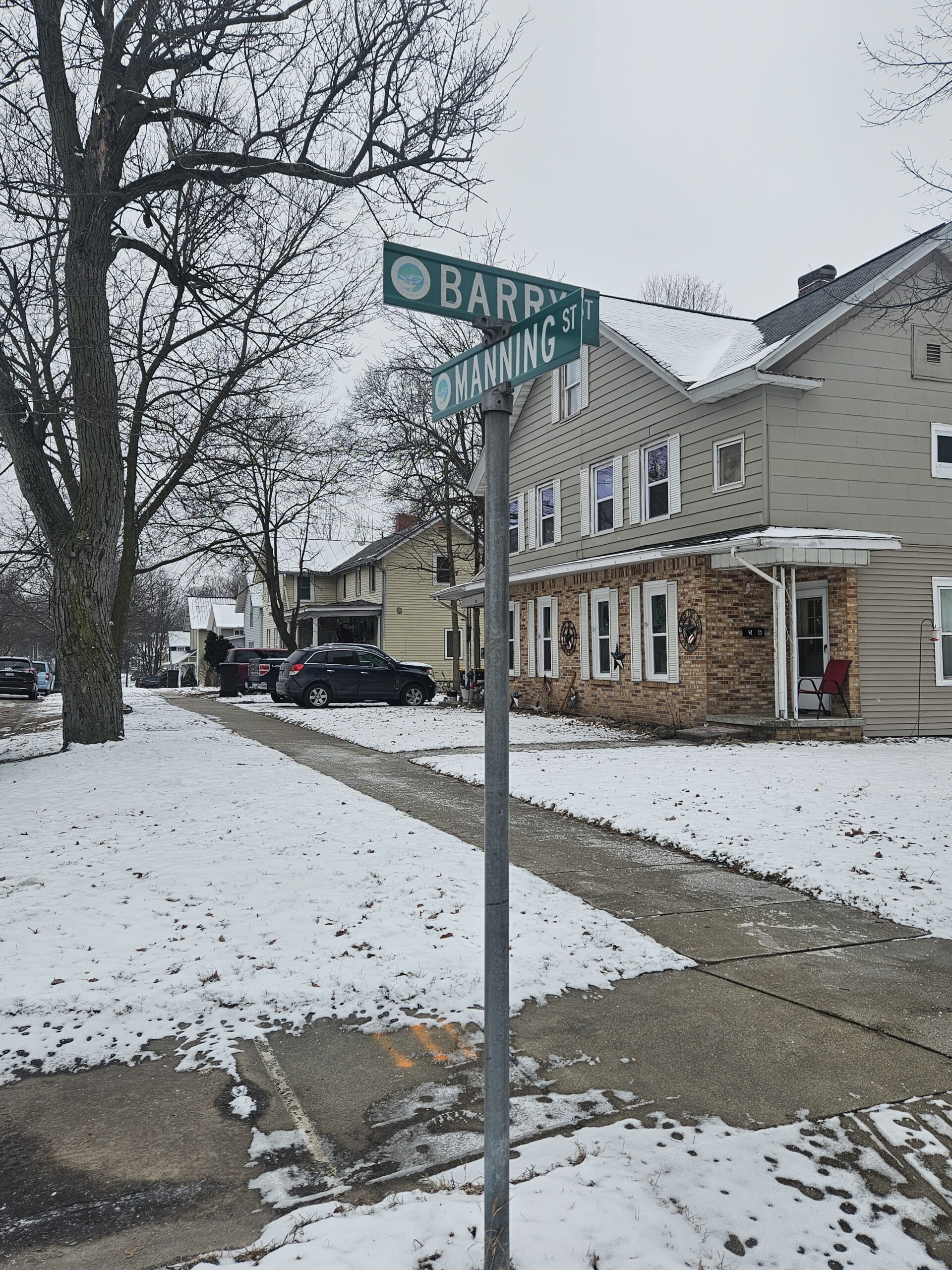
Hillsdale City Council delays decision on Barry Street’s road repair project. Christina Lewis | Collegian
A vote to stop a separate plan to narrow Broad Street and add bike lanes failed
The Hillsdale City Council delayed a decision on a road repair project for a second time as Acting Mayor Joshua Paladino suggested using city tax funds to reduce costs for homeowners on Barry Street.
In a unanimous vote, the council postponed its decision on the establishment of a special assessment district for the street until the second week in April. Establishment of the SAD would require Barry Street homeowners to pay up to $5,000 each for repairs to the dilapidated road.
At the March 3 city council meeting, Paladino proposed using extra funding from the Capital Improvement Fund, the new endowment from Hillsdale College, and the new SAD policy to offset the costs homeowners would have to pay. According to Paladino, this would reduce the costs from $5,000 to under $3,000 per property.
“Unless the assessor’s estimate is off by more than $50,0000, this proposal would put the residential cap at $3,000,” Paladino said. “We would still take in $50,000 in new revenue under the new policy that we passed in February than under the old policy.”
Ward 4 Councilman Robert Socha said he is concerned this proposal would cause future problems with citizens.
“If we make this change then we are going to have members of the community coming and saying that we did this for Barry so we should do it for them,” Socha said. “If we wanted a $3,000 cap, we should have amended the entire SAD. I think this is opening Pandora’s box.”
Paladino replied, saying governmental policies can change over time and the policy is not uniform.
“A uniform application of the law is not justice, the law is never in itself uniformly-applied, pure justice. You have to take into account the specifics,” Paladino said.
Timothy Polelle ’19, a Barry Street homeowner, said he would support the establishment of the SAD if Paladino’s proposal was accepted.
“In principle, I do still oppose the project, I wish there were no special assessments at all, but if you could negotiate a number below $3,000 that would be good for me personally rather than never having a road at all,” Polelle said. “Barring that, my opposition stands, and I think it should be voted down.”
Ward 3 councilman Bob Flynn said the council will be in a better position to discuss and move forward at the next city council meeting.
“When we started talking all of a sudden about moving numbers, I felt like I didn’t have enough information from city staff, the finance director, and others,” Flynn said. “We will have all those people there on April 7 and more specific numbers for what it will cost each person.”
The council is planning on voting on the establishment of the SAD April 14 because Socha will not be present at the April 7 meeting. According to Paladino, however, the council will vote April 7 if the opinions from city staff are amenable to everyone.
The council also voted down a motion by Ward 2 Councilman Matthew Bentley to stop a project that would narrow Broad Street to one lane in each direction and add bike lanes to the downtown road.
A 6-2 vote kept the plan on track, with Bentley and Bruns in favor of stopping the plan. Bentley said most residents at a recent public hearing on the plan spoke against the bike lanes.
“There was a public hearing, but the public was not heard,” Bentley said. “And I don’t understand the extent to which the public or this council as their representatives were involved in the nuts and bolts of the process.”
On the road diet plan, Zoning Administrator Alan Beeker said the Transportation Alternative Program grant, which would offset the project cost by 80%, requires the city to include bike lanes in the proposed plan. The city will find out in mid-April if it wins the grant for the project, he said.
“It is a Transportation Alternative Program and that means it has to be non-motorized improvements,” Beeker said. “Since the intent is to reduce the number of lanes but not actually reduce the physical width of the road, we have that space available anyway, and by calling that space a bike lane, it enables us to apply for that grant.”
According to Beeker, the main goal of the road diet is to force traffic to slow down on M-99 by decreasing the number of traffic lanes.
“We are not changing the physical width and I heard a lot more positivity about reducing the number of traffic lanes in order to reduce the speeds, especially through the downtown, and enable there being a buffer space,” Beeker said. “In this case, the buffer space is simply being termed a bike lane. If there aren’t any bikes on it, then it’s just a buffer space.”
