
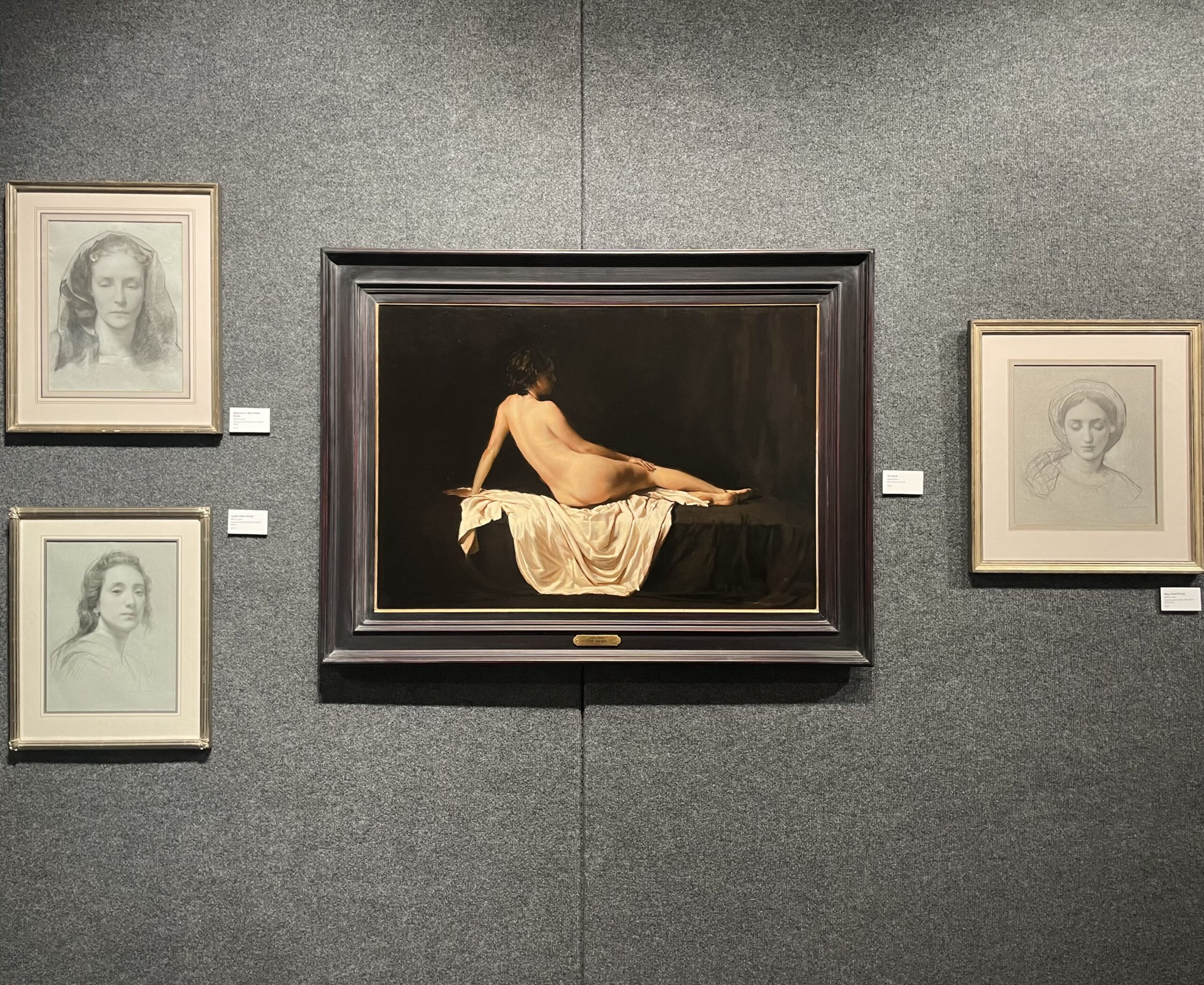
“The Bride” by Carla Paine and drawings by Will St. John in Stewarts’ collection.
COURTESY | Grace Brennan
Walking into the Daughtrey Art Gallery the first painting — “Mother Goose” a painting by Olga Guzhbina of a woman and her goose — strikes the viewer with its vivacity and joy. The woman smiles with rosy cheeks, matching her red headdress and jewels, as she holds her goose to her lap.
The most recent gallery, “Story Beautiful,” opened on Jan. 24 and will be open until March 23. Everything in the exhibit is owned by Nathaniel Stewart ’95. The collection contains works by modern artists, such as Anthony Baus, Colleen Barry, and Will St. John, following in the tradition of the old masters.
“The influence of the italian painter Giovanni Battista Tiepolo can clearly be seen in the ink drawings of Anothony Baus,” said Julio Suarez, chairman of the art department.
According to Suarez, some of the best artists in their genre of art are showcased in “Story Beautiful.”
“This exhibit showcases work from some of the best classically trained contemporary artists,” Suarez said.
According to Stewart, the gallery features 50 works from the 20th century as every piece is created by living artists.
“Everything in my collection is by a living artist,” Stewart said. “I don’t collect work from ages past. So these are folks that are currently working, and they are working in the old masters tradition.”
Junior Abi Palubinskas, vice president of Alpha Rho Tau art honorary said the gallery showcases the process behind the works of art.
“The exhibit is a perfect combination of the most masterful pieces of art that one can see, and also, the process,” Palubinskas said.
Anthony Baus, one of the many artists showcased in the exhibit, said the process behind the product is often easier to see in drawings, than in paintings.
“If I’m looking at an old master painting, it’s hard to access the painting because it’s done,” Baus said. “Sometimes a drawing is largely unfinished. So you can see how the artist is working.”
Baus said classical tradition inspired these artists.
“This group of artists is trying to reclaim this old-timey type of art and the type of skills that old artists used to have,” Baus said.
According to Baus, these artists are not simply copying the old masters, but using the same traditional skills to create something that is new, lively, and more sincere.
“There’s such a momentum and so many artists in small schools that are popping up, it’s a real movement,” Baus said. “I think this exhibit really displays some of the finest art that’s happening by living artists today in this genre.”
Barry’s oil on canvas, titled “Cain,” draws the viewer in with curiosity as to why the figure’s back is turned away with his head laying low.
These classically trained artists are using their skill to present real life stories.
“The art resonates with us because it is true,” freshman Fara Newell said. “It shows more than a surface level aesthetic of beauty, which speaks to the intrinsic nature of humanity.”
Stewart said part of his interest in collecting new art is being able to support living artists who are trying to make a living in the art world, as well as getting a chance to personally know them and the story they have to share.
“I think that the artists are trying to communicate something of an idea, which is why they’ve chosen realism, naturalism — something that the viewers know what they’re looking at,” Stewart said.
Stewart said that beauty doesn’t necessarily mean pretty, but refers to the human condition.
“It has to be conveyed in a beautiful way, or I don’t find it very appealing. That doesn’t mean that the subject matter is always pretty,” Stewart said. “Other themes that run through my collection, at least more recently, have been part of the human condition, the human story.” Stewart said he hopes when students and faculty go to see the exhibit they have a new appreciation for modern artists, and they choose to support the artists they enjoy.
“This gives us all some sort of confidence that there is a desire for our work in the world, and people want to see what other people have to create, and they are more than willing to purchase that and have it shown for other people to appreciate,” Palubinskas said. “I think it’s cultivating the love of beauty.”