
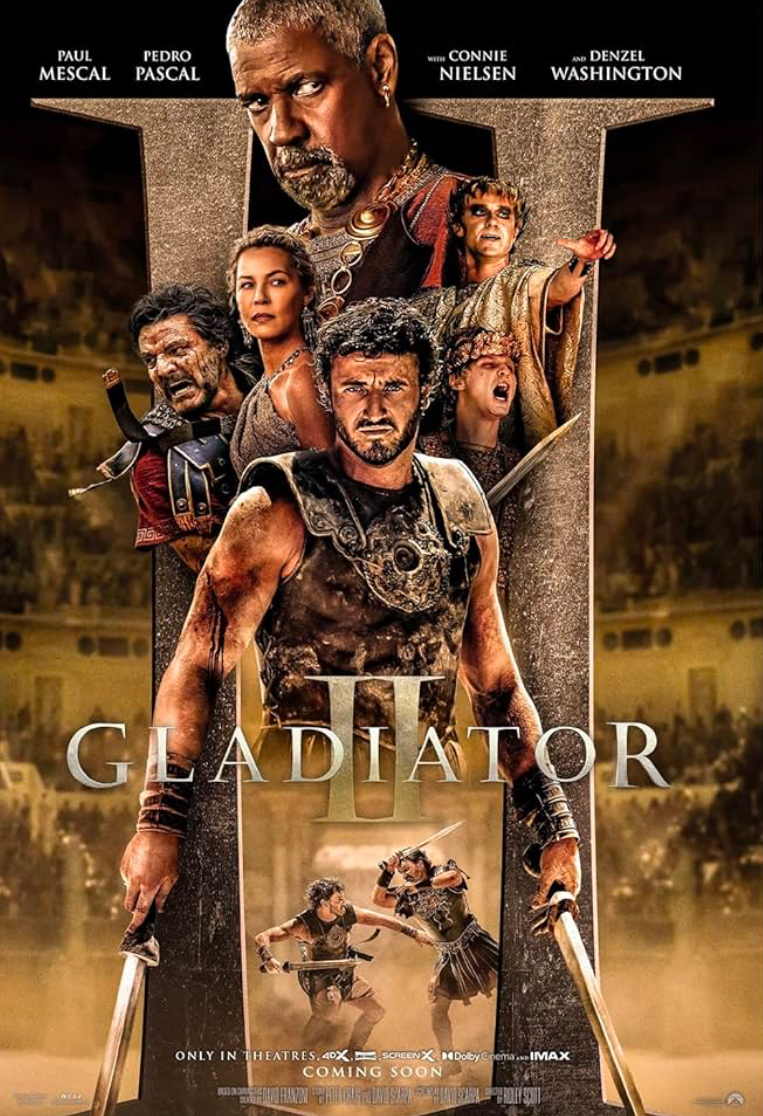
“Gladiator II” movie poster.
COURTESY | Amazon
Although “Gladiator II” falls short of its predecessor, the movie is justified as a legacy sequel.
I’m not here to say it’s an Oscar winner, I’m just here to say I was entertained.
Years after the death of Maximus Decimus Meridius, twin emperors Geta played, by Joseph Quinn, and Caracalla, played by Fred Hechinger, rule in absolute tyranny. Pedro Pascal as General Marcus Acacius fights on behalf of the emperors, but secretly plots to undermine their rule. With his wife Lucilla played by Connie Nielson, he seeks to restore Maximus’ dream of Rome. During the conquest of Numidia, Acacius takes as a prisoner of war a young soldier named Hanno, Paul Mescal, who later reveals himself as Lucius, the disenfranchised son of Lucilla and the prince of Rome. As a conquered barbarian, Lucius becomes a gladiator for the power hungry, rising citizen Macrinus, played by Denzel Washington, who plans to seize the throne.
Director Ridley Scott delivers Rome to scale. The movie faltered at times as it rode the coattails of the near-perfect original, but it never underwhelmed as a spectacle. The city-sized set showcasing the Colosseum fills the screen with the power of Rome. From the crowds at the games to the statues rising high above the cobble roads of Rome, Scott does not fail to, at least, entertain. Scott also took commendable creative risks showing a Colosseum that was even more brutal than that of Maximus in some ways. The gladiators are subject to rhino fights, ape fights, and a staged naval battle called a Naumachia.
The superstar cast also turns in fabulous performances, especially Denzel Washington’s menacing portrayal of Macrinus, who turns from sympathetic master of gladiators to political maniac desperate for power. Washington matches the solemnity of Roman politics with the absurdity of the gladiatorial games, and he matches the scale of Rome itself as a representation of the tyranny in Rome at the time.
Pascal and Nielson drive the plot with compelling performances as lovers and heroes who strive to restore Rome to its intended purpose. Paul Mescal’s portrayal of the betrayed, beaten, and scarred prince of Rome was convincing. Lucius’ rage from scene one to the finale developed throughout the movie, and Mescal brought the intensity to smooth out some one-dimensional writing.
This brings us to the central problem with the film. It is impossible not to compare the sequel to the original, which won the Academy Award for Best Picture in 2000 and for which Russel Crowe won the Academy Award for Best Actor. “Gladiator II” definitely does not rival “Gladiator.” As an example, the emperors Geta and Caracalla, while psychotic, do not touch Joaquin Pheonix’s Commodus, whose nuance and unhinged temper eventually sent him into the arena with Maximus. Geta and Caracalla spend most of their energy as villains screaming from the emperor’s box. And whereas Pheonix’s Commodus was propelled by vengeance against a father who cast him to the side, Geta and Caracalla seem to be driven by the cliche desire for “more power.” The second scene of the movie shows Acasius returning from the conquest of Numidia. The Emperors immediately develop plans for a conquest of India and Persia. Their constant grasp for power gives the sense that they will not rule together for long on account of their villainous desires. Sure enough, they tear their own empire apart by going after one another. Great acting from Quinn and Hechinger keep relatively bland villains above water.
But even with these critiques, the sequel works. It does not have the same originality as the first, but it evolves its characters naturally. The 2024 sequel picks up naturally from the implication that Lucius is Maximus’ son and runs with it. If there was any storyline from the first that could support a sequel, this was it. Scott does not deliver a masterpiece, but he certainly delivers another spectacle.