
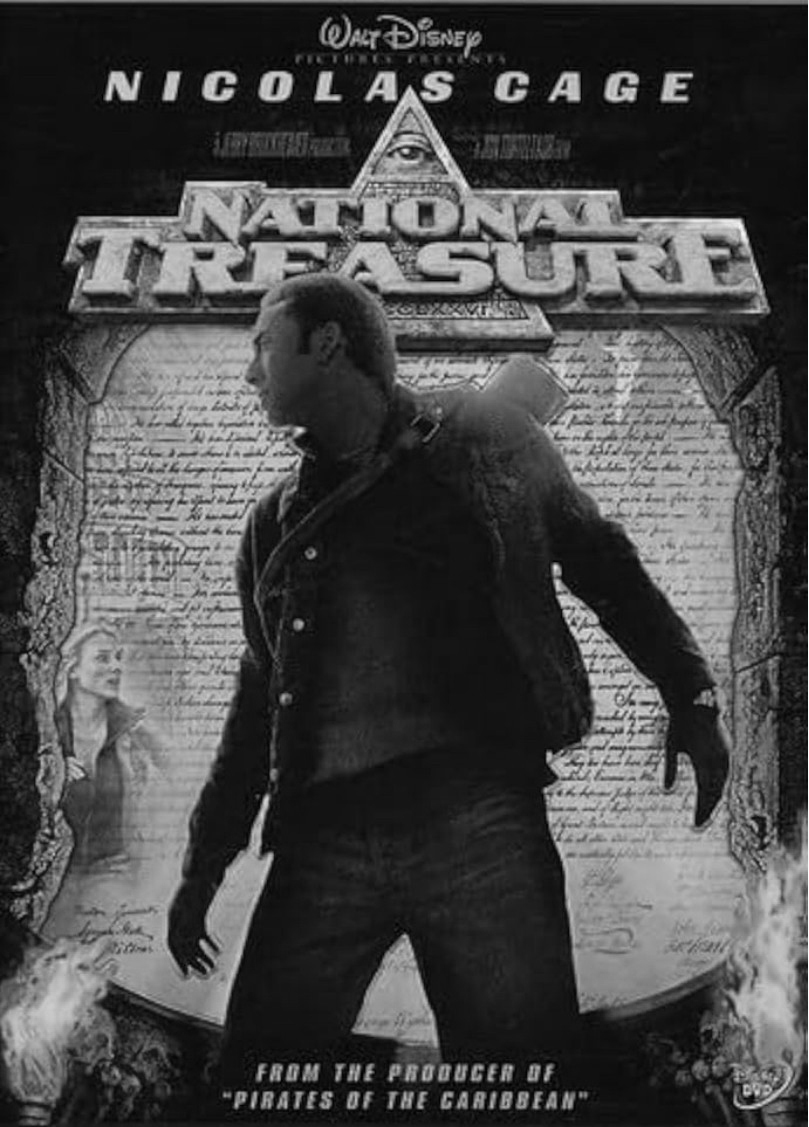
“National Treasure” poster.
COURTESY | Amazon
“The Declaration of Independence is not a bargaining chip, not to me,” Nicholas Cage says in the movie “National Treasure.”
When Ben Gates, Cage’s character, says this, he means the literal document. He holds the historical parchment so sacred that he claims he would never use it as collateral.
Walt Disney Pictures released the now-classic movie almost 20 years ago, on Nov. 19, 2004. American viewers still have affection for Cage’s over-the-top patriotism, the movie’s riveting treasure-hunting scenes, and of course, the ridiculous theft of the Declaration of Independence.
The film’s plot follows the adventures of Gates, the youngest of a long line of infamous treasure hunters. Along with Justin Bartha as Riley Poole and Sean Bean as Ian Howe, they unveil the secret of a century old clue leading to a Masonic treasure of immense worth. When Gates realizes continuing the hunt means stealing the Declaration of Independence, he refuses to assist further, and Howe turns on them.
Determined to steal the founding document for which he has little care or respect, Howe abandons Gates and Poole for dead.
This set up proposes one of the primary dilemmas of the movie: should Gates now steal the declaration so Howe, a unabashedly bad man, does not get to it and the treasure first?
Like Plato’s philosopher king is to the throne, Gates, though reluctant, is the ideal candidate to steal the declaration. Like the good king with his subjects, Gates will give the declaration the respect it deserves even though theft — kingship — is an intrinsically bad thing. If he does not take it, the tyrant Howe will defile it.
With this setup, Gates draws a direct connection between him stealing the declaration, and the Founding Fathers fighting a war over its contents.
“Here’s to the men who did what was considered wrong, in order to do what they knew was right,” Gates toasts at the National Archives Gala to the woman, Abigail Chase played by Diane Kruger, who goes from obstacle to ally in Gates’ mission.
In this scene, Gates sets up a comparison that can be followed throughout the whole movie: pursuing the treasure, and all the small crimes associated with finding it, is like pursuing the American experiment. Like the Founding Fathers, Gates wants the greatest treasure — the greatest government — ever.
In one scene, Gates says to Chase about the treasure, “I want to know it’s not just something in my head or in my heart.”
He wants confirmation that this treasure exists and that his family is not crazy. He wants this more than actually having the wealth of treasure.
Like Gates, the Founding Fathers’ purposes were higher than just the material good of their pursuit — it was about proving the American experiment right. Like the Declaration of Independence, the treasure is the summation of the wealth of all the great Western nations.
The movie argues to justify the Revolutionary War and more specifically, the Declaration of Independence, both to itself and to the viewer.
This is in part because of the position in which Chase is situated. Gates says his toast at the archives to Chase, who is introduced as a German-born citizen. Chase, then, is who Gates is trying to prove his point to, thus her response to finding the treasure should reflect the movie’s opinion on the revolution.
Initially, they go to her to try to get permission to look at the declaration so they do not have to steal it. Of course, she does not allow this, since the idea of it having a treasure map on the back is absurd.
When they do steal it, she happens to get dragged along with them and is very opposed to their plan. As she realizes that Gates is correct, she is more and more intrigued and eventually starts helping them. By the very end, she and Gates are dating.
Clearly Gates’ point got across to her.
Overall, the movie bleeds with patriotism. Gates has many speeches about America’s founding that are accompanied by inspiring music, his full name is Benjamin Franklin Gates, and at one point Gates stops when they are in Philadelphia’s Independence Hall to look at the declaration’s map and he pauses to note the last time it was in the hall was when it was signed.
The spirit of America, specifically through the lens of history, is palpable. It’s just the kind of movie for a Hillsdale student.
Gates’ father, played by Jon Voight, is hardened by the relentless and failed treasure-hunting of his family and has renounced the search. His refrain throughout the movie, “that will lead you to another clue,” is proven wrong.
Human history can strive and succeed using the clues of the past to assemble the treasure that is America. In the end, the hopeless and bitter sons of the Western Tradition, sick of the cyclical failure of government, are wrong and the truth of the American utopia prevails.