
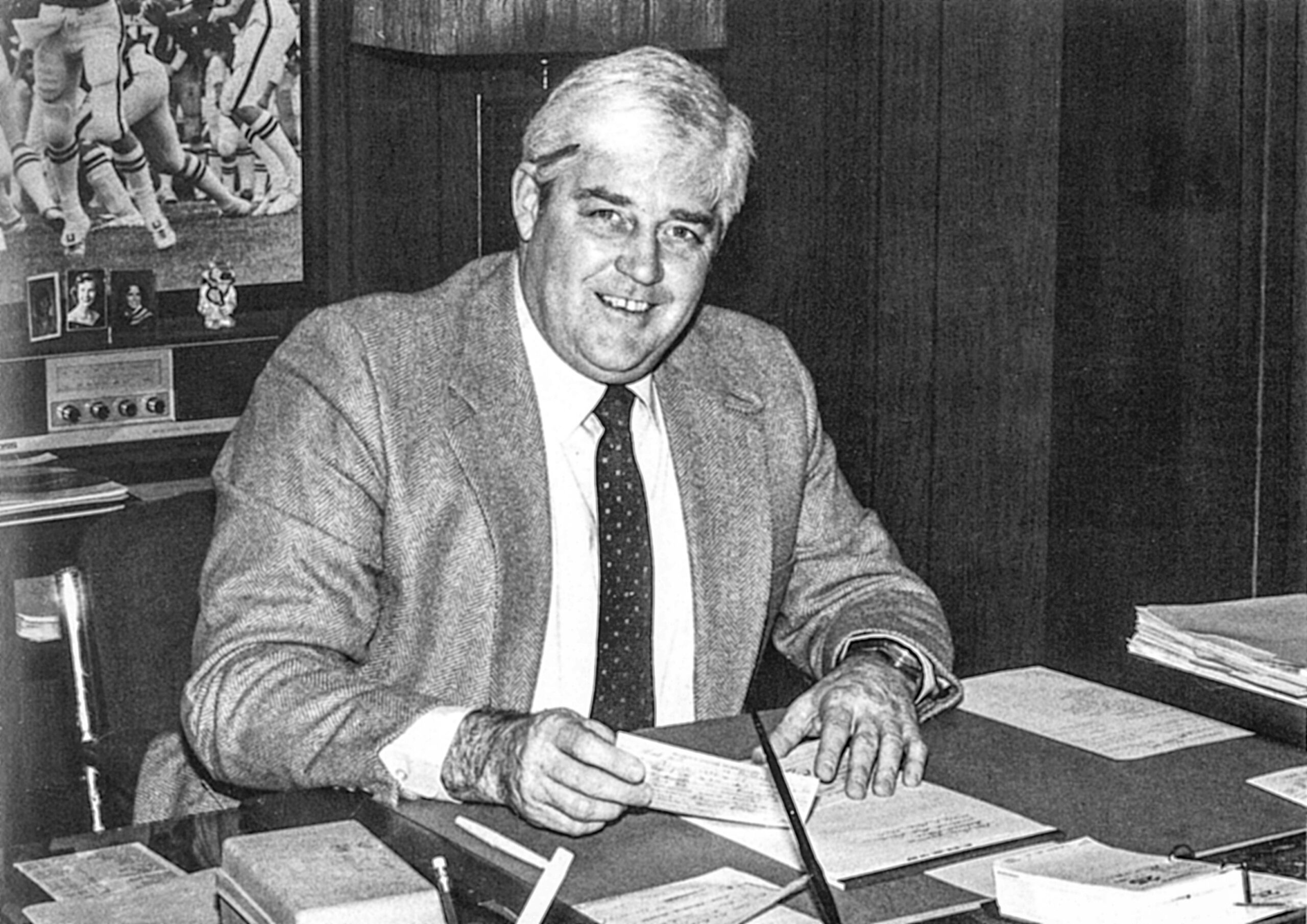
Richard “Dick” Lowry, the only Hillsdale Charger football coach to win a National Association of Intercollegiate Athletics championship, died Oct. 29 at age 89.
“I think his biggest strength was his commitment to the playing,” Nate Shreffler ‘93, head football coach and former player for Lowry, said. “He had a vision of what this program was supposed to look like: a hard-nosed football team that was very disciplined.”
Lowry was born on Oct. 16, 1935, in Columbus, Ohio. He excelled as a three-sport athlete at Berea High School in Ohio before becoming a football team captain as a student at Baldwin-Wallace University in Berea, Ohio.
“He took pride in athletics,” said Jeff Lantis ’89, director of development for athletics. “I mean, he won everywhere he went.”
After graduating from Baldwin-Wallace, Lowry jumped right into coaching, working his way from high school to college athletics. In 1980, he became head coach at Hillsdale College.
When Lowry took control of the program, the Chargers were coming off two of the worst seasons in Hillsdale history. In his first year on the job, Lowry led the team to their first-ever Great Lakes Intercollegiate Athletic Conference championship.
“He built an incredibly strong program that could really stand toe to toe with the best in the division,” Director of Athletic Communications James Gensterblum said. “He really elevated Hillsdale College athletics in a lot of ways.”
Lowry was awarded the NAIA Football Coach of the Year in 1982, shortly after he took charge of the Hillsdale football program.
Lowry’s biggest achievement while at Hillsdale was winning an NAIA championship in 1985, the only national football championship in school history. After lagging behind for most of that game, the Chargers scored a touchdown with minutes left in the fourth quarter to tie up the score, and eventually went on to win.
Lowry embodied the “Virtus Tentamine Gaudet” spirit, according to Lantis, who played on Lowry’s national championship team. Lantis remembers the commitment Lowry and his coaching staff had to their vision for Charger football and to shaping disciplined players.
Lantis described Lowry’s partnership with Dave Dye, who would take over Charger football after Lowry left in 1996, in molding a disciplined team.
“I think he started a tradition of winning. He and Dave Dye had workouts that were designed to weed out the weak and weary, so if you didn’t want to work hard, you quit,” Lantis said, “That helped them replace the quitters with guys who wanted to win, and guys who wanted to work hard.”
As a coach, Lowry was dedicated to encouraging his players to have a higher standard for themselves, according to Shreffler.
The most prominent facet of Lowry’s coaching style was his understanding of controllable factors. While the players could control how hard they played, they couldn’t control things like the weather and the referees.
“He was very consistent. His message to us was to always control the controllable factors and not worry about the ones that you can’t control. He was always very focused, and he kept it simple. The guys played really hard for him,” Shreffler said.
“I would say, more than anything, he was a leader,” Shreffler said, “He had this big laugh, too. You knew that he enjoyed football, he enjoyed the guys that he coached with. I think the lessons that he learned from the game, he understood them completely.”
Off the field, Lowry was a family man, an avid tennis and racquetball player, and an active member of the Rotary Club, according to a Hillsdale College Athletics Department press release.
Lowry married his wife, Phyllis Reed Lowry, in 1957. They were married for 67 years at the time of his death. They had two children together, Marianne (Lowry) Colbert and Reed Lowry. Marianne attended Hillsdale and was an All-American tennis player.
“He taught racquetball classes too, and I don’t know that anyone ever beat him,” Shreffler said. “He was a pretty competitive guy.”
When Lantis returned to Hillsdale as director of career services in 1998, Lowry mentored him as he started his career as an administrator. Lowry encouraged Lantis to join the Rotary Club as a way to give back to the community.
“He had a great compassion for service as a Rotarian. Under him, our football team did some philanthropy work as a team,” Lantis said.
More than anything, Lowry was dedicated to advocating for his players.
“I’m forever indebted to him because he gave me a scholarship and changed my life,” Shreffler said. “I don’t know what else I’d be doing now if I didn’t come here.”
“He was a fabulous coach and a great human being,” Lantis added.