
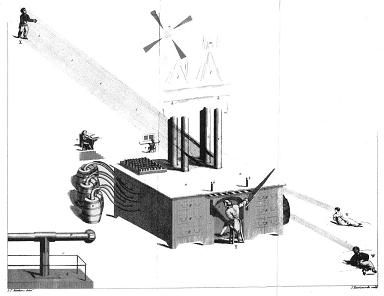
The air loom is a mind-control device capable of manipulating and influencing the thoughts of an individual from afar. James Tilly Matthews wrote of a network of these devices operated by gangs across London in his journal during the late 18th century. The victims targeted by the loom, including Matthews himself, could experience everything from pain described as “stomach-skinning” to fits of laughter at the hands of the air loom crew.
James Tilly Matthews is also considered to be the first fully described case of what we now call schizophrenia.
I learned about this in Media Theory and Criticism — taught by the Chairman of Rhetoric and Media Ethan Stoneman — a course everyone ought to prioritize before they graduate.
Given Matthews’ condition, it seems the fantastic description of British gangs and mind control loses all use beyond imaginative intrigue. Luckily, imagination is a valuable educational tool: one that Stoneman’s media classes work to expand and mature.
The air loom lecture isn’t the only one of its kind. Every Monday, Wednesday, and Friday, the class examines technology and a facet of life that it has transformed. From the rapid pace of life influenced by cameras to the way literacy changed man in community to the decentralization of the human person in the modern age, Stoneman highlights how media affects more than merely conversations the culture chooses to spotlight.
Often, when I talk about my “media” classes, people immediately picture an iPhone, a computer, and potentially a newspaper or magazine. I had the same, narrow definition of media before I became a Rhetoric and Media major. As it turns out, media is a lot wider than Apple and the modern press. Media, as defined by media theorist Karen Barad, is anything that disseminates information that has been chosen from the vast expanse of what is.
As a class, we examine how media distorts the messages it delivers, and how people can live in a largely mediated world. We question the use of terms such as “the cloud” to describe technology with concrete but confusing hardware. We explore the effect that the unconscious involvement and creation that accompanies humans using machines to do their work affects art. These are just a handful of examples that embody an outlook and orientation that the class equips its students to develop and apply. The class examines the things that existed before most students were born, challenges the assumptions that have been accepted as part of the status quo, and gives conscious thought to things that have become unconscious.
With this mindset has come a stronger sense of intellectual humility. I better understand that concepts I had never considered before have transformed our very language and perception of reality.
Learning truths about the universal human experience has allowed me to appreciate what makes humans the same, but I do that naturally as a 22-year-old woman. Unlike the themes I tend to latch onto in a history, English, or philosophy class — the cyclical patterns and the core vices and virtues that unite us — this class forced me to consider how and why I wouldn’t be able to communicate with a 22-year-old woman from 100, 200, 300 years ago and beyond.
Stoneman, often indirectly, asks the class to reconsider what parts of the human experience have been mediated, perhaps since before we were alive, and what parts really are innate, unable to be changed or touched by the far-reaching arm of the technopoly. At the most, taking this class could unlock an unknown passion for all things media. At the least, students will think more deeply, more humbly, and more frequently about the things they may have never considered before.
Jillian Parks is a senior studying Rhetoric and Media.
