
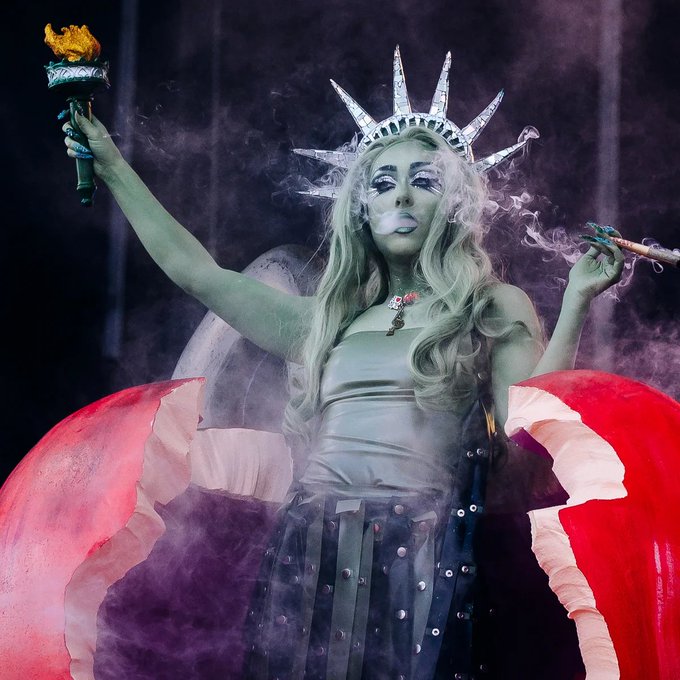
The tribalism of the presidential election forces celebrities to swear fealty to a faction or face the music.
One A-lister who won’t fold is pop star Chappel Roan, outraging many fans who falsely equate her unwillingness to endorse a candidate with support for former president Donald J. Trump.
Amidst the wave of recent left-wing celebrity endorsements, Roan’s resistance to play into identity politics is standalone.
Roan’s refusal to officially endorse a presidential ticket comes at a time when endorsements from major celebrities are rampant. Taylor Swift, Ariana Grande, John Legend, Cardi B, and Charli XCX are just a few of the celebrities publicly backing Harris.
“Today I want to offer my full support and endorsement for Kamala to be the nominee of our party this year. Democrats — it’s time to come together and beat Trump. Let’s do this,” Grande captioned her Instagram story repost of President Joe Biden’s endorsement post for Harris.
During this contested election, such endorsements leave a bitter taste in many fans’ mouths. Corralling members of the entertainment industry onto one side or the other leaves no room for nuance and makes their art inseparable from politics.
Roan’s meteoric rise to fame followed the release of her debut album “The Rise and Fall of a Midwest Princess.” The album draws influence from her humble Midwestern roots, sprinkling in elements of ’80s synth-pop and rock that pair well with her theatrical performance style.
Hailing from a small town in Missouri, Roan was raised in a conservative household before moving to California to pursue her musical dreams, according to Rolling Stone.
“I have family that are very Republican, and they love me, and I love them,” she told Rolling Stone in a new cover story. “It’s so hard for kids who grew up on the coast to understand why maybe I can understand [them].”
Roan, who is lesbian, declined to perform at the White House’s pride celebration this year, leading fans to believe the singer supports Trump.
“It is not so black and white that you hate one and you like the other,” she told Rolling Stone. “I’m not going to go to the White House because I am not going to be a monkey for Pride.”
Roan said she is excited that more gay artists are being taken seriously outside of their “queerness.”
“You don’t necessarily have to be out-loud out,” Roan told Rolling Stone. “You can kind of silently celebrate if you would like. It’s like, look, I love being gay. I just don’t want to talk about it every second of every day.”
Critics took to X to attack Roan.
“Chappell Roan is an embarrassment to lesbians,” one user wrote. “You can’t borrow from drag aesthetics and embrace your sexuality and then pretend the party that would criminalize our happiness is the same as the one who protects it.”
Roan has been vocal about her discomfort with her new fame, particularly that some fans feel entitled to interact with her when she is with her friends or family, or clearly upset. Parasocial relationships, one-sided connections between individuals and media figures who are unaware of their existence, have become more prevalent thanks to social media, making it easy for people to demonize celebrities for their beliefs and exacerbate the partisan divide.
Roan said she is more concerned with causes than candidates, and urged fans to think for themselves.
“I have so many issues with our government in every way,” she told The Guardian. “There are so many things that I would want to change. So I don’t feel pressured to endorse someone. There are problems on both sides. I encourage people to use your critical thinking skills, use your vote — vote small, vote for what’s going on in your city.”
After heavy public criticism, Roan released a video on TikTok stating that she’s unenthusiastically voting for Democratic nominee and Vice President Kamala Harris, although she made it clear that she feels disenfranchised from both parties and still refuses to endorse Harris.
“I don’t have a side because I hate both sides, and I’m so embarrassed about everything going on right now,” she told Rolling Stone of her political stance.
When celebrities like Swift endorse candidates, it makes waves. Swift’s endorsement of Harris drove more than 400,000 users to visit vote.gov in one day, compared to the roughly 30,000 daily visitors garnered the week before. Similarly, Swift gained 1.85 million Spotify followers after posting her endorsement.
When the super-rich endorses the super-powerful, the American people pay. It’s not that artists need to be apolitical or neutral, rather it’s about cultivating a nation of free thinkers and an environment that celebrates nuance of opinion.
Americans look to their favorite artists to escape the burdens of existence. Presidents come and go, but art lasts. Good art, especially, transcends lifetimes.
Music has a unique ability to heal and connect people. Good musicians cultivate a level of harmony and unity that politicians can only dream of. These elites should take a page from Roan’s book. If they focus on art instead of mutually beneficial political deals, they may be one of the best hopes yet to restore a unified American identity.
Sarah Katherine Sisk is a senior studying economics.
