
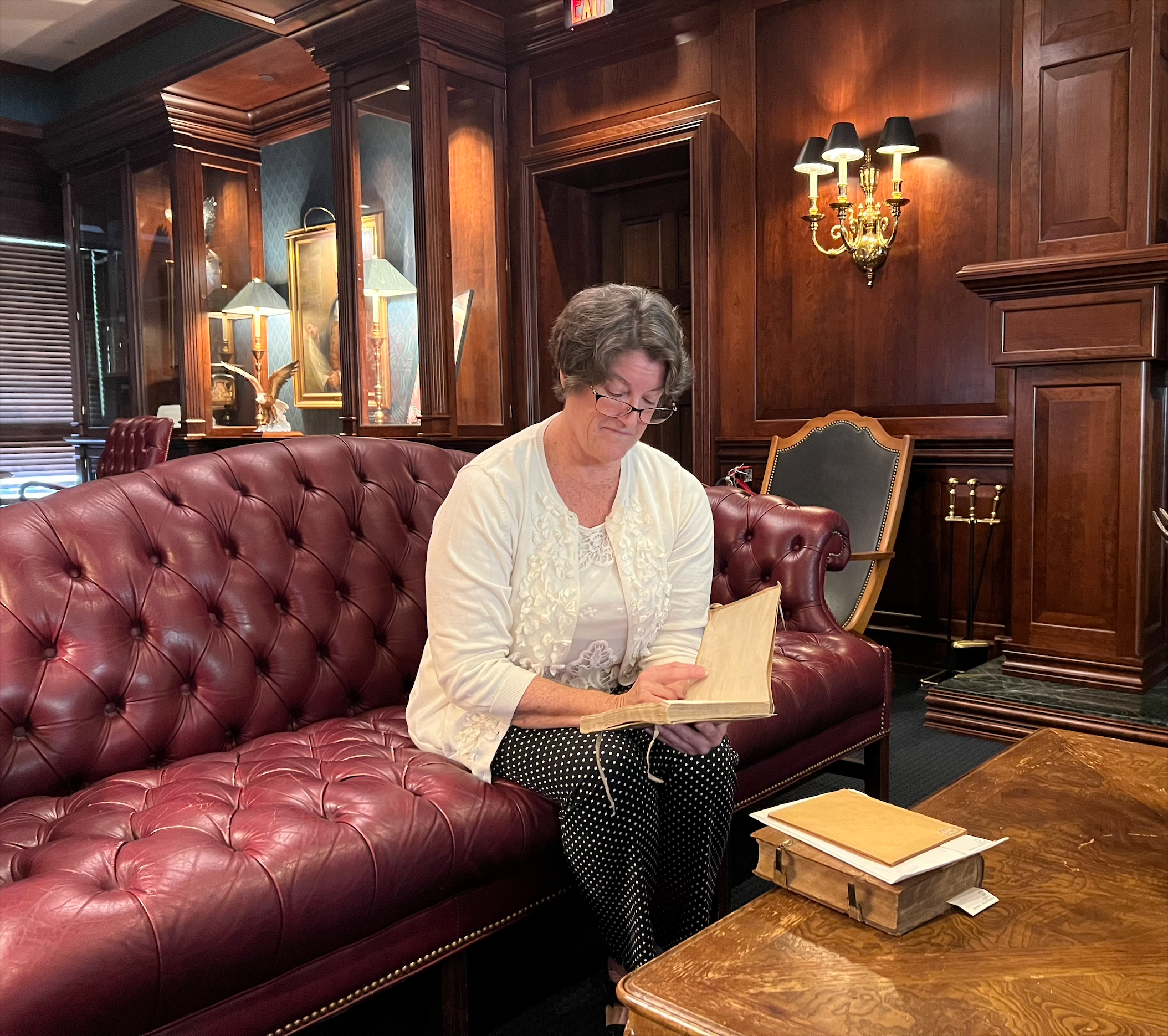
Lori Curtis, the archive and special collections librarian, reads a book written by King Henry VIII. Eleanor Whitaker | The Collegian
Wretched scribbler, king of lies, vessel of Satan – these are just a few of the savage insults Martin Luther throws at King Henry VIII in one written defense of his theology, a book that soared in popularity during the rapid spread of Luther’s Protestantism in the 1500s.
But the book is significant to more than just lovers of Luther’s lethal language. At the Mossey Library, Luther’s spicy pamphlet is the oldest published book in the college archives, dating back more than half a millennium. Although originally published in Latin, the version the college owns is a first edition German translation entitled, “Antwortt deutsch Mart. Luthers auff König Henrichs von Engelland Buch,” published in 1522.
Luther’s work is one of many that students not only have the opportunity to read, but to see, feel, and smell through the Mossey Library Archives and Special Collections.
“This book is just the coolest,” said Lori Curtis, Hillsdale’s archivist and special collections librarian.
With 18,482 books, periodicals, manuscripts, photographs, and artifacts, the Archives and Special Collections consist of many rare, influential, and beautiful pieces of history mostly donated by friends of the college. According to Curtis, Hillsdale College donors help make this project possible.
“The generosity of donors to Hillsdale just amazes me,” Curtis said. “Every time you turn around a donor wants to give you a beautiful, historical document.”
In display cases of the Heritage Room, history lovers will find a krater, an ancient Greek vessel made for diluting wine with water, authentic letters from U.S. presidents such as Theodore Roosevelt and Benjamin Harrison, and Byzantine coins – some of the oldest artifacts the college owns.
“The Byzantine coins are my favorite because I think they are so pretty,” Curtis said.
Other artifacts not on display include 18th century British military firearms that were likely used during the American Revolution, as well as a spoon made by Paul Revere.
Curtis said students and faculty often do not appreciate the vast array of historical documents, books, and artifacts owned by the college.
“Whenever I talk to new faculty, or I get a freshmen orientation group, and I’ll say, ‘Ah, we have this book by King Henry VIII,’ and they all just go, ‘Meh,’ and I have to say, ‘No! This is King Henry VIII! This is cool!’” Curtis said.
Curtis said one of the oldest written items, and possibly the one of the most famous, the college owns is two leaves, or four pages, of a handwritten, hand-illuminated liturgical book called the Beauvais Missile, written in the late 13th to early 14th century. The book is famous for being split up into individual leaves in the 20th century in order to be sold at a higher profit, but Hillsdale is working with other institutions to reconstruct the document digitally.
“Somebody broke it up, selling individual leaves,” Curtis said. “Sadly, most institutions don’t want to give up their pages, which, frankly, I feel they should, but they’re going to combine them digitally, so everybody’s contributing.”
But a book that helped to spark the French Revolution is likely the most influential book the college owns, according to Curtis.
In 1781, the financial minister of France, Jacques Necker, published the record of France’s finances, entitled “Compte rendu,” against the wishes of King Louis XVI. An instant bestseller, the book was the first public record of government finances, the first time the common people of France could read for themselves how the king was not handling his money well.
Curtis said the book helped to spark the 1789 French Revolution, and an original version sits in the Dow Room, the green room in the back of the library.
“We have these original documents from 1781 in France that were instrumental in causing a revolution, and to find those sitting on the shelf in the Dow Room in a little college is amazing,” Curtis said.
Curtis said for a while, she did not know where the book came from because it was absent from college records, but by tracing a bookplate signature, she found it was given to the college in the 1900s.
Anna Navrotskaya, associate professor of French, said she was astounded when she found out the college had an original “Compte rendu,” which she often talks about in her French 301 class.
“I was amazed when Lori brought the book,” Navrotskaya said. “I was like, ‘Really? Necker? You have got to be kidding me!’ It is an absolutely fascinating publication. We have a fascinating collection of books from the 18th century, you just need to go and talk to the librarian.”
Navrotskaya said it is unusual for a college like Hillsdale to own this type of book.
“It’s fairly rare, I think,” Navrotskaya said. “Very big libraries and big universities probably have a copy, but the fact that the small college in the middle of Michigan has a version is quite surprising. And we don’t have a copy, we have the actual thing.”
Navrotskaya brings her classes into the library to see “Compte rendu” so that her French students have an opportunity to feel, touch, and smell what they talk about in class.
“For my students, it is very good reading practice because they can use an authentic document,” she said. “We meet at the library, and the special collections librarian can talk to us about book printing at the time. We talk about Necker, and then they can actually work with the real book.”
Navrotskaya said more people should be interested in reading and holding original historical documents.
“Somehow, there is this personal link between me and Necker right now attached to the book he wrote. It’s important to hold original documents, especially when we study the culture of a country of which we don’t have an immediate personal attachment to,” she said.
Senior Andrew Klare, who works in the archive department of the library, said physical historical documents are just as much a part of the Western tradition as the words they contain.
“It is our turn to preserve the physical remnants of these timeless works for those who will come after us,” Klare said. “Without an emphasis on preserving these original books, manuscripts, and scrolls that make up our intellectual heritage, we will cease to appreciate the good, the true, and the beautiful. Is the preservation of this beautiful human experience not the ultimate goal of a liberal arts education?”
Curtis said she loves to see students interested in the archive collections.
“That’s what I really like to see: these riches being shared and cared for,” Curtis said.