
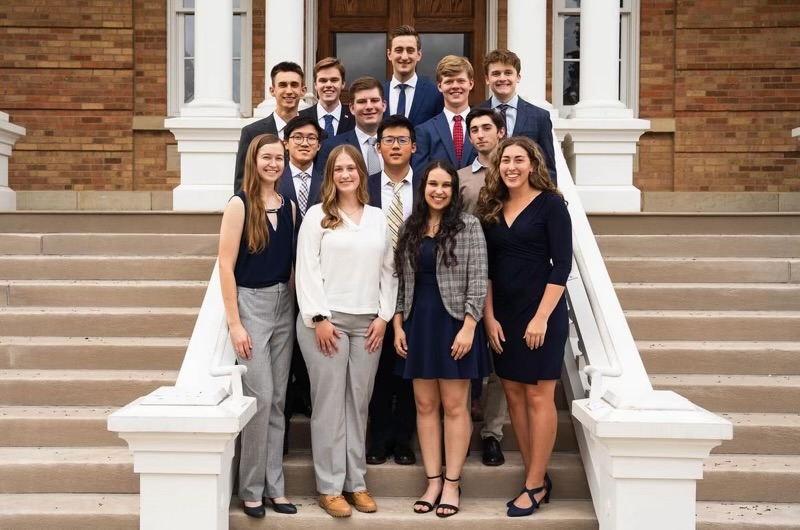
The 2024 debate team poses for a photo. Courtesy | Instagram
Sophomore Alex Mooney and junior Benjamin Brown placed in the top four of the 21 competing teams at the online David Frank Tournament of Scholars, held in Eugene, Oregon, over Fall Break weekend on Oct. 19 and 20.
Sophomore Jonathan Evans and seniors Mark den Hollander and Elizabeth Williams also competed in a rotating three-person team to fit the two-person format of each round.
According to Mooney, he and Brown won three rounds and lost one on Saturday, then capped the tournament with one win on Sunday. Mooney said his Sunday debate with Brown against Western Washington University’s team was a particularly strong performance for the pair.
“Early on, we weren’t sure how the round would go since it was our first time facing that team,” Mooney said. “But by the end, we decisively won nearly every point. That win secured our spot in the top four.”
Mooney and Brown came out of the tournament with four wins and one loss. Brown said he was proud of his final rebuttal in one of the winning rounds.
“I felt we were probably winning heading into the end of it,” Brown said. “But even given that, I felt that my last speech was really clean, really organized, really well communicated, and the judges comments on the ballot after the round reflected that.”
Mooney and Brown lost to a team from Gonzaga University, who had competed in the national finals last year, in their fourth round.
“We debated our case well, but they had better preparation than we did at this time,” Mooney said. “We did good, we held our own, but it was definitely one that we learned a lot from, and got good feedback to change things that we can already see.”
Mooney said the round was a good opportunity for them to see holes in their cases that needed more research, which would be helpful heading into the following tournaments.
“Ben and I can work together more in different ways that compliment each other than we did. Part of that was just because it was such high pressure — like they were so good that it was throwing this off our A game,” Mooney said. “This is the first tournament of the year, so there are going to be some holes, and they showed us where.”
According to Brown, there were judges that provided helpful feedback at the tournament.
“I’ve been doing debate for eight years, and one or two of these judges had some advice that I never even considered before — that was really enlightening,” Brown said. “You never stop learning in debate no matter how long you do it, which makes it a really engaging thing.”
The team competes within the Collegiate Advocacy Research and Debate league (CARD), which sets the format of debate and chooses the topic for each semester. This semester’s topic is Energy and Environmental Policy. During the tournament, each team switches from arguing the affirmative side, which advocates for certain reform to the current policy, to the negative side, which argues for the status quo, in each round.
The team plans to attend the online WWU Viking Classic Tournament on Nov. 16th and 17th in Bellingham, Washington, and the 3rd Big Tent Online tournament hosted only online from Dec. 6-8th. According to Mooney, CARD releases an online library of all the evidence and research that debaters are permitted to use in tournaments in increments, for which students can submit articles and research for new sides to the topic that they want to speak to. This enables the team to ask what kinds of arguments and research do they need more of for the points they want to make.
“Everyone else is on the same page as far as what research and arguments are going to be used,” Mooney said. “But at the same time, we do have a say.”
Mooney and junior Ryan Rodell are assistant team managers on the team’s student leadership board, with Brown as the team manager and Professor of Rhetoric and Public Address Kirstin Kiledal as faculty advisor and teacher. Senior Elizabeth Williams runs database operations and others coordinate social media and outreach.
Junior Rebekah George joined the team in her first semester of freshman year without any debate experience.
“It was very challenging, especially at first,” George said. “Debate has a lot of unique terms and procedures that you have to get used to. But it’s been really great because my first year on the team, there were some amazing seniors who were great mentors to me, and just having that encouragement along the way was really helpful.”
George said debate has helped her to grow herself and get out of her comfort zone.
“I love to speak publicly, but debating and learning how to argue is a whole other skill on top of that,” George said. “Challenging myself and proving that I can do those hard things, but then also making friendships, especially with my debate partner, Miranda.”
The team meets on Mondays and Wednesdays from 6 p.m. to 8 p.m. The meetings often consist of a lecture given by Kiledal, Brown, or Mooney, drills based on lecture material, practice rounds, or research and argument formulation. According to Mooney, meetings at the beginning of the semester consisted of building the skills of newcomers that have never done debate before.
“As we move on throughout the semester, it will become more refined and more research focused,” Mooney said. “‘Okay, now you have the skills. We’re going to keep continuing to build those skills, but now we’re going to also apply it more specifically to the topic that we’re discussing this year.’”
Brown said the art of teaching debate to others as the team’s manager and captain is something he is learning to navigate.
“Learning or understanding, not just how to debate well, but how to communicate that well to someone is a bit of a challenge,” Brown said. “One, trying to teach anything is a challenge. But two, because there are so many parts of debate. I feel like it’s not that they’re entirely unteachable. But learning well and teaching them well also depends on actually debating — debate’s sort of like riding a bike. There are certain parts where you can’t really explain just how — you have to do.”
Mooney said doing debate has helped him build certain skill sets that can be applied across many areas of his academic life.
“Just being able to engage with people who have vastly different ideas in you is just a really, really important skill set to have, and also to be able to advocate in favor of those ideas, because you have to argue both sides in a debate tournament,” Mooney said. “I just love doing debate. I love the team that we have and the community, so I’m intending to stick around for my whole time with the debate team.”