
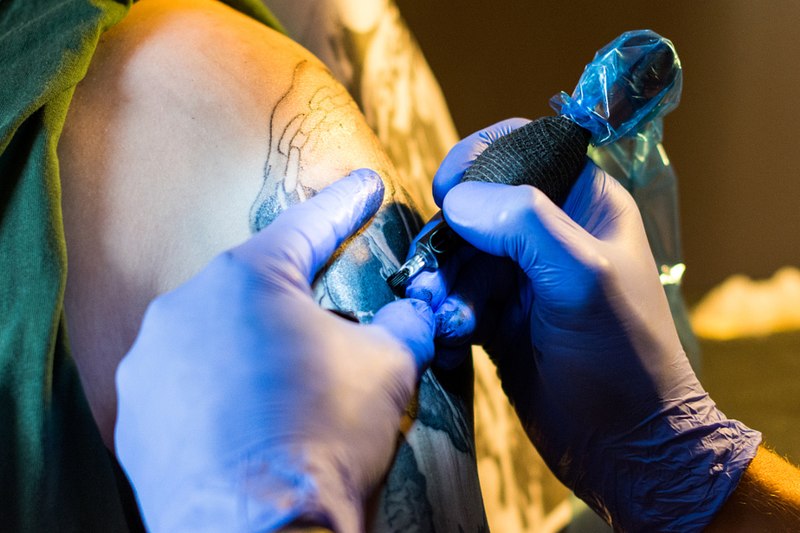
When I walked into the Gilded Unicorn Tattoo Parlor in Charlotte, North Carolina, to get my first tattoo at 19 years old, the voices of my grandparents and parents in my head reminded me I might never get a “real” job because of it.
But now, four tattoos later and after a summer spent in Washington, D.C., interning for a “real” job, it would seem that — respectfully — I proved both my grandparents and parents wrong.
When I told my parents I was leaving to get four small flowers tattooed on my arm, the argument that ensued was filled with hyperbolic statements about the trajectory of my life.
“Tattoos are a gateway,” my mother told me.
A gateway to what specifically? She did not seem to know herself.
And unsurprisingly, it is not just my mother who feels that way. According to Pew Research Analysis, in a study on Americans’ impression of tattoos, 22% of non-tattooed Americans reported a negative impression upon seeing a tattooed adult.
More consequentially, 40% of adults 65 and older reported negative impressions when seeing tattoos on adults.
Yet the same study found that Americans with and without tattoos have grown more accepting of tattoos in general and in the workplace. Cultural acceptance of tattoos is increasing with each generation.
According to the Statista Research Department, by generation, adults getting tattoos has increased, peaking with the Millennials and slowing down with Generation Z. The report showed 13% of Baby Boomers have tattoos, 32% of Generation X, 41% of Millennials, and 23% of Gen Z.
It is no wonder that older generations have stronger feelings toward tattoos. My grandparents are driven by their concerns about the morality of getting a tattoo, which is taboo in the southern Christian circles where I grew up.
Non-Christians understand tattoos primarily as a fashion or stylistic choice. For Millennials and members of Gen Z, tattoos have grown in popularity as a fashion statement, especially as social media influencers have gained prominence.
Emma Chamberlain, who boasts 15 million followers across social media, is one of the most popular social media and fashion influencers within Gen Z. Chamberlain, who has 11 tattoos, popularized “micro tattoos,” which means having multiple small tattoos that lack sentimental meaning.
The Statista Research Department also found 19% of Gen Z Americans with tattoos have more than one, fitting into the “micro tattoo” trend. The fashion and stylistic trend is heavily promoted by social media influencers, increasing the cultural acceptance of being tattooed.
The trend of “micro tattooing” has normalized two ideas: tattoos are not as serious as our parents might have made us believe, and they don’t necessarily need meaning beyond a statement of fashion and style.
All of my four tattoos mean something very significant to me, which is how I won over my parents. But regardless of their meaning, they communicate an important life milestone: an exercise of my adult discernment.
People can have tattoos with and without significant meaning. Getting a simple and unsentimental tattoo just for the sake of getting a tattoo is not immoral or irresponsible and it will not stop you from getting a “real” job. It simply boils down to personal preferences, stylistic choices, and recognition that tattoos are permanent. While tattoos can range from simple doodles to elaborate artwork, they deserve intentional consideration — just like most decisions in adulthood.
Contrary to the opinions of older generations, getting a tattoo is an exercise in discernment that pushes young adults to understand the consequences of permanent choices. Even if that exercise in discernment is not motivated by some deep sentiment and you’re simply getting a tattoo you’ve always thought was cool, it still holds meaning.
While a new 19-year-old with little real-life experience is not incapable of mistakes, getting my first tattoo was a lesson in considering the permanence of my choices. I fully intend to get more tattoos and I have also grown more confident in my ability to defend my adult choices.
Anna Broussard is a junior studying politics.
