
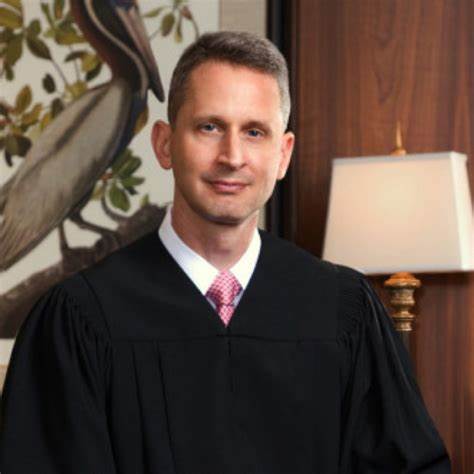
Nobody screamed at a pair of federal judges in the Hoynak Room Oct. 2 — unlike what happened to one of them last year at Stanford Law School — while they discussed the common misunderstanding that the role of the judiciary is to create policy rather than apply law.
The Federalist Society hosted the conversation with two Hillsdale dads, Justice Jay Mitchell of the Alabama Supreme Court and Judge Kyle Duncan of the 5th U.S. Circuit Court of Appeals.
Mitchell’s daughter Elizabeth “Tully” Mitchell and Duncan’s son Joseph Duncan are both juniors at the college.
While appearing before the Federalist Society at Stanford Law School in March 2023, Duncan was verbally accosted by protestors.
“We have both been the subject of some pretty intense public controversies surrounding opinions we’ve written and other things I’ve done in my career,” Duncan said.
The protestors were angry over his role in Grimm v. Gloucester County School Board, which stopped transgender individuals from using the bathroom of their choice at state institutions.
“They were screaming at me,” Duncan said. “All these protestors came in and they occupied the room.”
Duncan said the protestors made it difficult for him to give his speech by overtaking the meeting.
“It’s really hard to give a speech when, after every other word, people make visible retching sounds and scream at you,” Duncan said.
For Mitchell, his controversy surrounded the majority opinion he wrote in the case LePage v. The Center for Reproductive Medicine this past February.
The opinion garnered claims that the Alabama Supreme Court was abolishing IVF, said Duncan, who spoke for Mitchell regarding the case.
“I read in the newspaper, ‘Jay Mitchell of Alabama Supreme Court abolishes IVF,’” Duncan said. “But the Alabama Supreme Court doesn’t have the authority to abolish IVF. That’s just not what courts do.”
Sophomore Jackson Casey said he appreciated this point and hopes students and the public at large takes this into account.
“I’m glad they each stressed the importance of the judiciary’s apolitical and independent role in a society that so often hopes for judges to be activists for progress,” Casey said. “Only by consistently interpreting our state and federal constitutions according to their own words, and not by our own convictions or the influence of public factions, can we steer our legal system in the right direction.”
Duncan went on to articulate the fact that courts have the sole duty to interpret the laws in specific situations.
“Courts don’t sit around and wave wands and say, ‘we abolish this,’ right? That’s what emperors do,” Duncan said.
The judges spoke well to the way in which to react and handle controversies, said sophomore Bradley Haley.
“Both have been the subject of public criticism and scrutiny in recent times, and they had a great discussion about handling that with the composure and character befitting a member of the judiciary,” Haley said.
Mitchell said the public must decouple the common misconception that courts tackle big issues while that power is returned to the elected representatives of the people.
“The American public and probably the legal academy have become very conditioned to the wish that the judiciary will just decide our big questions in society,” Mitchell said. “There must be an unwinding — now we gotta do democracy, and now we gotta reason with each other and go through the democratic process.”