
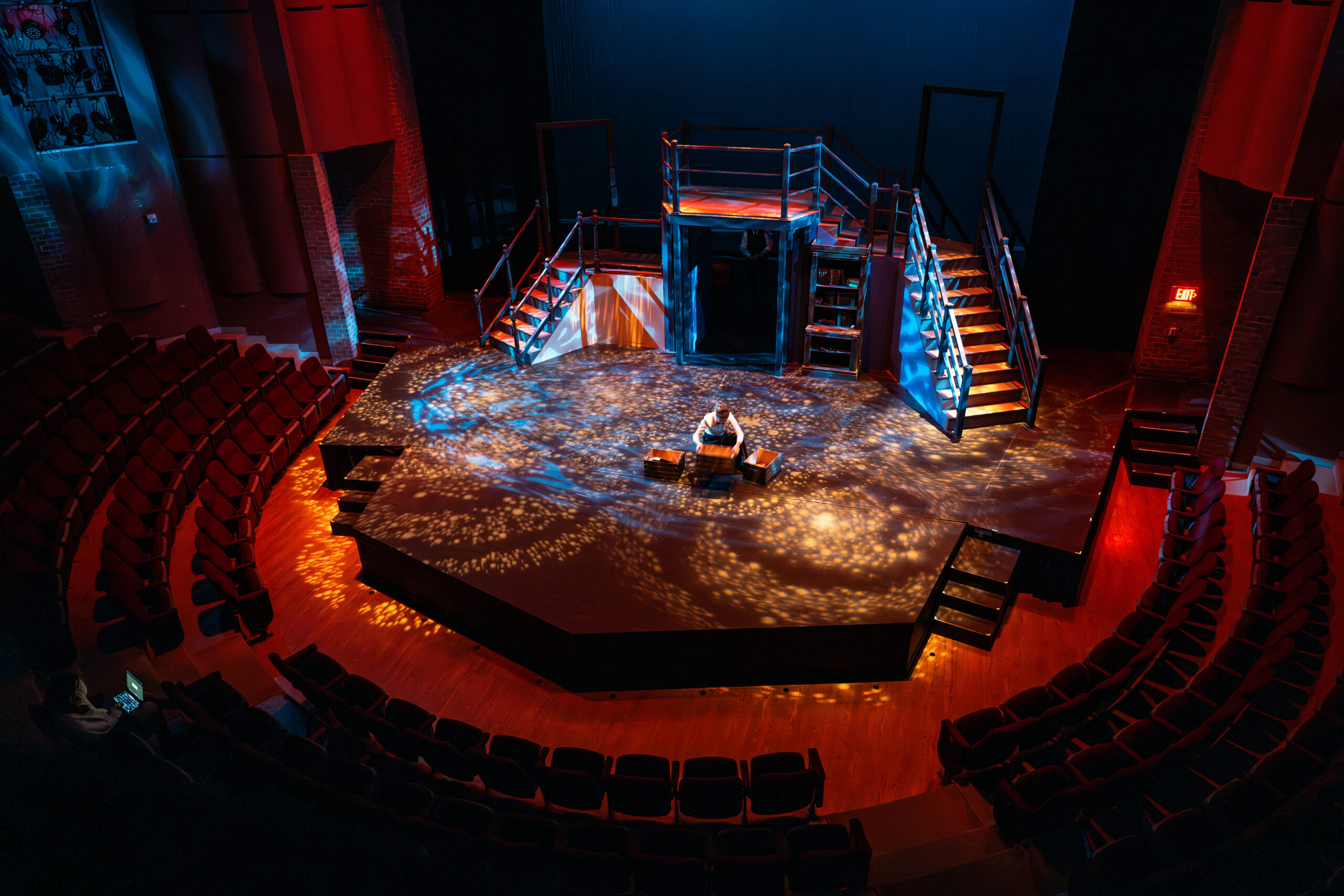
Even STEM majors may want to wander into the Fine Arts Building this week to watch the stars of “Silent Sky,” which tells the story of the astronomers who discovered Earth’s position in the galaxy.
The Tower Players’ production of “Silent Sky” by Lauren Gunderson will take place in Markel Auditorium from Oct. 2-5 at 7:30 p.m. and Oct. 6 at 2 p.m. No ticket reservation is required to attend.
“As we know, the country gets more and more divided every single day,” senior Emily Griffith said. “But we all share the same sky. This is a wonderful, warm, uniting play that I think anyone would benefit from coming to see.”
The play follows Henrietta Leavitt, a real astronomer who made all of her discoveries while she was almost entirely deaf. Senior Fiona Mulley plays Leavitt who accepts a job at the Harvard Observatory in the early 1900s. She works alongside Williamina Fleming, played by Griffith, and Annie Cannon, played by junior Rachel Dunphey. The women are relegated to reading star charts, and are not permitted to do research or touch the telescope — rule they often break.
Henrietta leaves behind a small town with her dad and her sister, Margaret Leavitt, played by senior Kenda Showalter. While in Cambridge, she meets her colleague, Peter Shaw played by freshman Aidan Bauer, and scientific discovery and romance unfold simultaneously.
The scenic design by Chris Zinger and light design by Michael Beyer are truly marvelous. Strings of lights against the back wall of the stage and weaved across the ceiling illuminate the show’s central motif: the sky under which everyone sits regardless of sex or distance. The set presents an appropriately warm academic feel with books and wooden, or at least brown, sets of stairs leading to a platform that overlooks the stage.
The show’s soundtrack, composed by Jenny Giering for the original production, is available for licensing. It has a magical, almost hymnal sound — especially with “For the Beauty of the Earth” repeated throughout the show — that often transforms the blocking into a kind of choreography. The opening track is a twinkling instrumental piano track that underscores Mulley as she enters the stage under a flurry of colorful light. For those who are disappointed about the lack of musicals this year, this play is a worthy supplement.
“It just seemed like the right move to go ahead and use it because that’s [the composer and the playwright] sort of talking to us about what they think the production feels like,” director Tory Matsos said. “The music itself has this kind of spaciousness. I feel like it sort of leaves you wondering what’s gonna come in the next phrase, but in a really beautiful and harmonious way, which I feel like is what the play is doing too.”
The action unfolds entirely in front of the main curtain, creating an almost 360-degree experience on the thrust stage. Actors frequently use the aisles and often face away from parts of the audience.
“Tory has always talked about how when you’re acting with a scene partner, you’re receiving something from them, and then you’re radiating it back. And that means you’re acting with your whole body as your instrument, not just facial expression,” Mulley said. “If you’re present in yourself, you can gain a different sort of experience, but just as valuable, from seeing maybe someone’s posture shift or how they’re holding themself. And we tend to try to do it on diagonals, so at least one person is facing out to kind of counteract that.”
Mulley and Showalter both play characters with a sure sense of self, driven by the same degree of passion but different beliefs about how it should be enacted. Showalter and the family she represents give the show its high stakes in the beginning, rather than the science itself.
Griffith effortlessly provides the show with some much-needed humor amongst four other characters who take themselves very seriously. Her Scottish accent is steady yet understandable, and her serious moments manage to read naturally amid her fun demeanor.
Mulley, Griffith, and Dunphey all have distinct characterizations that make their scenes together really fun to watch. They, and the whole cast really, bring a lot of joy and friendship to the parts they play.
While some of this is baked into the dialogue, Matsos said the rehearsal process itself was a lot of fun. Four of the five people in the cast took Acting II together with Matsos in the spring, and this was their first opportunity to try out what they learned in the spring, on the stage.
“Coming out of having that class with her, which was a very intense, studio course, writing all this terminology and different techniques that we haven’t used before, this was our first chance to actually apply that to a show with a director who also understood the terminology,” Showalter said. “We actually used a lot of it to create the show. The final scene is one of my favorites, and that we made based on stuff we did in Acting II.”
As a freshman, Bauer recently joined the Tower Players ensemble. When he first enters the stage, he seems a little too suave to play a Harvard physicist. His character later mentions a bygone dream of becoming an actor, and things start to make more sense.
He fits in well with the women on stage, immediately presenting a clear character and a strong stage presence. His brown tweed suit suit, red leather loafers, and fedora also likely helps with that.
“Working in a college-level theater has been different in the sense that there’s more vocabulary for things to learn, like radiating and all these things that are kind of new to me, but it still makes sense, because it kind of follows the same track of theater,” Bauer said. “That’s been new and exciting.”
One of the interesting things about Gunderson’s plays is that she often spells out her themes and takeaways for the audience in the form of monologues. In the midst of that, however, she comes up against hurt and human tension that she doesn’t fully resolve or explain away. Griffith’s favorite line of hers embodies this tendency.
“We are in the business of perspective. You know it is fundamentally hard to tell if something is big and bright or just close by. . . Hearts and stars, they can be blinding,” Griffith said. “The metaphor is clear, but I think it’s just a wonderful moment of drawing the audience’s attention to that parallel of the emotions that are running throughout the show and then the imagery of the stars. Those moments where they combine are just magical.”
The parallels between the science and person give the show a universal quality. The kind of humility that scientists need in order to pursue truth is the kind of humility everyone needs in order to really know and love the people around them.
“There is this idea that in order to discover, we have to wonder first, and whether that’s about science or about relationships, I think there are a lot of characters in this show who start out thinking they know something, and feeling very certain about that, and then discovering that they don’t,” Mulley said. “That can be either really beautiful or really painful, but eventually, in order to move forward, you have to open yourself up to that possibility that you don’t know.”
At the end of the show, I may have shed a few tears — not because I was sad, although the ending is a little sad — but because it offers a chance for the audience to appreciate the beauty of it all. This includes not just the set, music, costumes, and acting, but art, science, and life as a whole. “Silent Sky” serves as a reminder that as science changes, as people change, as matter itself and what matters to us changes, beauty and the human capacity for wonder do not.