
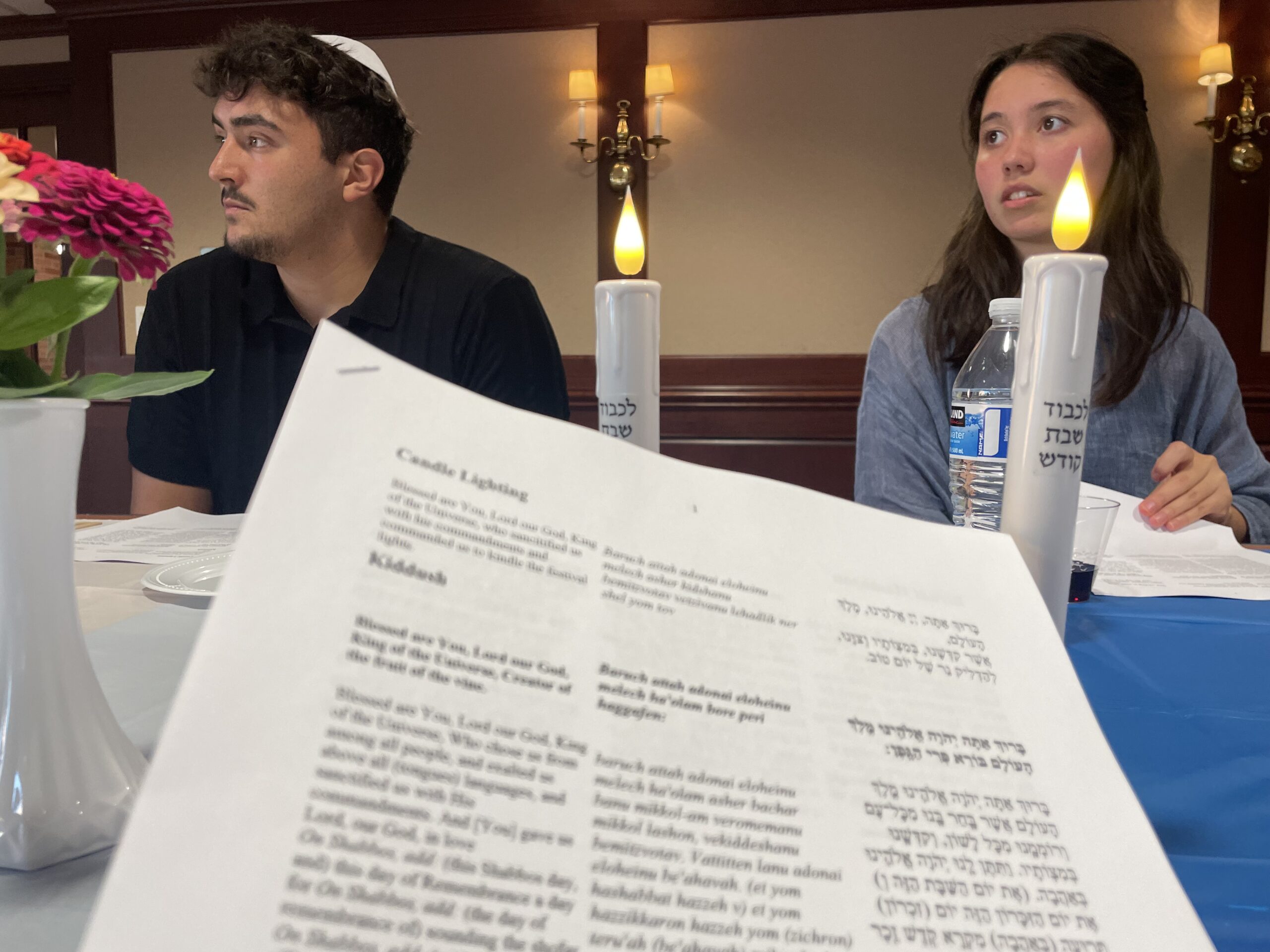
Jewish students celebrate Rosh Hashanah. Courtesy | Maggie O’Conner
What symbolizes a sweet new year better than apples dipped in honey?
On Wednesday evening, six Jewish students, eight non-Jewish students and three Jewish community members gathered in Dow over a Kosher, home-cooked meal to celebrate Rosh Hashanah, the start of the Jewish new year. The table was lined with flowers, Kosher wine, electronic candles— real candles are not allowed to be lit on campus grounds— challah bread, sliced apples, and honey.
Rosh Hashanah is one of the many events hosted throughout the year by Hillsdale College Jewish Mishpacha, the Jewish faith club on campus. The club also celebrates Shabbat every Friday evening, gathering around home-baked challah bread and grape juice to celebrate the beginning of the Jewish sabbath.
“It’s just a short and very beautiful service to open the Sabbath period, which goes from Friday sundown to Saturday sundown,” said Hillsdale alumna Sara Garfinkle ‘20.
Garfinkle, along with two fellow Jewish students, revived the Jewish faith club on campus during their freshman year in 2016. Then called Hillsdale Chavarah, the club began consistently celebrating Shabbat and other major Jewish holidays, and hosting movie nights and discussion groups.
“Of course, we would bring our friends to Shabbat,” Garfinkle said. “It was just a wonderful thing to do, to end the work week and to share bread and traditions that are important to us. Our Christian friends loved it.”
The Mishpacha executive board this school year consists entirely of freshmen, with Yahli Salzman as president. Salzman, who is on the track and field team, said he chose Hillsdale for its athletic and academic excellence and its vibrant spiritual life.
“I wanted to be a well-rounded individual by the end of my college experience,” Salzman said. “I didn’t want to be in a place where I would feel scared to be Jewish.”
Salzman’s plans for Mishpacha this year include Shabbat services every Friday and celebrations on major Jewish holidays. So far, the club has hosted Shabbat every Friday of the fall semester, often in a classroom in Kendall Hall but sometimes at an off-campus house. The club also celebrated Rosh Hashanah, the Jewish New Year, with a meal in the Dow Hotel and Conference Center. The club’s events are open to students of all faiths.
“I want to make the club as open, welcoming, and educational as possible,” Salzman said.
According to Salzman, essential to the Mishpacha’s educational goal is the club’s faculty adviser, Joshua Fincher, associate professor of classics.
“He’s one of the most knowledgeable people I’ve ever met when it comes to Jewish liturgy and culture,” Salzman said. “He knows enough to be a rabbi.”
Fincher has been the Mishpacha faculty adviser since 2017 and has led Shabbat and other events for the club every year since.
“The club has operated consistently in the past seven years, but its publicity has varied,” Fincher said. “I’m really happy with how things are going this year, that people are interested in coming to events.”
When Garfinkle and her friends ran the Mishpacha, the club had many non-Jewish students interested in and attending its events.
“I encourage Christian students to be curious. Get to know Jewish students, invite them to your events and go to theirs, eat their food — it will be delicious,” she said.
Garfinkle herself spent many Fridays baking challah, a traditional braided bread central to the Shabbat service, in her dorm.
“Some of my sweetest memories are making friends as I was baking,” Garfinkle said. “Baking bread makes the dorm smell wonderful, and people would come out and we would do homework together. It was marvelous. I hope somebody on campus is still baking challah.”
Jonesville resident Cheryl Phillips became Mishpacha’s resident challah baker after moving to Jonesville from Toledo, Ohio, last December. She discovered Mishpacha on the college’s website and began attending the club’s Shabbat services on campus this semester.
“Hillsdale College is known for academic excellence and for its safe, beautiful campus and that’s what made me think, ‘I bet there’s Jewish kids there,’” Phillips said. “Praying together and coexisting in peace on this multicultural campus gives me hope for the future. You all are uplifting and doing good in a chaotic world.”
Phillips helped prepare dinner for the club’s celebration of Rosh Hashanah, a meal which required her to drive to Ann Arbor for kosher meat. She made an effort to buy more food than necessary for the anticipated number of students.
“This way the students can have a nice little dinner the next day, too,” Phillips said. “You know, food is love.”
Associate Professor of French Anna Navrotskaya is another frequent attendee of Shabbat.
“Considering what’s happening on other college campuses, I’m very glad I’m Jewish here,” Navrotskaya said. “Thanks to all my students and colleagues, Hillsdale feels like home. I don’t feel like I need to hide my identity, which I probably would feel if I found myself at Columbia.”
According to an Associated Press article from April, Columbia University was the first of many colleges in the United States to experience pro-Palestinian, student-led campus encampments earlier this year protesting Isael’s occupation of Palestine as the Middle East conflict between Isreal and Hamas continues.
These protests occurred seven months after the Oct. 7 attack on Israel by Hamas that led to a rise in “protests and antisemitic incidents on campuses that have left many Jewish students deeply unnerved,” according to The Wall Street Journal.
Like Navrotskaya, freshman Leon Rapoport, the club’s secretary, has found a sense of safety at Hillsdale.
“Hillsdale is a very welcoming place, and that’s why I hope more Jews consider it,” Rapoport said. “I feel like people might be dissuaded by the ‘Christian college’ label. Yes, this is a Christian college, but at the same time being respectful and welcoming are such important parts of Christianity.”
Being in the religious minority comes with its difficulties, though.
“Everyone is very respectful, but the one thing that’s been slightly overwhelming is that nearly everyone in my dorm has tried to convert me at one point or another,” Rapoport said.
He explained that although many Christian students try to persuade him that the Christian ideas in the Old Testament are proof for Christianity’s validity over Judaism, they often misunderstand that the Jewish Torah is very different from the Biblical Old Testament.
“There’s no harmful intent here, it’s just simply that they don’t know much about Judaism,” Rapoport said. “I think it would be really nice if the concept and values of Judaism were more known around campus.”
Fred Yaniga, chairman and associate professor of German, has worked with the German honorary in conjunction with Mishpacha in the past to celebrate Jewish holidays like Sukkot, encouraging students to learn from each other.
“A lot of our students want to proselytize,” Yaniga said. “I understand the drive to evangelize, but first of all we should be ready to learn. We’re here to learn things that we don’t know about — that’s the exciting thing about being in college.”
The college is currently working on ways to strengthen the focus on Judaism within Hillsdale’s curriculum, Hillsdale College President Larry Arnn said in an email statement.
“Our plans are not firm,” Arnn said in the email. “They include a few things under discussion: hiring an additional Jewish professor or two to teach the classic Jewish texts; admitting some additional Jewish students if they want to come, that is, if they are willing and able to pursue our work with us in the proper spirit; launching a minor or a master’s program or both in classical Jewish studies; adding a kosher section to our kitchen. These things would be open to all students.”
Associate Vice President for Curriculum David Whalen has been a part of these discussions for advancing Jewish life on campus.
“There is a great deal about Judaism and Jewish culture that is unfamiliar to many Christians and therefore perhaps puzzling,” Whalen said. “But greater knowledge of Judaism is a boon and a blessing for Christians, rather than a distraction or any kind of diminution.”
Salzman’s plans for mishpacha are focused on spreading this greater knowledge of Judaism on campus and on community building.
“I’m a social person. And I think that’s what this school is all about,” Salzman said. “You can talk about the good, the true and the beautiful, but they have no meaning unless you actually go out of your way to become a better person, to make better friends, make a family here.”
After all, Mishpacha is the Hebrew word for family.