
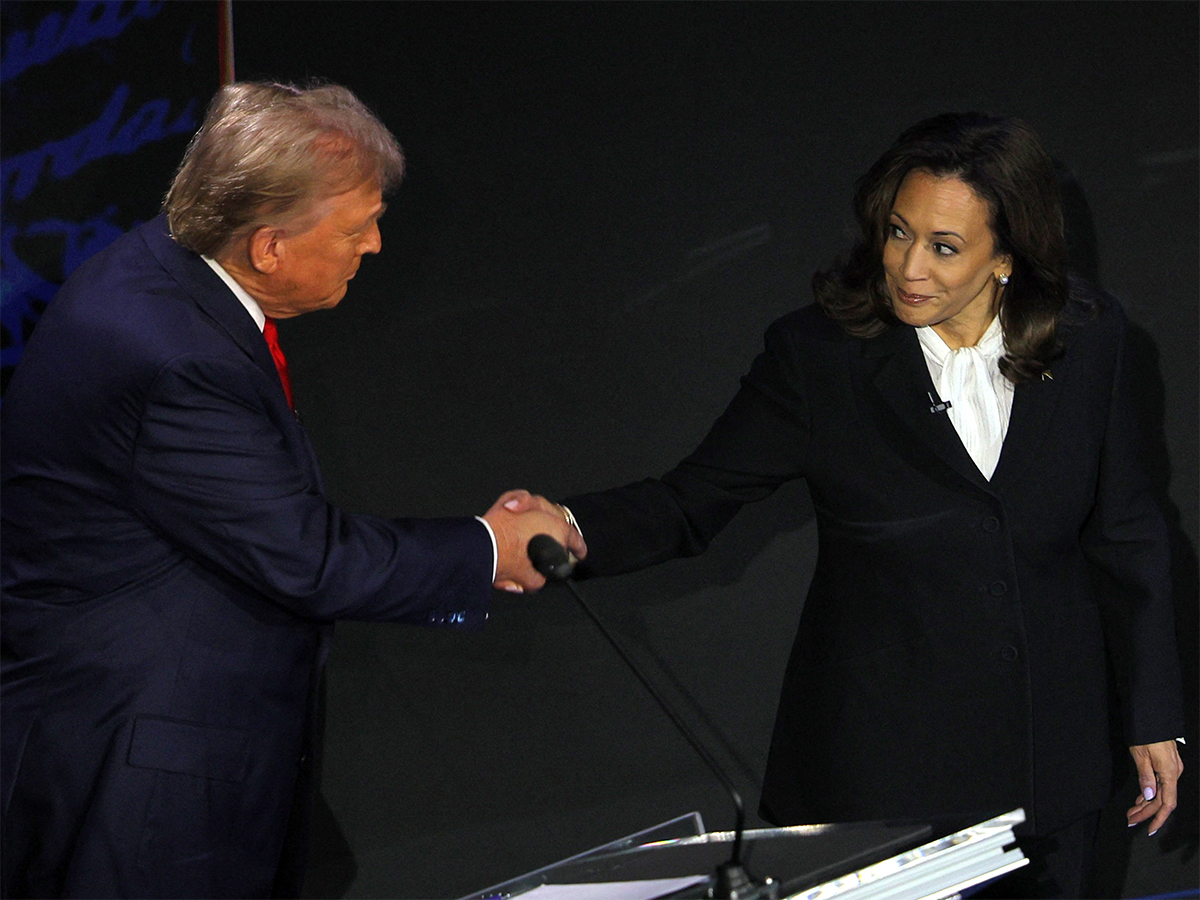
Democratic candidate Kamala Harris and Republican candidate Donald Trump shake hands in lieu of the presidential debate. Courtesy | M9 News
Hillsdale students and professors expressed a wide range of takeaways and frustrations following Tuesday night’s presidential debate between Democratic candidate Kamala Harris and Republican candidate Donald Trump.
The debate, held at the National Constitution Center in Philadelphia without a live audience, was hosted by ABC News and moderated by ABC anchors David Muir and Linsey Davis.
Unlike the planned Biden-Trump debates, this debate was not organized by the Commission on Presidential Debates nor was it held on a college or university campus.
“The function of a televised debate is primarily to showcase performance,” said Catherine Sims Kuiper, assistant professor of education. “In that regard, Harris had the upper hand; she seemed at ease, confidently responding to Trump with her posture, facial expressions, and tone.”
Professor of History Brad Birzer agreed Harris came across as poised and prepared, while Trump came across as defensive, cranky, and unappealing. Historically, however, Birzer said both candidates would not have stood a chance.
“To put this into context of larger American history, both Harris and Trump were pathetic,” Birzer said. “Daniel Webster, Henry Clay, or John Quincy Adams would’ve destroyed either of these candidates in a matter of moments. Let alone, think of an Edmund Burke or a John Adams confronting either of these candidates. Sheesh.”
Senior Vivian Turnbull had a different perspective on the candidates, saying Trump came across more stately compared to Harris and walked the line on contentious issues like abortion and Obamacare.
“With the disastrous last debate, essentially all Harris had to do last night was sound competent and maintain her narrative about Trump, the would-be-fascist,” Turnbull said. “I think she did that, though. Other than an expanded general child tax credit and first time homeowners program, she failed to clarify specific policy ideas or defend her seemingly shifting positions.”
Kuiper also addressed Harris’ weaknesses from a policy standpoint.
“For the people who are struggling with the cost of living right now and looking for someone to fix it, I don’t think Harris explained how she will address that — despite her insistence that she ‘has a plan,’” Kuiper said.
The New York Times published data on the debate that pinpointed the issues discussed the most: the economy, abortion, the Russia-Ukraine war, democracy, and immigration. The data also highlighted that Harris spent 17:25 minutes attacking Trump while Trump spent 12:54 attacking Harris.
“Kamala Harris believed that she was at war,” said Kirstin Kiledal, professor of rhetoric and media. “From the very beginning, she minimized her opponent as a person and as a candidate. Trump, on the other hand, learned one big thing before he started to debate, and that was that he had to be very careful not to attack her person.”
Kiledal said Trump would have done better in the debate by focusing on his vision for the country rather than defending his record as former president.
“I think he got caught up both by the questions that were asked, some of the constraints on his positioning with Kamala, and spent more time refuting and engaging with the points she made than putting his own case forward,” Kiledal said.
Former presidential debate moderator Megyn Kelly, former Republican presidential nominee candidate Vivek Ramaswamy, and Donald Trump Jr. all took to X during and after the debate to complain that the moderators were unfairly partisan.
Associate Professor of Politics Joseph Postell said he was less angry about the behavior of the moderators than some of that popular social media sentiment, but he thought moderators should stay away from fact-checking candidates in real time.
“I think that is a problem, and so I would criticize that aspect, not because it went for one candidate or the other this time,” Postell said. “I just don’t think it’s the job of moderators. There’s plenty of time for that analysis to happen after debate.”
Postell also said ABC’s choice to turn off a candidate’s microphone while the other candidate spoke made for a better debate-watching experience. ABC News released the microphone rule, among others, ahead of time.
“There will be no opening statements, and closing statements will be two minutes per candidate,” Will Steakin said in an ABC News article. “Each candidate will be allotted two minutes to answer each question with a two-minute rebuttal, and an additional minute for a follow-up, clarification, or response.”
According to Kiledal, the moderators rarely waited for the candidates to rebut or clarify, and, even when they did, the moderators tried to intercede with their own comments.
“It became not about what the candidate wanted to say, but about the candidate having to either deflect this comment and say what he or she wanted to say, or get stuck once again in the moderators positioning of it,” Kiledal said. “I think that the moderators weakened the place for one candidate [Trump] throughout the entire event, being so bold as to suggest that one, not each of the candidates, said something that was false or incongruous,” Kiledal said.
Senior Geert Ensing was unimpressed by the debate all around.
“The debate was a debacle, no matter what side you take,” Ensing said. “That in a democracy of 330 million people, it comes down to two candidates who are not able to answer simple questions or hold a detailed debate about public policy, is embarrassing.”
The Harris campaign chair Jen O’Malley Dillon said in a statement that the Harris campaign would like another debate in October, but Trump, while claiming he won the debate, told the hosts of “Fox & Friends” that he was less inclined to debate Harris a second time.