
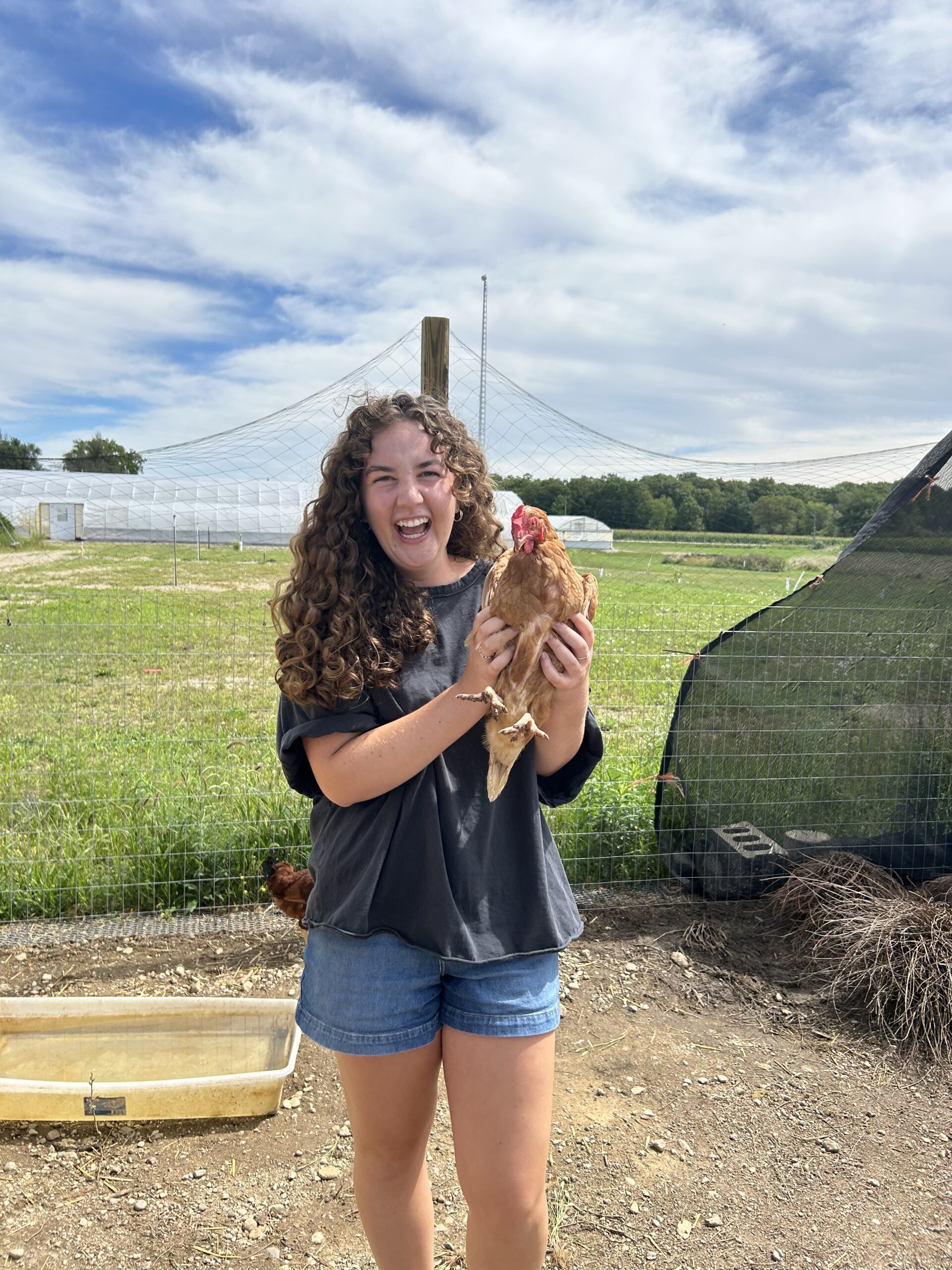
Some kids come to college thankful to escape the chores of a family farm. At the Hillsdale Homestead, students can embrace them.
After the closure of Glei’s Orchards and Greenhouses last year, the college bought part of the land and set aside four acres to create the Hillsdale Homestead, a small, student-focused farm that opened this summer.
Ryan Perkins, director of Campus Recreation and club sports, leads the farm project and said the main purpose of the farm is to give students an opportunity to gain hands-on skills that lead to self-sustainability.
“We want to provide an outdoor education that’s going to further build a student’s character outside of the classroom,” Perkins said.
The farm currently houses 50 chickens, as well as a number of pepper and tomato plants, according to Perkins.
Director of Student Programming Rachel Marinko ’22 said Hillsdale students will benefit from outdoor education.
“Being outside and working with my hands was something that I got through outdoor adventures and stuff like that in college,” she said.
Marinko said she is excited for students to have a new and unique opportunity to learn.
“I think that will be an awesome outlet for students to be outside of the classroom, using a different part of their brain and learning different skills,” Marinko said.
According to Perkins, chores on the Homestead will allow students to see some of the things they learn in classes come to life.
“We talk so much about the Founding Fathers and some of the lifestyles that they lived,” he said. “I think a lot of times students read that they were, a lot of times, these frontiersmen, and students are interested in learning how to live that quiet, humble lifestyle and be able to raise their own food.”
Perkins said much of the growth at the Homestead is due in part to people in the community who already have that knowledge.
“When you start spreading the word, you realize all these people on campus have experience with farming, or they want to get involved in farming,” he said.
But the farm will rely heavily on the work of students, many of whom have little to no farm experience.
“I have no farm experience at all, except for maybe the pumpkin patch we went to as a kid,” junior Lulu Celecia said. “I’m a city kid born and raised, although not always necessarily proud of it.”
Celecia said the opportunity to learn farming skills was a reason she decided to get involved with the Homestead.
“Maybe that’s also part of the reason I wanted to join, because getting some dirt on my hands might be good for my health,” she said.
Students can sign up to work shifts on the farm in the morning or in the evening. Shifts take about 45 minutes, and according to Perkins, students are allowed to take three eggs and a pint-sized basket of produce for each shift worked.
“Each shift includes feeding the chickens, watering the plants, collecting eggs, and cleaning out the coop,” Perkins said.
Shifts are open to all students, with opportunities to be involved on a weekly basis or sporadically.
“The main way that students can get involved is through helping with these shifts,” Perkins said. “But we’re also open to having a farm visit day for a dorm or a fraternity or sorority if a group wants to just come out and work for an hour on a weekend and introduce their students to the farm.”
This winter, students who volunteer at the Homestead will be given the option to raise a chick, according to Perkins.
“Anybody who joins and helps with chore shifts will be given the opportunity to raise a chick,” Perkins said. “Once the bird reaches maturity around 16 to 18 weeks, they will begin to lay eggs and the student that raised the chicken will be able to take those eggs.”
In the future, Perkins said there are plans to expand the farm, but student interest must be gauged first.
“Our long-term goal would be to have a wide variety of vegetables and different produce that we’re able to give out, and to have a dairy cow, pigs, and maybe some sheep,” Perkins said.
As the farm grows, the chores would also increase. But Perkins sees this as a way for students to gain even more hands-on experiences.
“What we would love to be able to do is teach students the whole process of raising the food, doing any of the slaughtering, butchering, the harvesting all the way through to making the meals,” he said.
Ultimately, Perkins hopes the farm teaches students skills that come only from getting dirty.
“There’s just so many good things that come out of hands-on labor and getting your hands dirty, working the soil and taking care of animals,” he said.