
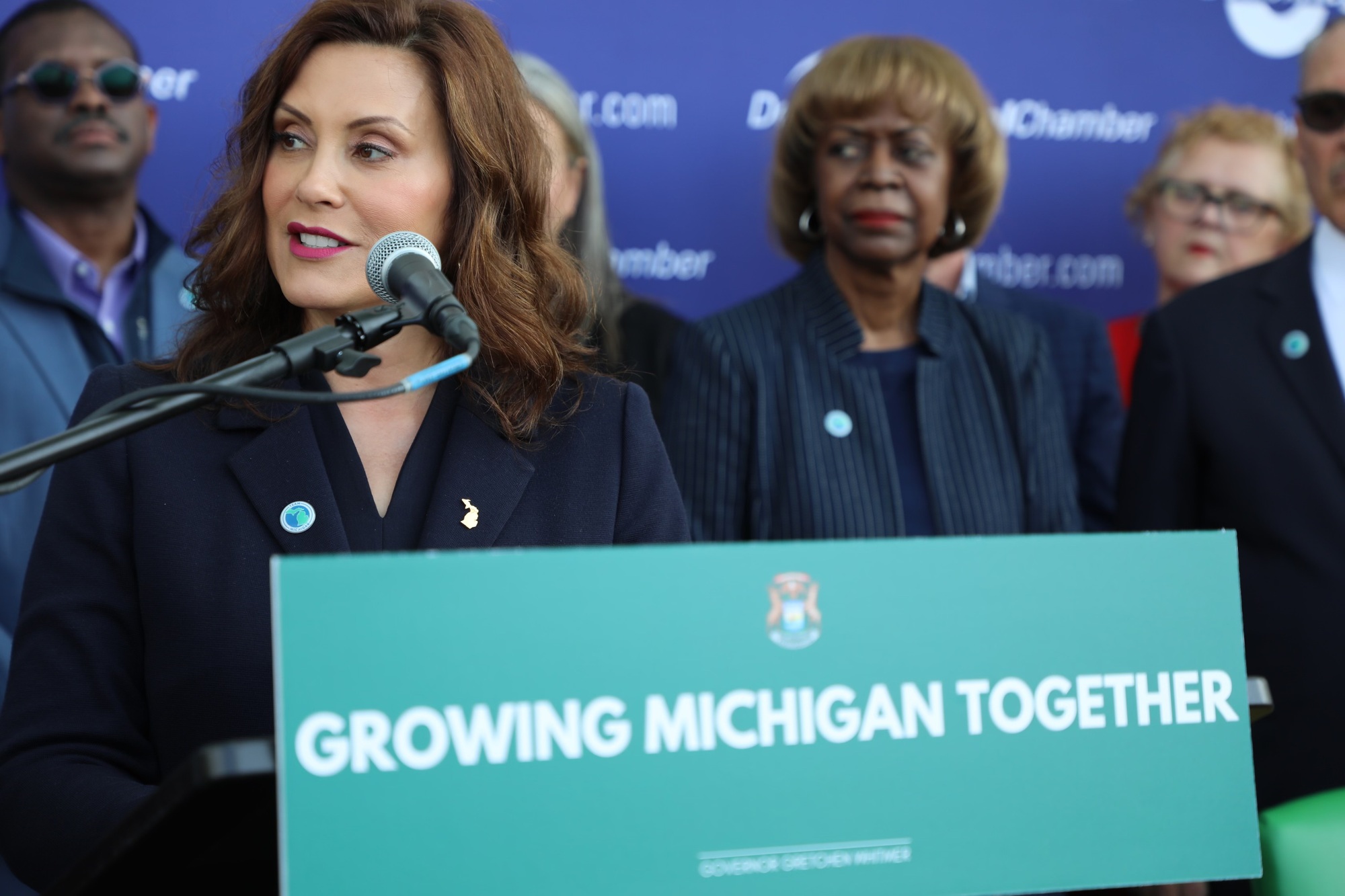
Governor Whitmer speaks on steps the state will take to grow Michigan’s population. Courtesy | State of Michigan
A state council that seeks to reverse Michigan’s population decline should not push for tax increases, according to local political and business leaders.
“There is never a good time to raise taxes, but now is probably the worst time to even consider it,” Susan Smith, executive director of the Hillsdale County Economic Development Partnership, told The Collegian. “If increasing the population in Michigan is one of the goals of the new council, increasing taxes will not bring business or population growth. The opposite will be true.”
Documents released last month by the Growing Michigan Together Council, created by Democratic Gov. Gretchen Whitmer in June, revealed the working groups are considering tax hikes.
The 64-member advisory body consists of lawmakers, state bureaucrats, professors, and union and business leaders. Each of the council’s four workgroups — labor, infrastructure, higher education, and pre-K to 12 educators — published policy recommendations last month.
The pre-K to 12 educator work group recommended the state increase funding for schools through “potential revenue generation realized by modifying current taxation and budgeting practices.” A recommendation from the infrastructure group said the state should “implement a phased approach that broadens funding sources for transportation” and “raises additional revenue.”
Nonprofit news organization Bridge Michigan said it filed a Freedom of Information Act request for the documents after they were presented to the governor but not published.
“As the representative for the only Michigan House district that borders two states, I know how easy it is for the people I represent to move a few miles south to enjoy lower taxes and more economic prosperity,” said state Rep. Andrew Fink, R-Hillsdale. “Trying to solve our population crisis through more bureaucracy and now potentially more taxes only accelerates the problem.”
Michigan lost close to 30,000 residents last year, according to a federal survey. Hillsdale County gained 153 residents, a 0.3 percent increase between 2021 and 2022.
State Sen. Joe Bellino, R-Monroe, also said a tax increase would hurt his constituents since his district lies along the southern border.
“It would be horrendously hurtful for the people in my three counties,” Bellino said. “We would lose small business. People would move over the border. If we raised the business tax again, they’d take their business over the border.”
According to the council’s reports, the increased revenue would be used to fund school and road improvement. Bellino said the legislature should not increase education funding while at the same time making teacher evaluations less dependent on student performance.
“You want more money, but you don’t want to be accountable,” Bellino said. “That’s like being a bank robber.”
Business lobbying groups are also voicing opposition.
Leah Robinson, director of legislative affairs and leadership programming at the Michigan Chamber of Commerce, said the Chamber is still waiting for details to take an official stance but is “generally concerned” about the prospect of tax hikes.
“We’re not just talking about one tax increase. We’re talking about multiple for different reasons,” Robinson said. “We’ve spent an unprecedented amount of money this past year as a state. Does that make sense? Is that being a good steward of Michigan’s taxpayer dollars?”
John McNamara, vice president of government affairs for the Michigan Restaurant and Lodging Association, said a tax increase would damage the state’s hospitality industry.
“I don’t think we can tax our way into increased population,” McNamara said. “Michigan’s population has been stagnant for decades — in fact, we’ve continued to lose population for decades. With increased taxes, the first thing you see to go is discretionary spending and that’s eating out and that’s traveling. I think that’s potentially bad for any number of sectors.”
One tax change the council’s infrastructure working group recommended was to remove a 1978 cap — known as the Headlee Amendment — on property tax increases at five percent or the rate of inflation.
Professor of Political Economy Gary Wolfram, who represents Ward 3 on the Hillsdale City Council, said when property values fell significantly after the 2008 real estate market crash, so did revenue from property taxes. He said returning the revenue to its prior level by allowing rates to be raised faster than five percent would give local governments more revenue to spend on projects.
“Local units of government could fix the roads,” Wolfram said.
But reforming the Headlee Amendment would require a constitutional amendment, Wolfram said.
The chances of that amendment, or any tax increase passing the state legislature, are slim, according to sources in Lansing. McNamara said any proposed tax hike would have an “uphill battle,” as Robinson said she would not expect to see “movement” on a tax increase until later in 2024.
Bellino said he does not think a tax increase will reach a vote in the Democrat-controlled legislature before next year’s elections.
“I fail to see how Democrats that want to stay in office would vote for a tax increase because they would lose their seats,” Bellino said. “I don’t think it would fly.”
