
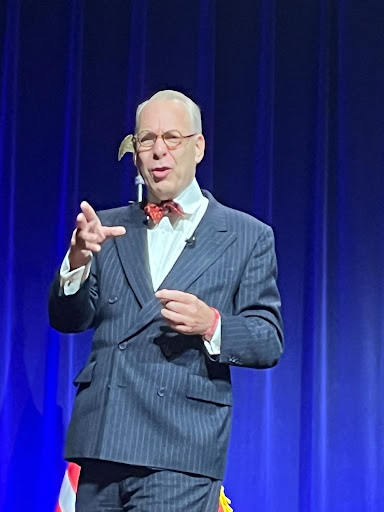
A nation’s freedom is strongly connected to its economic freedom, according to speakers at this week’s Center for Constructive Alternatives seminars.
Hillsdale College hosted its second CCA of the academic year, “Great Economists,” from Nov. 5-8.
Mark Skousen, professor of free enterprise at Chapman University, gave the first lecture, discussing Adam Smith, on Sunday afternoon.
Skousen detailed Adam Smith’s contributions to economic thought, such as the case for specialization of labor, his critiques of protectionism, globalization, and free trade, pointing out the problems of central planning, and popularizing the term “invisible hand” to describe the market economy.
“Adam Smith can be labeled, in my opinion, a multi-faceted genius,” Skousen said.
Skousen also spoke of Smith’s book, “The Wealth of Nations,” and what it said is necessary for nations to build prosperity.
“You need to have a system of justice, you need to have maximum freedom, and you need to have a robust model of competition,” Skousen said. “If you have that, you will achieve this tremendous benefit.”
The series also discussed the consequences of a loss of economic freedom.
On Monday afternoon, Benjamin Powell of Texas Tech University discussed why the socialist ideas of Karl Marx are still popular today.
“[The recession] shook people’s beliefs in capitalism and they started looking toward alternatives, including the legacy of Karl Marx and socialism,” Powell said.
Powell also mentioned many socialists don’t realize what the word truly means.
“They think that socialism is against oppression, that it is about ending alienation, and about helping people realize themselves and their freedoms,” Powell said. “Most people don’t think of socialism as the government owning and controlling the major factors that go into production.”
On the rising popularity of socialism, Powell said the New York Times ran a column every week in 2017 commemorating the 100th anniversary of the Russian revolution and the history of socialism. According to Powell, out of the 52 columns, fewer than five of them mentioned the negative economic impact socialism had on the Soviet Union and other socialist nations.
Jeffrey Tucker of the Brownstone Institute gave a lecture on Ludwig von Mises and his views on classical liberalism Monday evening.
Citing Mises’ 1927 book “Liberalism,” Tucker pointed out what Mises saw as the key attributes of liberalism in the classic sense.
“Liberalism is property rights, it’s trade, it’s freedom of commerce, and it’s free speech,” Tucker said. “He lays it out very systematically in this marvelous book.”
Mises concluded his book by saying genuine liberals have rationality and are able to argue their points with calmness and conviction.
“The theme of Mises’ life was that ideas really matter,” Tucker said. “The ideas that you hold are the things that drive your actions.”
Nicholas Wapshott, author of “Samuelson/Friedman: The Battle Over the Free Market,” spoke on how Milton Friedman revived some Keynesian policies through his advising of political leaders.
Wapshott talked about how Friedman advised Richard Nixon to take the United States off the gold standard and control the money supply when asked how to fix inflation.
The series concluded with a faculty roundtable on Wednesday afternoon.
Professor of Economics Ivan Pongracic said spontaneous economic order is at the heart of every argument in favor of liberty.
“Liberty is not just the best organizing principle for society, but really the only successful principle for organizing society,” Pongracic said. “Any alternative way of organizing society will fail.”
Pongracic also said although the ideas of these great economists may have failed to influence the economic profession sufficiently to bring a truly liberal society, it does not have to be that way permanently.
“This is not a failed project necessarily in the long run,” Pongracic said. “It depends on each one of us individually.”
