
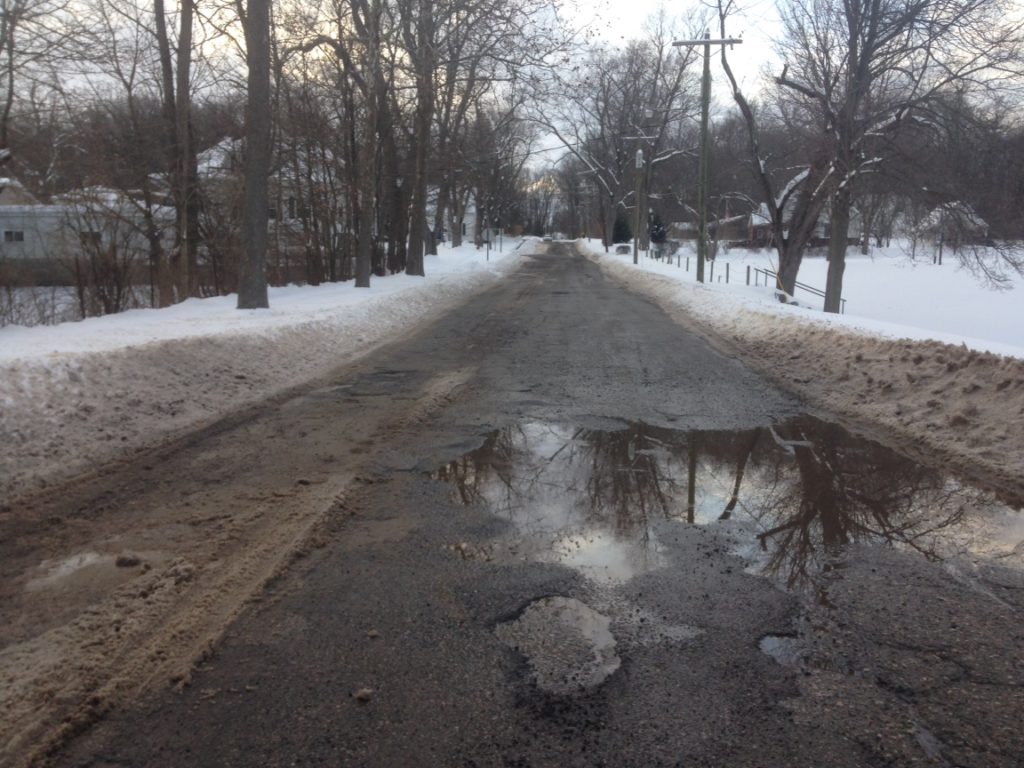
Road conditions in Hillsdale deteriorate as winter approaches.
Katherine Scheu | Collegian
Get ready for roadkill season.
Cars in Hillsdale County struck 628 deer between the hours of 3 and 9 p.m. in 2022, according to the Office of Highway Safety Planning. The OHSP explains that as the days grow shorter and deer begin to mate, the combination of poor visibility and increased dusk activity can become a hazardous combination.
“It seems that the deer in Hillsdale are exceptionally stupid, and that it’s more dangerous to drive with them around,” senior Anna Julia Bassols said. “When they get hit, the roadkill on the side of the road is just nasty. Especially in the warm summer months, it gets bloated and smells bad and makes your pleasant country drive pretty unpleasant.”
The Michigan Department of Agriculture and Rural Development has developed laws for roadkill removal, which differ based on whether the animal dies within city limits. Within the city of Hillsdale, the Department of Public Services is responsible for clean-up.
“The city’s Department of Public Services buries the animals according to state guidelines,” Hillsdale City Manager David Mackie said. “They don’t pick up many animals throughout the year.”
When an animal is struck by a car outside city limits, the rules are different. It is then the responsibility of the Hillsdale County Road Commission or Michigan State Police, according to county road commissioner Mark Kline.
“Many times, sheriff’s deputies or Michigan State Police at the scene of a car-deer accident will drag the carcass off to the side of the road or inform the road commission,” county road commissioner Mark Kline said. “Motorists can also call 911 and inform of a traffic hazard. The carcass is removed to an unpopulated area and left for decomposition or food for predators.”
According to the Bodies of Dead Animals Act, passed in 1982, Michigan residents can even harvest roadkill for consumption if given a salvage permit by county law enforcement. If the animal dies on private property, the owner has the right to bury, burn, or compost the carcass, according to Michigan law.
“Many years ago, deer carcasses were buried at a common site, but with the size of the deer herd and the amount of road kills, this was not an economic or ecological practice,” Kline said. “The Michigan Department of Natural Resources approved this practice.”
In the case of a serious accident, motorists are advised to call 911. To prevent collisions, Consumer Reports advises drivers to use headlights beginning an hour before dusk, and scan the sides of the road in a sweeping motion, looking for horizontal objects or eyeshine.