
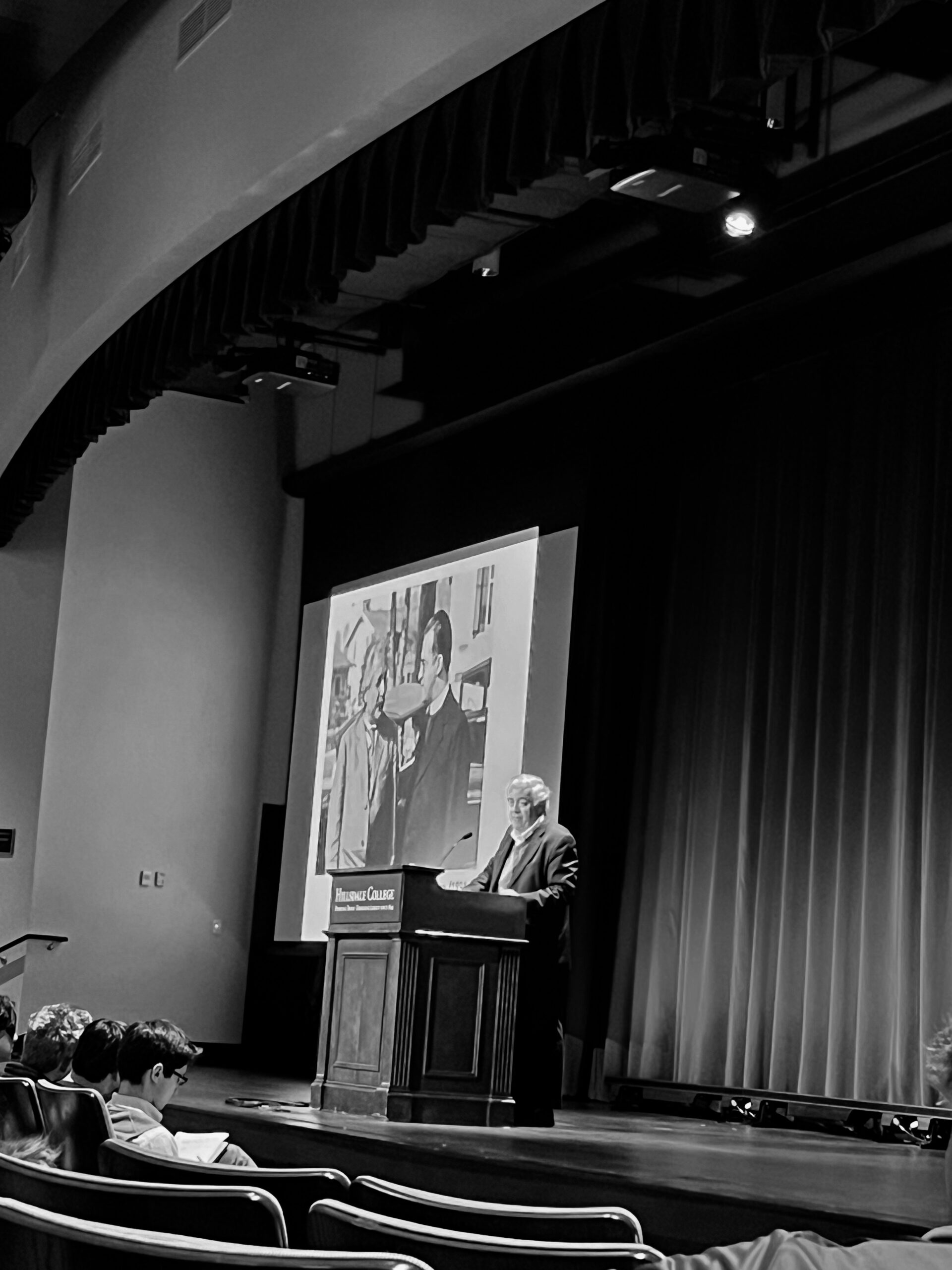
Courtesy | Alexandra Hall Stephen Barr spoke to a crowded Plaster Auditorium about the intersections of science and religion.
“Robert Boyle, the first modern chemist and considered the founder of chemistry, was a pious Anglican who said that he liked to do his chemical experiments on Sunday because they were a form of worship,” Theoretical Particle Physicist Stephen Barr said in a lecture on April 24.
His talk, “Science and Religion: the Myth of Conflict” was more than just a list of scientists like Boyle who happened to be devout. Barr spoke to a packed Plaster Auditorium about how science and religion both historically and contemporarily shake hands on more topics than the general public thinks. The talk on Monday was preceded by a Gold Mass at St. Anthony’s Catholic Church, with the purpose of celebrating science as a vocation.
Barr is a Professor Emeritus of Physics from the University of Delaware, a fellow of the American Physical Society, and the founder and president of the Society of Catholic Scientists, whose Michigan-area Colleges Chapter co-sponsored the event alongside the Hillsdale College physics department.
The focal point of Barr’s speech was a distinction he set up as science “itself” versus scientific materialism, which concludes that all of reality is reducible to matter and its behavior. According to Barr, scientific materialism is just a philosophical opinion– not an accurate representation of science as a whole.
“If matter were the only reality, then of course God would not exist because God is not a material entity,” Barr said. “Not even human spiritual souls would exist. A human being would be nothing more than a complex structure made of atoms, and everything about a human being would therefore be ultimately explicable in terms of the laws of physics that govern how those atoms move.”
Barr helped construct a narrative of viewing science as a sequence of order and the lawfulness of nature, making believing in God as a “creator” and not directly in conflict with reason or science. Barr furthered this idea with his setup of primary and secondary causes, asserting that the failure to grasp the distinction between the two is why people see conflict between science and religion.
Using the analogy of Shakespeare’s “Hamlet,” Barr asked the audience if they thought one of the character’s deaths in the play was due to the hands of his killer or simply because that’s how Shakespeare wrote the play. He stated that these two reasons can be true at once.
“By analogy, there’s no competition if God is the author of the universe,” Barr said. “He’s the vertical cause of the universe and its whole plot, whereas there are causes within the plot of the universe, which we call natural causes which scientists and everybody else studies.”
Sophomore Ruth Kirsch was unconvinced by Barr’s talk.
“It was odd because the speaker was a Catholic physicist and the talk was on why science and religion are not at odds with each other, but the only thing he used as proof of this was that there are a lot of religious scientists and that they have been important historically,” Kirsch said. “I expected him to have at least some material proof of coinciding views between scientific discoveries and religious views. Also, the talk should not have been titled ‘science and religion’ because the only religion he spoke to was Christianity.”
Assistant Professor of Physics Michael Tripepi hoped the audience was able to gain a new perspective on science and religion.
“Any thorough study of science makes you more, not less, astounded by nature and how it seems to operate,” Tripepi said. “I hope those coming away from the talk understand that science enriches our understanding of nature and God because awe and wonder for creation can only increase our awe and wonder for the Creator. This is part of the ‘intelligent piety’ spoken of in the College’s founding documents.”
