
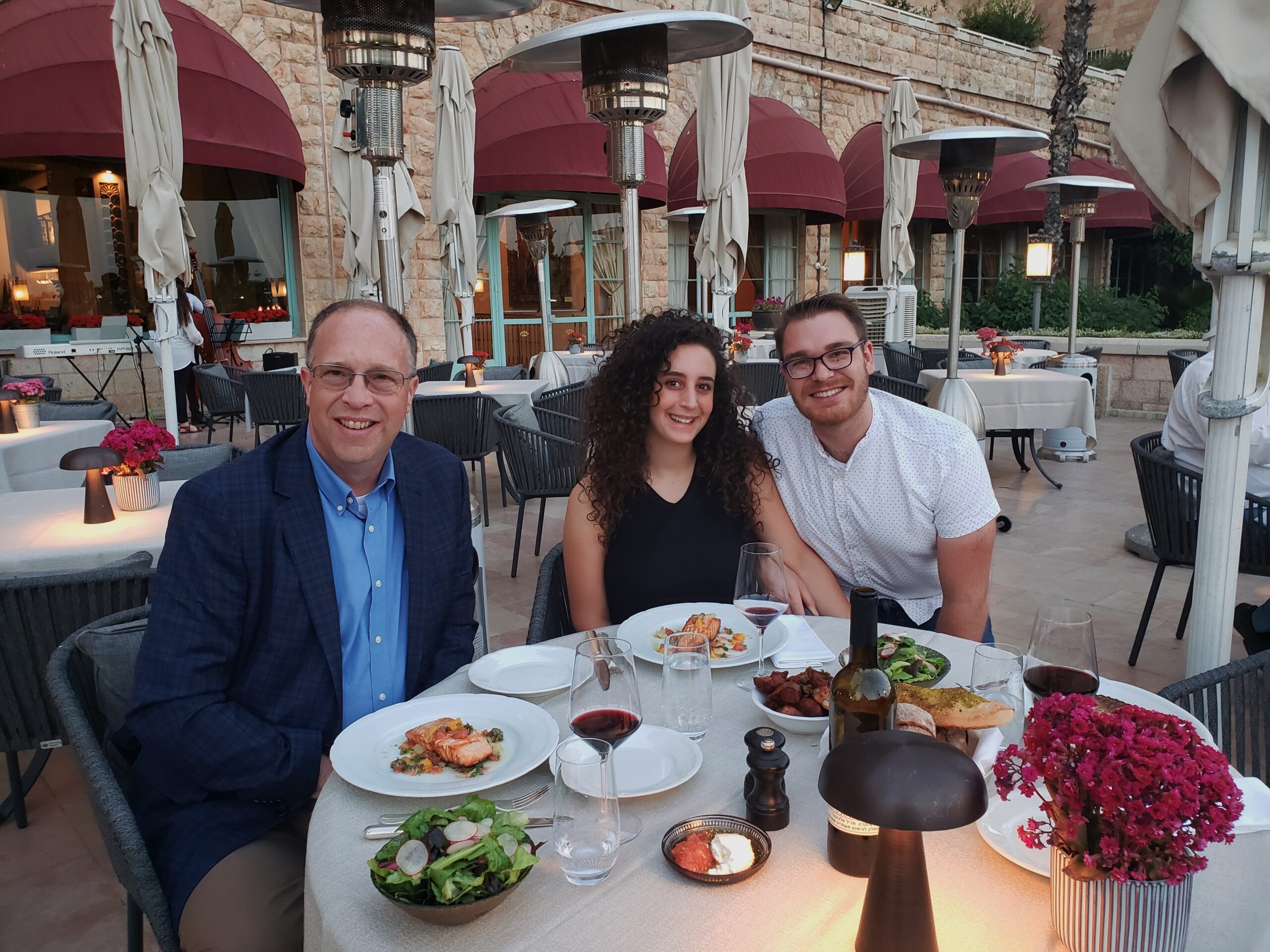
Kenneth Calvert visited Steinmeyer and his wife Roz in Israel last summer. Courtesy|Kenneth Calvert.
Five years after graduating from Hillsdale, Nathan Steinmeyer ’18 spends his days reading Aramaic, Hittite, Sumerian, and Akkadian texts.
“I study the entirety of the ancient Near East,” Steinmeyer said. “Anywhere there is cuneiform writing going on, I study it.”
Steinmayer, who lives and works in Israel, is pursuing a Ph.D in Assyriology at Tel Aviv University with a focus on the Old Late Babylonian Period.
Steinmeyer’s dissertation is about life at Dūr-Abiešuḫ, a border fortress on the Tigris River during the Late Babylonian period. As part of his research, he is studying a collection of tablets from the fortress that was discovered 30 years ago.
“Up until this point most of the work on it has just been the translation,” Steinmeyer said. “I am one of the first people going through and doing an in depth study of the text as a historical record.”
For his thesis, Steinmeyer plans to create a prosopography, a social mapping of the fortress that will explore its social hierarchy. His research focuses on the Practitioners of Divination, a class of prophetic priests that moved into the fortress after a nearby city was attacked.
“Because this is a border site, how are these diviners different at this site than at a major city? Is their job different? Do they interact with people differently? Is their function within the society at the fortress different?”
While Steinmeyer said he has not finished his social mapping, his research has allowed him to make important historical discoveries, including the date the Babylonian king was able to reconquer the fortress.
Steinmeyer was recently given control over a private collection of artifacts in the Old City of Jerusalem that has never been studied before.
“I convinced the owner of the collection to grant me permission to be the first person to study the collection and do the publication,” Steinmeyer said. “Just holding a tablet myself and knowing that I am the person academically responsible for it has been really cool.”
Steinmeyer focuses on social and anthropological questions, many of which remain pertinent today.
“We’re exactly the same way we were 4,000 years ago, the only difference is technology has allowed us to do things quicker and from a longer distance.”
Even still, Steinmeyer said much of the technology we use today, such as stamps, was invited thousands of years ago. In some instances, ancient technology surpasses what we have today.
“These tiny stamps really serve as a reminder of ingenuity. It would be difficult for someone today to figure out how to make something that small that intricate with normal hand tools,” Steinmeyer said. “To look at these things that are so artistically beautiful is breathtaking.”
Steinmeyer hopes to become a professor after completing his Ph.D. He currently serves as assistant editor of Biblical Archaeology Review, a general audience magazine about the Biblical world.
“That is something that I am really passionate about — finding ways to take really complicated topics that the average person does not have the time to learn themselves and finding ways to share that with them in a way that is easy to understand and condensed,” Steinmeyer said.
According to Steinmeyer, archaeology allows Christians to better understand Biblical context even if it cannot provide answers about specific people and events.
Steinmeyer cited Psalm 23 as an example. The imagery of God as a shepherd is not unique to King David, he said. Similar poetry dates back to a 4th-millennium Sumar King worshiping his personal god.
“That doesn’t take anything away from the Psalms but reminds us that people writing scripture were connected to a much richer, much deeper cultural heritage than we imagine,” Steinmayer said. “When we talk about the western heritage, Rome and Greece were only the new new kids on the block.”
While at Hillsdale, Steinmeyer majored in philosophy and religion with a minor in math. Steinmeyer said Professor of History Kenneth Calvert encouraged him in his study of the ancient world.
“On the one hand, he was an excellent student. He was very interested in the ancient near east right of the bat,” Calvert said. “On the other hand, he regularly fell asleep in class.”
Professor of Religion Don Westblade, who taught Steinmeyer for three semesters, agreed that Steinmeyer was an excellent student.
“His love of the Ancient Near East was exceeded only by his passion for percussion,” Westblade said. “Who can forget the outdoor drum circle he organized reverberating all over the campus?”
As an assyriologist working in Israel, Steinmeyer said he has the opportunity to visit and excavate archaeological sites throughout the Near East.
“One of the most remarkable feelings in the world is when you uncover a pot and you hold it in your hands, and you realize the last person to hold the pot lived 4,000 years ago,” Steinmeyer said. “There are few things that match that feeling.”
Steinmeyer recently helped a friend excavate a nomadic site on the Dead Sea. The group was looking for lumanates — small, crescent shaped arrowheads used to hunt small prey such as rabbits.
“They are so small that even a good archaeologist would miss them. Yet someone six thousand years ago took the time to delicately create each of these by hand for a very important purpose,” Steinmeyer said.
According to Steinmeyer, archeology is an extremely methodical process. Each archaeologist is responsible for a small dig whole which they excavate strata by strata, recording data as they go. At the end of the day, artifacts are cleaned and sorted and further data is recorded.
“It’s nothing like you see in Indiana Jones, but it is just as exciting.”
