
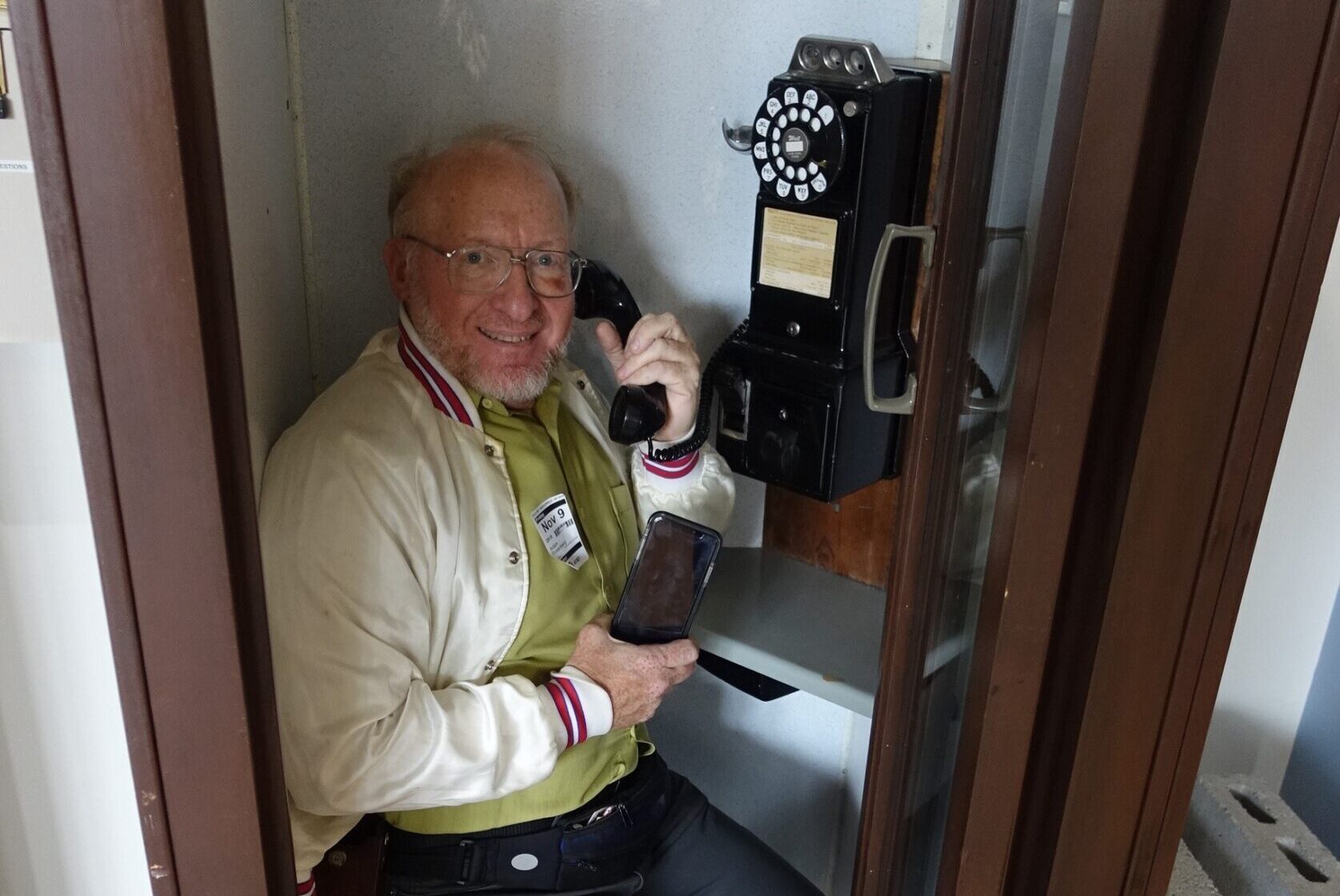
Rosenberg visited the AT&T museum and called his cell phone from a pay phone. Courtesy | Adam Rosenberg
When Ronald Reagan launched air strikes against Libya in 1986, he used a cellular phone system invented by Adam Rosenberg and his colleagues. The unsecured connection faltered and failed the commander in chief since it relied on FM waves that could be tapped into by anyone.
“We were forgiven, we got the system to work,” Rosenberg said in his talk on Feb.13. “We had this privacy system and all of the standard technology doesn’t work on a channel that’s constantly changing. They really don’t like it when that signal gets interrupted for a second.”
In “The Early Days of Cellular Technology,” Rosenberg spoke to students and professors about his time and work at Bell Telephone Laboratories, now known as Bell Labs, and beyond. Rosenberg received his bachelor’s degree from Princeton University and completed his graduate work at Stanford University in the field of operations research.
While the average citizen may not be relying on their phones to order air strikes, the result of the technological evolution of cell phones proves to be an integral part of our daily lives.
“I don’t know how many of you have watched an old television show like ‘Columbo’ or ‘Mannix,’” Rosenberg said. “But there’s a phone. And it rings. And you don’t know who is at the other end.”
In 1947, Rosenberg joined a team of engineers at Bell Telephone Laboratories who built a model of mobile telephone service. They were working with car phones, the closest thing to mobile phones at the time. Instead of using antennas that limited the number of frequencies able to be used in specific locations, the team divided the terrain of interest into hexagonal regions. These regions would each have a radio tower at their center.
“This is as far as they got with the model,” Rosenberg said. “The problem was that this was fundamentally different than a static telephone system. A call had sets of wires and switches that did not change. Nobody had to worry about whether a call moved.”
The regions, called cells, resembled a honeycomb structure when mapped out. When someone was driving and moved between these cells, the frequency would be handed off from one cell to another through channels. Rosenberg was responsible for developing this system which was used for 15 years. He even wrote a program called Autogrow in 1982, which helped evolve the model by adding midpoints between the pre-existing cells.
“The fundamentals of a telephone call had to be redefined,” Rosenberg said. “Radio setup, handles, roaming, and quality standards were all new and different and scary. I was on this trip– not quite the engineer, but the passenger. I worked with amazing people with different skills and a common mission. It was a wonderful thing.”
Senior mathematics major Anthony Iatropoulos noted that the hexagonal grid maps aren’t anything like the digital networks used today.
“I thought it was interesting how the qualities of each mathematical obstacle presented to Dr. Rosenberg arose from and shifted naturally in response to the technological limitations at the time he was working in the telephone industry,” Iatropoulos said. “ The changes are cool to see and I’m grateful for his contributions to cellular network technology, because I really enjoy being able to stream Spotify during my hikes in the mountains.”
Freshman Valerie Check was also interested in the business side of Rosenberg’s talk.
“It was interesting to hear about how the cell phone company dealt with needing different sized cells to service all of their customers,” Check said. “They designed maps that could continue to be altered as their demand grew,” Check said.
The analog model was far from perfect. Cell phones saw many phases over the following decades, mostly seeing their largest transformation in the digital era. Questions of privacy, the mechanics of dialing, and the impending promise of Wi-Fi rose to the surface as the technologies developed. Rosenberg’s career was defined by discovering and helping evolve technologies now used in most people’s everyday life. Without his contributions, we may still have cell phones the size of bricks.
“I’m pretty proud of my work,” Rosenberg said. “I did nothing to deserve it whatsoever. I mean, I’d like to think I’ve earned it since then, but I just got lucky. Sometimes being lucky is enough to get things going.”
