
Roe v. Wade and Planned Parenthood v. Casey deprived people of the right to make their own choices, the Mississippi solicitor general who persuaded the Supreme Court to overturn Roe said at Hillsdale in D.C.’s annual Constitution Day Celebration last week.
Scott Stewart, who spoke to alumni, students, faculty, and friends of the college at the Waldorf Astoria Washington D.C., aligned the fight for states to regulate abortions with the struggle for independence and civil rights.
“I’ve never worked on a case like this,” he said. “As the case was unfolding, person after person who talked to me about the case said ‘I’m praying for you.’ That sticks with you.”
Stewart, who graduated from Stanford Law School and clerked for Associate Justice Clarence Thomas, began working for Dobbs v. Jackson Women’s Health Organization during his first year in office.
Stewart began his speech by laying out the background of Dobbs, saying Roe and Casey made it difficult for states to make their own laws about abortion – especially during the first 23 weeks of pregnancy, when a baby is much less likely to survive outside the womb.
“The states kept trying. They tried after Roe, they tried after Casey. The issue was just too important not to try, and so it went for decades,” he said. “Mississippi is one of the states that has long tried to protect life and health in the medical profession by regulating abortion.”
When Mississippi proposed a law prohibiting abortion after 15 weeks, lower courts struck it down because it fell outside of the viability window set in place by Roe and Casey. That’s when Stewart picked up the case.
“It didn’t matter that the 15-week law applies when an unborn child is undeniably human – when risks to women surge and when the common abortion procedure is brutal,” he said. “The lower courts held that because the law prohibits abortions before viability, it was unconstitutional no matter what.”
After months of deliberation, Stewart said, the Supreme Court agreed to hear Dobbs.
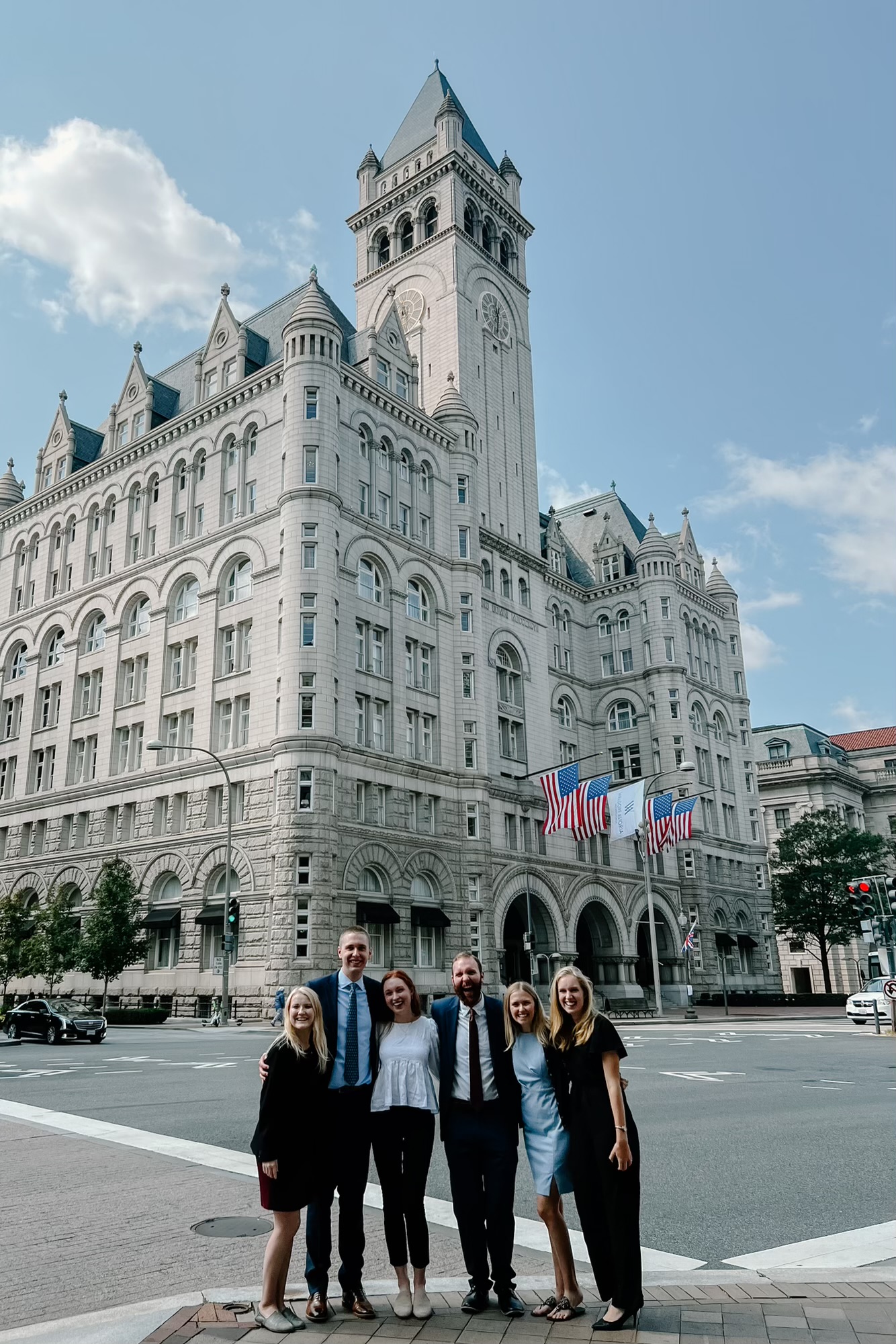
Courtesy | Ashley Kaitz
He recounted the arguments he used to win the case, starting with Roe and Casey’s lack of constitutional basis.
“Roe and Casey adopt a unique right, a right to end a human life. Nowhere else does the court recognize this,” Stewart said. “Nowhere else does the right to privacy, liberty, dignity, or autonomy mean a right to take a life.”
Second, Roe and Casey robbed the people of their constitutional right to make their own decisions. “Roe and Casey undermine democratic government,” said Stewart. “The Constitution leaves the most important issues to the people, and Roe and Casey ended that. They block people from deciding one of the most important issues we face.”
Third, supporters of Roe and Casey argue that women couldn’t be successful without a right to abortion, Stewart said. He disagreed.
“The clinic quoted, ‘A right to abortion is critical to women’s success, and its absence would shackle women.’ That is all wrong,” he said. “Countless women and mothers have achieved both major career success and a rich family life without needing a right to abortion.”
Stewart said the controversy surrounding the case was one of the greatest challenges he has faced. He said he was struck by the amount of people who cared more about maintaining a right to abortion than about remaining faithful to America’s founding documents.
“I’m talking about people who know what our Constitution is, what our judiciary is, how vital they are, and yet act to destroy them. I don’t have to describe all that happened these past few months,” he said.
“We all saw it,” Stewart said. “It reveals a darkness, and the darkness lies in a warped view of the Supreme Court.”
According to Stewart, many people falsely believe the Supreme Court’s job is to make decisions for Americans – to “pick winners and losers even when the Constitution does not pick winners and losers.”
Stewart said this does not discourage him.
“In my view, we should see darkness, sinister expectations and controversy as opportunities – they’re not reasons to be discouraged or retreat,” he said. “These are opportunities to stand for what is right.”
Mary Greco, Hillsdale in D.C.’s undergraduate program coordinator, said she was interested to hear about the polarizing reactions Stewart encountered when he took the case.
“When he first got the case, and people were coming up to him, I was surprised to hear that some of them said ‘this isn’t worth it,’ and ‘what are you doing?’” she said. “On the other hand, a lot of people came up to him and said, ‘I’m praying for you.’ I think, ultimately, this was a moral battle.”
Junior Olivia Hajicek, a WHIP student who attended the lecture, said Stewart’s courage in bringing Dobbs before the Supreme Court inspired her.
“I was most affected by the fact that he challenged Roe v. Wade because he thought it was the right thing to do, even though a lot of attorneys thought it was foolish,” she said. “I hope we keep fighting abortion with that kind of courage until every human being is recognized as a person under the law.”
For Stewart, the United States’ most controversial moments have become its most noble memories.
“The battle for American independence, the fight against slavery, the struggle for civil rights – these were all fraught, hard, and controversial,” Stewart said. “We now see them as the greatest moments for our country. Easy things are not great. And that’s why Dobbs was a great decision.”