
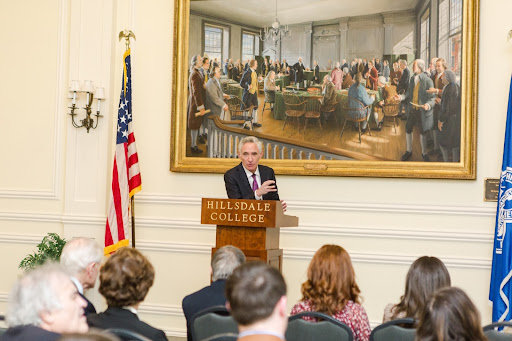
The Academy for Science and Freedom held its first event in a series of public lectures on Jan. 24, 2022 at which academy fellow and senior fellow in health care policy at the Hoover Institution of Stanford University Scott Atlas spoke on media misinformation about the COVID-19 pandemic.
The academy is dedicated to the pursuit of truth in the sciences, according to Jay Battacharya, a fellow at the academy and professor of medicine at Stanford University. The majority of the public lectures will be held at the Hillsdale in D.C. campus.
Battacharya, Atlas, President of Hillsdale College Larry Arnn, and Director at the Brownstone Institute and Professor Emeritus of Medicine at Harvard University Martin Kulldorff founded the academy in December 2021.
“The pandemic is not what our academy is about but it has exposed profound problems in our society,” Atlas said. “They probably existed beforehand, but came to the fore in frightening colors we still see today in the management of this healthcare crisis.”
In his presentation, Atlas emphasized the importance of data when it comes to finding the truth about the pandemic. He said the media, especially social media, overlook data when spreading information about COVID-19.
“We absolutely must live in a country where facts matter, and we are seeing an overt denial of facts here,” Atlas said.
He presented data about infection rates, deaths, and the negative effects of lockdowns, particularly on children and low-income communities.
Though the academy’s efforts are not purely aimed at exposing media inaccuracies about COVID-19, it was founded as a response to the effects of the pandemic on Americans, according to Battacharya.
“The three academy fellows and President Arnn collaborated throughout the pandemic to assess the data and make prudential decisions,” Battacharya said in an email. “The Academy for Science and Freedom emerged as a result of their collaboration and the need to educate as widely as possible about the proper ends and conduct of scientific inquiry.”
Dean of the Natural Sciences and Associate Professor of Chemistry Matthew Young said the work of the academy on encouraging truth in science is essential to the practice of science.
“A healthy scientific culture is one in which discourse based on evidence is enthusiastically pursued rather than retreated from due to fear of censorship,” Young said.
Battacharya said the media’s use of COVID-19 as a political tool is antithetical to the true purpose of science.
“I hope that the work of this project helps restore the norm of free discussion of ideas within science and restore science to its proper place within society as a source of knowledge and technologies that better the lives of people, rather than as a partisan political tool,” Battacharya said.
Though the academy has only held one public event to date, Battacharya said he looks forward to what comes next.
“Right now, we are still organizing the work of the center,” Battacharya said. “Practically, this work involves preparing for a series of public lectures over the coming months and organizing conferences where scientific leaders will lend their perspectives on topics related to the reform of science.”
Young said he is also looking forward to seeing what the academy will accomplish.
“Science provides a way to discover the truth about the way things actually are,” he said. “It has given us tremendous insights into what the universe is and how it works. I hope the academy will spark thoughtful academic dialogue about the proper functioning of the scientific process.”
