
Students, faculty, visitors, and friends of the college packed Plaster Auditorium for the long-anticipated Center for Constructive Alternatives on “The Inklings.” More than 750 guests and 257 students registered for this series, according to CCA student assistant and sophomore Annaliese Oeverman.
External Affairs Program Manager Markie Repp said the CCA is a repeat of the 2005 CCA on the Inklings.
Lectures began at 4 p.m. on Sunday, Jan. 30 in Plaster Auditorium and concluded at 4 p.m. on Wednesday, Feb. 2, with the faculty roundtable.
Presentations included overall discussions of the Inklings, their specific works, themes of C.S. Lewis and J.R.R Tolkien’s writings, and a dramatic presentation of “An Evening with C.S. Lewis.”
Professor of Historyat Hillsdale College Brad J. Birzer, who opened the lecture series, praised the Inklings as bards of the modern age.
“A bard is at the center of a community, culture, and civilization,” Birzer said. “He is the bridge and intermediary between God and His worshippers.”
Birzer outlined the history of the Inklings. The Inklings were an informal literary discussion group associated with J. R. R. Tolkien and C.S. Lewis who met twice a week from 1931 to 1949. They critiqued and praised one another’s works, encouraged each other in various endeavors, and strengthened the bonds of friendship, Birzer said. Birzer regards the friendship between the men in the group as one of the greatest of the 20th century.
“True friendship is exclusive and non-political,” Birzer said. “It is the highest level of non-individuality and necessary in a community.”
Birzer spoke on the immense influence of Lewis and Tolkien. He compared them to other famous men, writers, philosophers, or prophets who lived at the end of their time and sought to preserve virtue and wisdom – Socrates, Plato, Aristotle, Cicero, and Dante.
“C.S. Lewis and J.R.R Tolkien were preservers of timeless wisdom for ages to come,” Birzer said.
Birzer said Lewis and Tolkien lived during the end of the Modern Age and wrote as bards to defend the best of western civilization.
“Only through story can one understand himself, inherit rewards, and pass these on to future generations,” Birzer said.
Author at Word on Fire Institute Holly Ordway spoke on “Tolkien and the Christian Imagination.”
“Reason is the organ of truth,” Ordway said. “Imagination is the organ of meaning. It shapes the way we understand and engage with the world.”
Ordway said Tolkien understood the culture in which he lived and wrote as a critic of the modern era.
Ordway discussed Tolkien’s unique approach of subtle religious aspects in contrast to Lewis’ overt presence of theological elements in his literature.
“The religious element is absorbed into the story and the symbolism,” Tolkien wrote in his Letter of 1953.
Ordway advocated for current writers to engage with the culture without consuming its poison. She said writers ought to understand the deep emptiness within the human heart and search for good to answer this longing in their literature.
Other speakers included Professor of English at Wheaton College Michael Drout and Chair of Religious Studies at Thorneloe University Jason Lepojarvi. Drout discussed Tolkien’s interaction with old English works such as “Beowulf” and “Sir Gawain and the Green Knight.” Lepojarvi warned the audience against “the personal opinion fallacy” which puts fiction before the biography of the authors.
Senior Research Fellow at Blackfriars Hall, University of Oxford Michael Ward, in “C.S. Lewis The Abolition of Man: Philosophy or Theology?” agreed with Lepojarvi that Lewis intentionally grounded his works in underlying, yet ambiguous principles.
Ward said Lewis’ main point in “Abolition of Man” was that the belief in the unifying principle of objective value underlies all religion. Only after understanding Lewis’ intention can readers draw parallels to other themes in literature or even “The Bible,” Ward said.
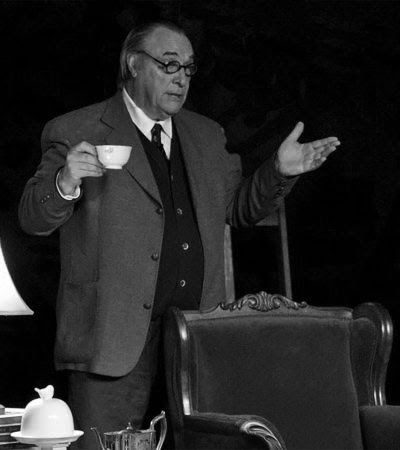
In the final session of the CCA, actor David Payne performed “An Evening with C.S. Lewis.” Through his C.S. Lewis impersonation, Payne shared Lewis’ life as a child, young adult, and eventually old man. He recalled Lewis’ hard childhood, the loss of his mother at age 9, his rejection of God and later conversion, and his eventual love for his wife Joy Davidman, whom he also lost before his own death. Instead of focusing on what he had lost, he reflected on what God gave him. Payne quoted Davidman’s last words to Lewis.
“Jack, you have made me very happy,” Davidman said.
Sophomore Dean Ballantyne said he hoped to ignite this love for Lewis in his own life by attending the CCA.
“I have wanted to begin reading C.S. Lewis for a while now,” Ballantyne said, “so I am taking the CCA in hopes that it will give me a good foundation of understanding and an appreciation for how special his writing really is.”
Sophomore Addy Longnecker said her favorite part of the CCA was learning about the deep friendship of Lewis and Tolkien.
“I knew they were friends, but I have come to know what the friendship truly meant to them,” Longnecker said. “It was a bond they valued above almost anything else in their lives.”
At the Faculty Roundtables concluding the CCA, Professor of Philosophy and Religion Nathan Schlueter said this CCA has been one of the greatest at Hillsdale College.
“This has really been all around one of the highest quality CCA’s we’ve ever had,” Schlueter said. “I think it was fabulous.”
