
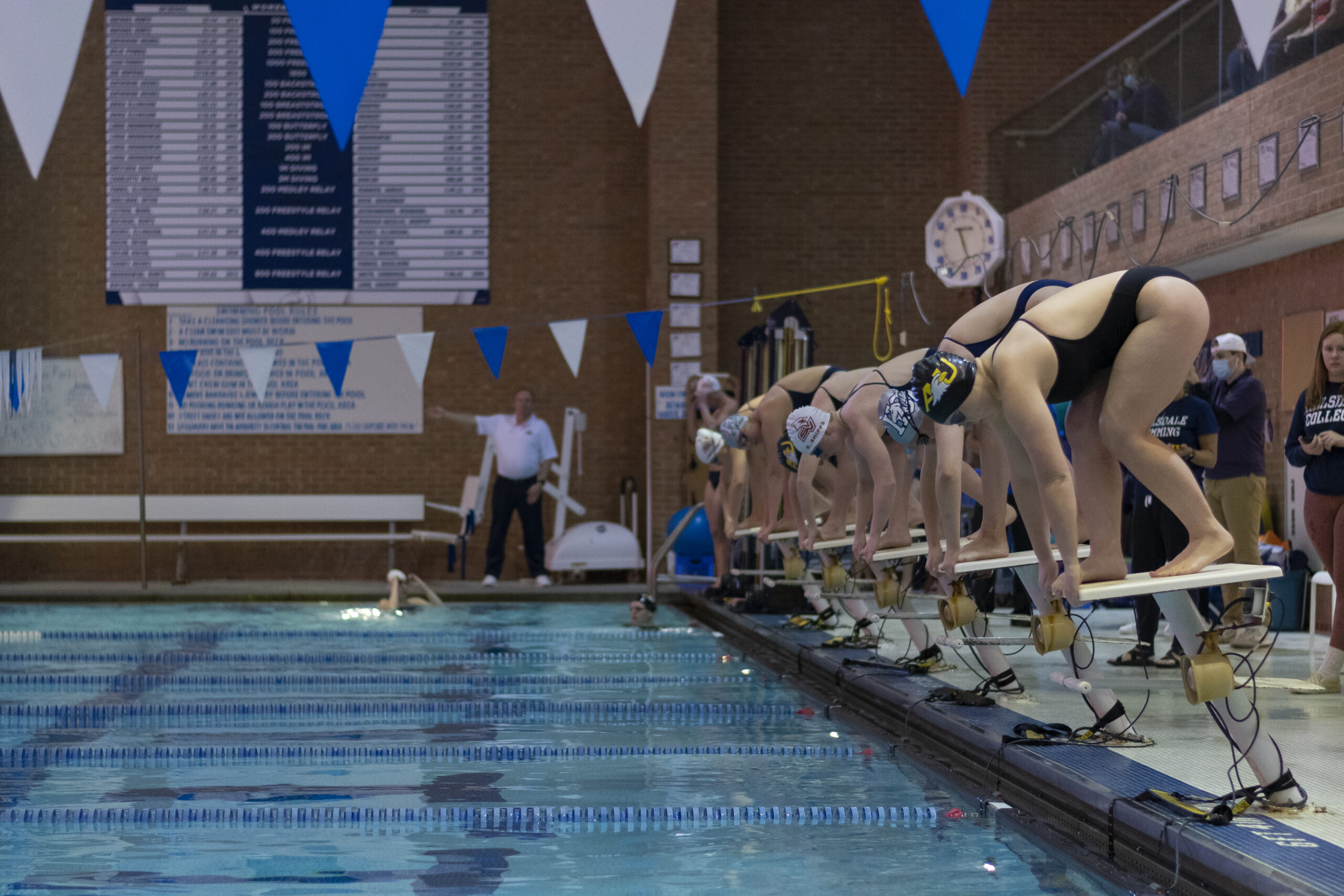
Hillsdale swimmers say they are worried that athletes who compete as transitioned females will take over the recruitment and scoring systems of college swimming.
Lia Thomas, who competed as a male swimmer at the University of Pennsylvania, transitioned to female, joined the women’s team at Penn, and now has broken both university and national records this season.
“She’s taking away relay spots from biological females,” sophomore freestyler Caroline Holmes said. “If I was her teammate, I would be like ‘Well, what’s the point in me competing?’”
The NCAA requires athletes born as biological men to receive hormone therapy for a year before they can compete as women, and Thomas began therapy in 2019. Many athletes, however, argue that the effects of testosterone suppressants would not negate her nearly 20 years of male development.
The NCAA has said it will allow the governing bodies of each individual sport to set their own requirements beginning in 2022-23. For the time being, however, Thomas is still able to swim in the women’s category.
“Other transgender athletes have spoken out about this,” junior freestyler Leah Tunney said. “From their experience, they didn’t start to feel a huge difference in their testosterone levels until 36 months. So, these other athletes are saying it’s way too soon.”
Thomas’s physical prowess can still be seen in her physical appearance despite her years on hormone blockers.
“Its super interesting because when transgender atheletes became a huge thing it was initially with a bodybuilder and a track runner who were transgendered women,” Tunney said. “I remembered talking to my swimmer friends and we didn’t ever think it would be an issue for swim because it’s such an exposing sport as far as uniforms go. I was honestly shocked when the story came out.”
Several athletes have spoken out against Thomas’s successes in the female category.
In an interview on Christiane Amanpour’s podcast, Micheal Phelps, the most decorated Olympian of all time, said that “we all should feel comfortable with who we are, but I think sports should be played on an even playing field.”
Phelp’s comments met with backlash from critics who say he was born with a biological advantage as well. According to Scientific American, his lung capacity is two times greater than the average person.
Phelps isn’t the only Olympian who has criticized Thomas’s participation in women’s sports. In an interview with Newsmax last Friday, Olympic gold-medalist Caitlyn Jenner, formerly known as Bruce Jenner, said she also disagreed with the NCAA’s rules, saying both its and Thomas’s choices come without “responsibility and some integrity.”
Others have supported Thomas as a female swimmer. The Ivy League, Penn’s athletic conference, proclaimed in a statement its “unwavering commitment to providing an inclusive environment for all student-athletes while condemning transphobia and discrimination in any form.”
Swimmers at Hillsdale worry that transgender athletes will undermine Title IX, a federal civil-rights law that seeks to provide equal opportunities for female athletes.
“Whenever you allow men who have transitioned to women to compete with women, I don’t think that’s in line with what Title IX has fought to support or protect,” Holmes said. “Lia choosing to be transgender isn’t an issue, you’re free to do what you want to do. However, when you choose to compete against women and have this huge biological advantage, that is where the problem lies.”
Thomas’s eligibility has Hillsdale swimmers questioning what kind of athletes will be recruited by D1 schools.
“Especially with schools that are on Title IX and have a lot of scholarship money, D1 specifically, why are they going to be recruiting biologically females who will be losing when they can just recruit people that identify as female but are biologically male who can simply demolish the competition?” sophomore Phoebe Johnston said, who swims both butterfly and IM.
Hillsdale swimmers have their own ideas on the future of swimming, and hope that the NCAA will continue making amendments to their rulings.
“As far as letting transgnder people compete, I would make a separate category for them,” Johnston said. “With swimming, especially at the collegiate level, they score men and women differently. They’re on different teams, so it’s still the universities swimming and diving, but it’s always the men’s team and the women’s team. We’re not scored together, we do not race together.”
Other swimmers agree with this, advocating for distinction rather than descrimination.
“It upsets the level playing field everyone relies on in athletics,” Tunney said. “I’m actually surprised that it’s even really an issue. A transgender athelete shouldn’t be stopped from competing altogether, they should just be in the level that doesn’t give them this huge competitive edge. I think a good solution would be opening a transgender male or female category.”
Other students want politics removed from the issue, and instead prioritizing consideration for the female athletes who have dedicated their lives to their sport.
“I’m not here to prevent anyone from competing,” Holmes said. “I’m a lover and fan of the sport, the last thing I would want would be for people to be turned away from the sport. But the purpose of sports, and women’s swimming, is not to promote a political agenda, it’s to encourage success. Whenever you complicate the situation, like by not separating men and women, the purpose of the sport is undermined.”
