
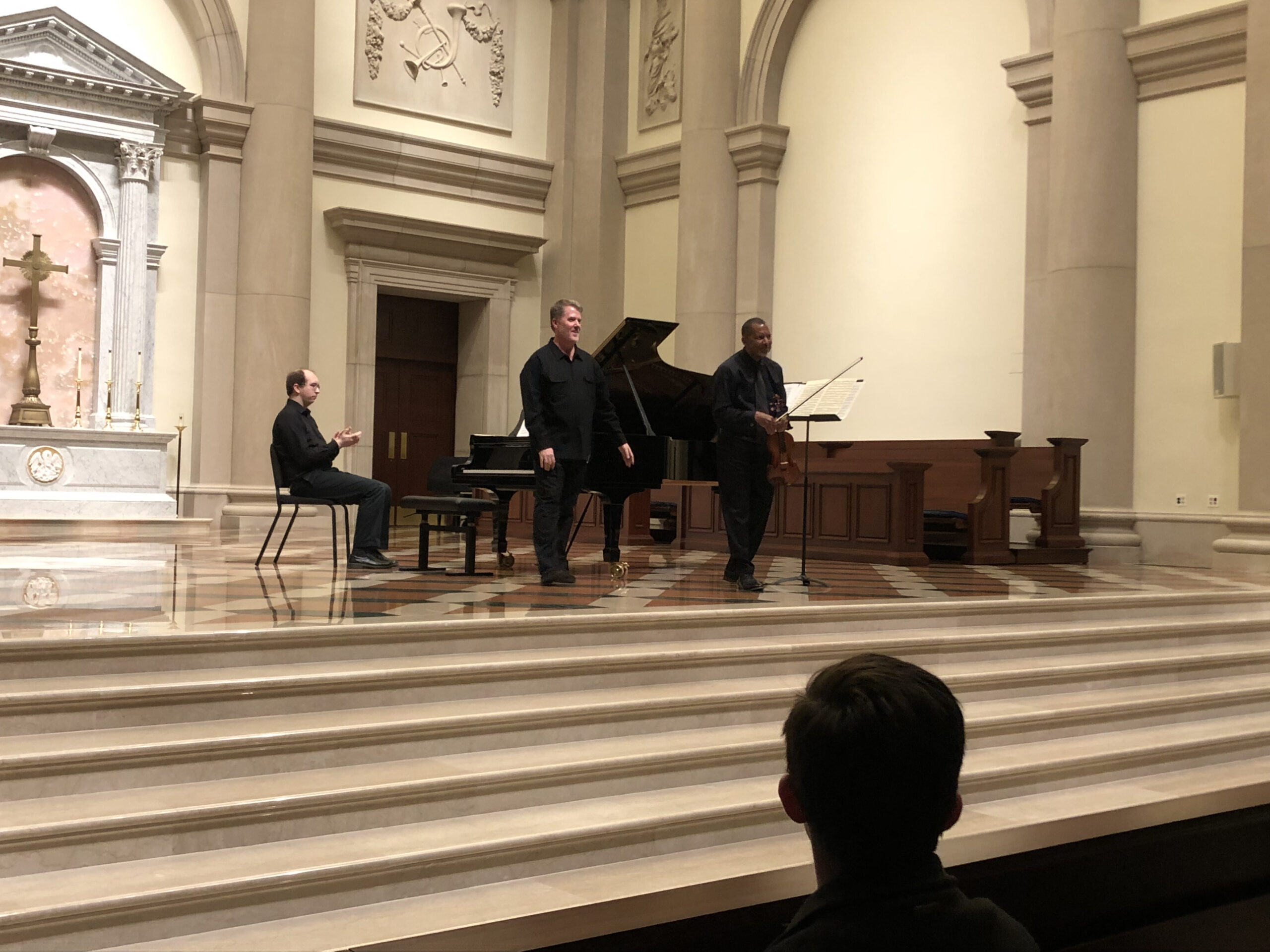
Last Saturday evening, Director of Keyboard Studies Brad Blackham and guest violinist John McLaughlin Williams collaborated to bring the chamber music of modern composers to Christ Chapel.
“I think John and I were both hoping that most of the works on the program were going to be new for many people,” said Blackham. “It’s always great to open the minds and ears of the audience.”
Blackham and Williams met while in graduate school at The Cleveland Institute of Music.
“The funny thing is, we never got the chance to perform with one another while there, so that made this recent performance extra special,” Blackham said.
Williams is an award-winning conductor who has made world-premiere recordings of orchestral works by both well-known and obscure composers. He received a Grammy for his recording of Messiaen’s L’Oiseau Exotiques in 2007 and received further Grammy nominations in 2009 and 2011.
Outside of his conducting experience, Williams is also an accomplished pianist and violin soloist and has performed with the National Symphony Orchestra as well as the Boston Pops Esplanade Orchestra, among others.
Blackham and Williams share an interest in the works of modern composers, and the program included works by composers Somei Satoh, Nikolai Kapustin, Maurice Ravel, and Pancho Vladigerov. It explored the different colors and styles of modern music written for violin and piano.
“It was exciting that the pieces were newer pieces; it certainly made it intriguing,” said senior Helen Murdoch. “It is always good for me to be exposed to new kinds of music.”
The program opened with Birds in Warped Time II by Satoh, a composer who is still living. The piece is almost otherworldly, creating that sense using expressive vocalistic slides on the violin offset by a rolling and consistent piano line mimicking fluttering wings.
“There is a certain stillness in the work, there is no time signature,” Williams said. “It’s up to the musician to place the notes in a way that gives them meaning.”
Nikolai Kapustin’s Sonata, Op.70 provided a sharp contrast to Satoh’s work, mixing classical and jazz style’s in a unique and unpredictable way.
“The Kapustin was fun, but it’s an extremely difficult work, especially the first time you perform it,” Blackham said. “That one was both fun and scary. It’s one of those pieces that can come apart at the seams very easily.”
The second half of the program included Ravel’s Sonata No.2 in G and ended with Vladigerov’s “Horo” from “Two Bulgarian Paraphrases.”
Vladigerov, who was trained in Germany, wrote many works based on Bulgarian folk tunes.
“If you’ve heard Bulgarian music before, it’s insane. It has crazy time and all the strangest time signatures,” Williams said. “This work was based on a Bulgarian round dance.”
The work featured a conversation between piano and violin, the time signatures and accent lending to a feeling of unpredictability while maintaining a steady sense of movement and regularity.
The program closed with the Theme of Schindler’s List, which Williams and Blackham dedicated to all of the lives unnecessarily lost due to COVID-19, Williams said.
“I like that they wanted to set apart a moment to think about the specific lives that have been lost,” Murdoch said. “I had some questions about the wording of how it was dedicated, but I thought it was good to remember the individuals.”
Blackham believes it is an important part of the role of a musician to seek out and to promote new music.
“At the very least so that students who are studying music can get a sense of what’s out there currently,” Blackham said. “We should be aware of new voices in the music world especially if those voices connect with us.”
