
Courtesy | Josi Cuddeback
For less money than it would cost most of them to travel within the United States, sophomores Josi Cuddeback, Catherine Spalding, Addy Longnecker, and Luke Hollister threw together a three-day trip to Portugal over fall break.
“We didn’t plan the trip at all,” Hollister said. “We were not prepared for this. All of us had midterms on the previous Tuesday and Wednesday.”
Despite the trip’s humble origins, the trip across the world was somehow more convenient than a trip back home, Spalding said. Their round trip tickets cost only $325.
“We lived lavishly,” Spalding said. “But the thing is, after everything was said and done, the trip was still well under $1000. It was cheaper than going home, which is crazy.”
Their trip began with an early morning that turned into a long day. After taking a red-eye flight and traveling for 32 hours straight, they finally landed in Portugal.
“We stumbled up into the light of Portugal after being up for hours,” Cuddeback said. “Luke was attached to the map and was asking all these different people for directions. He totally stepped into his dad shoes.”
It was 6 a.m., and the group had nowhere to leave their luggage until their Airbnb opened at 3 p.m. To pass the time, they went to a cafe called Janice, where they ate acai bowls, avocado toast, and earl grey mousse waffles.
“We got a seat outside in the morning sunrise,” Cuddeback said. “We all got a different dish and then rotated to the left so everyone got some of everything.”
After brunch, the four of them went to explore the city, but faced some obstacles.
“The tram station there was made to confuse and scare tourists,” Hollister said. “It got our money and was happier for it.”
The group then found themselves on the shores of Cascais beach, where they stayed until sunset.
“The houses there were all the most aggressive, vivid, pastel colors,” Cuddeback said. “It fit the style of architecture beautifully.”
Before eating, the group stumbled upon one more attraction.
“We saw these road signs that said ‘the mouth of hell,’ so we just decided to… hop the fence,” Cuddeback said. “We’re running through these rocky formations and we get to the edge and it’s just a cliff. There were rocks that were about eight feet tall all around us.”
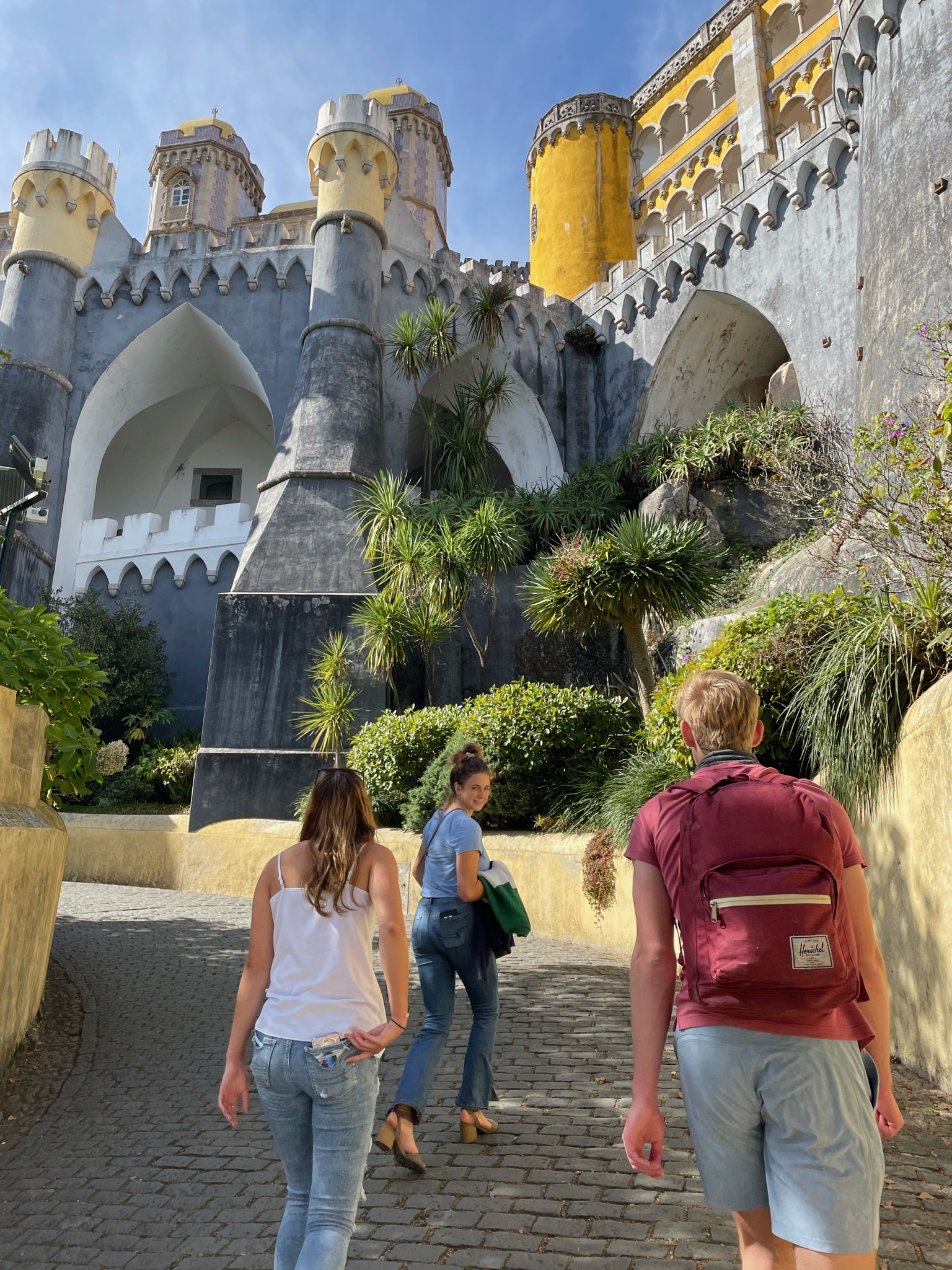
The next day, they traveled to the Palace of Pena, where they met a new friend.
“Raphael. I was in love with him,” Spalding said.
Raphael, a local tuk tuk driver, offered to take the group up to the palace for the same amount of euros as the bus would be.
“He brought us to a pool of ‘magical’ water,” Hollister said. “He said it healed his knee.”
At the top of the mountain, they toured the palace and adjoining fortress.
“There was a Muslim fortress, and the palace itself was really bright and colorful,” Cuddeback said. “It was beautiful.”
On their third day, the group split up; Spalding and Cuddeback went to the Sanctuary of Our Lady of Fatima.
“When we got there, they were holding Mass in the main square,” Cuddeback said. “It was wonderful, but we both got sun scorched on our faces from standing out there for an hour and a half.”
After Mass, the two travelled the path to the site where the Virgin Mary appeared to three Portuguese children in 1917.
“The condition of going there is that you have to walk this marble path on your knees,” Cuddeback said.
While other pilgrims brought protective gear, Spalding and Cuddeback travelled on their bare knees.
“It is intense, it is like half a mile long down hill,” Spalding said. “Josi and I did not bring knee pads.”
As Spalding and Cuddeback were making their way toward the Sanctuary, Hollister was exploring a local monastery, as well as a museum housing the largest collection of coaches in the world.
“I walked into this church, and the roof was being held up by these massive pillars, but they were all very intricately carved,” Hollister said. “It was the most awe-inspiring thing I saw on the trip.”
Spalding said she learned a lot from her time in Portugal.
“Going to Portugal taught me many things,” Spalding said, “especially the importance of thorough research into other cultures and being able to appreciate those cultures for what they are.”
Cuddeback said she would recommend going abroad to any students who are considering doing so.
“The experience made me so grateful for good, trustworthy friends, because being abroad makes you vulnerable in ways you’ve never been before,” Cuddeback said. “It’s also so memorable because it was such a spontaneous adventure; it felt like the epitome of living fully, taking risks and being gutsy while you’re young. Very fulfilling for sure.”
