
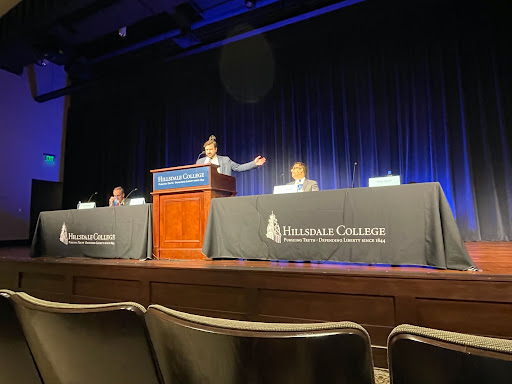
The first Center for Constructive Alternatives lecture series of the fall 2021 semester examined contentious presidential elections, with each speech illuminating the controversies of the 2020 election, according to CCA attendees.
“No one can say with certainty that there was no fraud in 2020,” said Andrew Busch, crown professor of government and George R. Roberts Fellow at Claremont McKenna College. He argued that voter fraud had a limited impact on the election.
From Sept. 19-22, Hillsdale College professors and guest speakers presented on the most influential elections in American history, from the election of 1800 to Donald Trump’s controversial loss in 2020.
The first day’s lectures consisted of historical summaries of elections that changed the American political process.
Professor of Politics Kevin Portteus said the radical transformation of values in the 1860 election relates to the culture wars today.
Michael Barone, senior writer for U.S. News & World Report and Fox News contributor, spoke on the 1876 election, which had a high voter turnout much like the 2020 election. Barone said the staunch political divide between the North and the South created a charged political environment in 1876.
“We get high turnout from genuine policy differences,” Barone said, “not because everyone loves one another.”
The second day turned to the “Progressive Revolution,” where author Charles Kesler talked about the 1932 presidential election, where Franklin D. Roosevelt’s election ushered in a new era of social programs.
He argued the landslide victory of Ronald Reagan in the 1980 election christened the “Reagan Revolution” and ended the long Progressive era.
On the third day, Busch said there have been corrupt elections in American history.
“I don’t believe that there is no fraud in American elections,” he said.
Despite this, he expressed doubt that any possible fraud in the 2020 election was enough to change the outcome, and that polls showed that Trump’s defeat was inevitable. He pointed to RealClearPolitics’ aggregate polling.
“Of 230 polls, Trump led five of them,” he said.
After listening to Busch’s defense of the 2020 election, Hillsdale resident Dr. Charles “Bud” Vear, who attended the CCA, said he was convinced that the election results were legitimate.
“I think Busch made a strong case that the 2020 election was not stolen,” he said. “In spite of my conservative values, I thoroughly enjoyed Busch’s presentation.”
Junior Jack Hammons said he was unconvinced by Busch that the election wasn’t stolen.
“He didn’t really go into depth on voter fraud,” he said. “He mostly tried to prove that Trump lost in the polls.”
However, Hammons said he appreciated hearing both sides of the argument.
“I think that they’ve had very good speakers representing a variety of opinions,” he said.
Phillip D. Kline, director of the Amistad Project of the Thomas More Society, focused more on reports of irregularities in the 2020 election.
“The 2020 election was the most lawless in the nation’s history,” Kline said. “Our election was conducted by a shadow government of nonprofits with 15 years of planning.”
Kline made claims about ballot drop box distribution and hacking.
“The drop boxes? Zuckerberg paid for ‘em,” Kline said. He referred to them as “Zuckerboxes.”
The CCA closed with a panel of Hillsdale professors who commented on the collection of lectures throughout the series.
“We heard a lot of frightening things this week,” said Professor of History Paul Moreno.
Associate Professor of Politics Joseph Postell argued the best way to combat unending conflict in U.S. elections was to return to stronger, more local parties. He said centralizing politics in Washington, D.C. causes a lack of clarity.
“We don’t have a very good definition of a fair election or a stolen election,” Postell said.
Sophomore Grace Gottwalt said she took the CCA due to her interest in pursuing a minor in politics.
Though Gottwalt said she remains unsure about whether the 2020 election results were legitimate after hearing the two speakers, she said she agreed with Barone’s argument that questioning American elections damages the strength of the democracy. She said the CCA topic gave a voice to the struggles of conservatives today.
“The title was very relevant in today’s society and the issues we face today,” Gottwalt said.
