
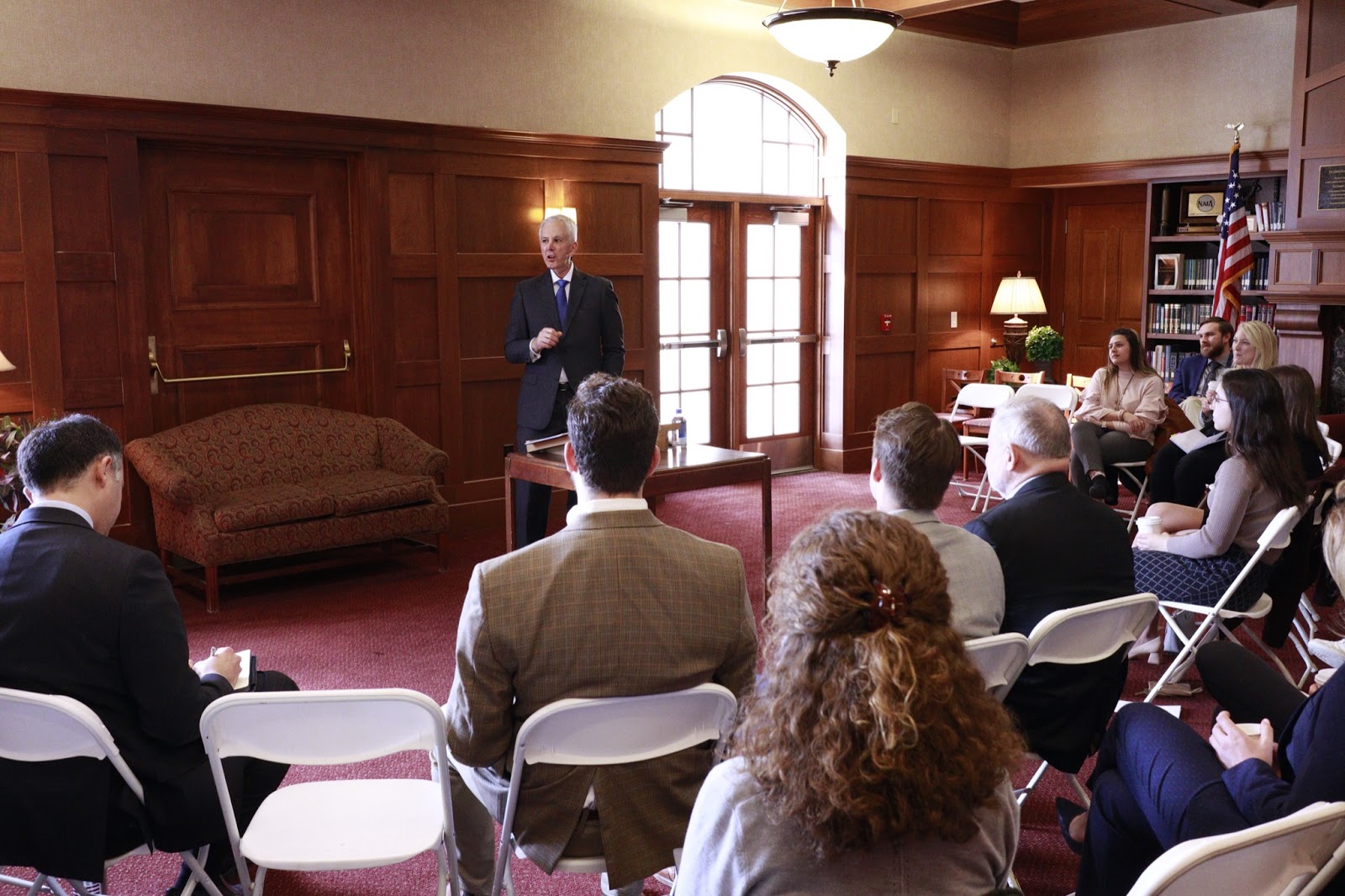
Andrew Dixon | Collegian
Stephen A. “Tony” Batman has made more money than most people his age, but his biggest piece of advice for Hillsdale students at a lecture last Thursday was not to overvalue money.
“There’s nothing wrong with making money, but some people make money their entire life,” Batman said. “If you ask them what is most important to them and they say money, you don’t want to be friends with them. There’s something in their character that is not right.”
Batman, founder and former chairman and CEO of 1st Global Inc., spoke on “How to Live a Life to Praise and to Prize” on April 1. In his talk, he shared advice from his career as a financial analyst to teach students how to succeed both in the work world and in their personal lives.
Batman spoke on the idea of utility, which he said drives nearly every aspect of modern life, and discussed where it is useful and where it goes too far. Monetary utility, for example, is not always a good thing, because a person who loves money more than anything else is contemptible. Another type of utility is “tactical utility,” Batman said: young people change jobs at a far quicker rate than middle-aged and older people, because of their curiosity.
“Employers don’t like that, because they invest in you and then that investment is turned into naught. But they understand that that is part of the process. I just want you to know that they know that that is part of the process,” Batman said.
Employers who prefer an older employee to a younger one aren’t engaging in “age discrimination,” he added, they just understand human psychology.
His advice ranged from how to succeed in an interview — let the person interviewing you know what you can offer them if hired — to Aristotle’s “Nicomachean Ethics.”
Batman recounted the three kinds of friendship Aristotle outlines: friendships of pleasure, which end when pleasure ends; friendships of utility, which end when utility ends; and friendships of virtue, wherein friends don’t require anything from one another besides friendship.
“I read the ‘Nicomachean Ethics’ and it changed my view about who my friends are,” Batman said with a laugh. “I realized I probably only have about two or three friends.”
A chartered financial analyst and the chairman of SVB Interests, Batman and his wife, Vicki, live in Dallas, Texas, and are involved in philanthropy to advance their four core values, faith & worship, knowledge & education, business & commerce, and civics & patriotism.
Batman is a “trailblazer,” according to the American Institute of Certified Public Accountants, for his vision and entrepreneurial spirit concerning the future of the accounting profession. Accounting Today magazine voted Batman one of the most influential accountants in America for 13 years in a row, from 1996 through 2008. He sold 1st Global, now known as Avantax Financial Services, to Blucora Inc., in May 2019.
In addition to his success in the world of financial management, Batman shared about his deep and abiding interest in higher education with Hillsdale students. A graduate of the University of Kansas, Batman told the audience how he has completed nearly 100 online courses from different universities in order to learn about the great books — from ancient Greek and enlightenment philosophy to world history and Judeo-Christian theology. He has been fascinated with classical education since a child, when he observed his father’s collection of the great books of the Western tradition.
Batman tapped into this knowledge for his lecture, even when advising students on something as simple as how to speak — or, “expressive utility”: omit “like” and “you know.”
“It is OK to be silent. Silence is power. If you have nothing to say, say nothing. There is no power in saying, ‘you know,’” Batman said.
He returned to Aristotle when explaining the purpose of starting a business.
“Everything has a purpose,” Batman said. “That light here: one purpose of it is ambiance. One purpose is a decoration. But the highest purpose of light is illumination, and perfect illumination. Likewise, the purpose of business is not to make money. Those are secondary purposes. The primary purpose of business is to make other peoples’ lives better. If you do that, you will make money.”
Russell Richardson, an institutional advancement associate who attended the lecture, said he was impressed by how humble Batman was.
“He was an incredibly successful man, and yet he was interested in helping other people become successful,” Richardson said. “There are often two types of successful people: those who are just interested in themselves and in self-glorification, and the rare type of people that are interested in helping others reach their level.”
Senior Taryn Murphy also remarked on Batman’s eagerness to aid and instruct.
“One of the things that really stood out to me was his commitment to helping other people,” Murphy said. “Also, that success doesn’t come from just chasing some sort of ever-moving bottom line, but that genuine success and fulfillment will come if you commit yourself to help people. That doesn’t mean you won’t run into failures — I mean, he was sort of frank about times when he was fired and so on — but that commitment to help people can be a driving force.”
