
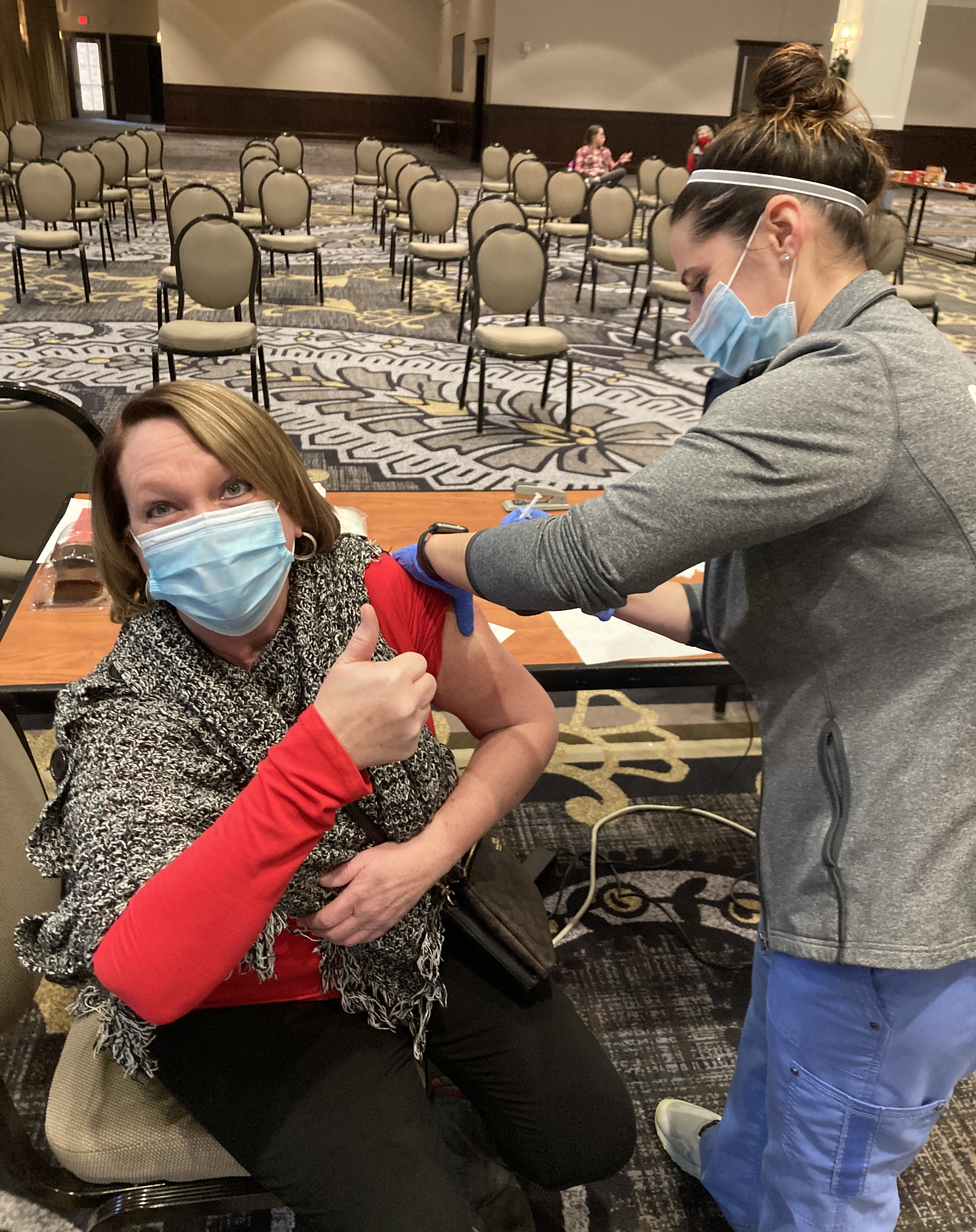
Hillsdale Hospital administered nearly a thousand COVID-19 vaccinations on Jan. 28 and 29 at the Searle Center, bringing the county one step closer to overcoming the pandemic.
“We have done exactly what the state has asked of us, which is to get shots in arms,” J.J. Hodshire, president and CEO of Hillsdale Hospital, said in an email.
He cited the college’s low-temperature freezer, housed in the biochemistry lab and connected to backup generators, as essential because it allows the vaccine to be stored at temperatures as low as ‑80 degrees Celsius.
“In rural healthcare, we are used to operating with fewer resources than our urban and suburban counterparts,” Hodshire said. “Our partnership with Hillsdale College for the use of their ultra-low temperature freezer is a perfect example of how we have to get creative to care for our community.”
Because the hospital was able to use the college’s ultra-low temperature freezer, it received 1,950 doses of Pfizer’s vaccine, Hodshire said. Without the freezer, it would have received only 400 doses of Moderna’s vaccine, which does not require the same refrigeration.
In clinical trials, Pfizer’s vaccine has been 95% effective against COVID-19 and Moderna’s 94% effective.
“We can’t do it alone and we hope that other rural communities in our position will reach out to organizations in their area that might be able to help them with the challenging logistics of this vaccination effort,” Hodshire said.
Hillsdale Mayor Adam Stockford said the college’s willingness to share its freezer with the hospital allowed for a greater distribution of the vaccine.
“I think it’s great that Hillsdale Hospital was able to use the college’s deep freezer for storage,” Stockford said. “Hillsdale is built on institutions and small communities like ours flourish most when those institutions work together.”
Before the two January clinics, the hospital administered Pfizer vaccines to tier 1A healthcare workers, including hospital staff, home health agencies, and more, according to state guidelines. Those shots were delivered by Dec. 31.
With the remaining Pfizer vaccines, the hospital administered more than 900 doses on Jan. 8 and 9 at the Searle Center. The Pfizer vaccine consists of two shots, given three weeks apart. The hospital administered the second round of approximately 900 doses on Jan. 28 and 29.
Rachel Lott, Hillsdale Hospital director of marketing and development, said both of the two-day clinics in January took place at the Searle Center due to its large size.
“We vaccinated more than 900 people over that two-day period and needed space with ample room for social distancing,” Lott said. “We also needed space to move people through in a timely and orderly fashion.”
Lott said in an email that the hospital also provided vaccines for some long-term care facility workers and residents, also considered tier 1A, in between the time that it had finished vaccinating healthcare workers in tier 1A and started vaccinating tier 1B.
“The long-term care workers and residents were supposed to get vaccinated by the pharmacy program, but when we learned that they were still waiting, we stepped in to get them taken care of,” Lott said.
The hospital’s vaccine distribution outpaced the schedule released by the Michigan Department of Health and Human Services, so Lott said it followed the recommendations from the Center for Disease Control and Prevention and administered vaccines to tier 1B workers, which can include “fire fighters, police officers, corrections officers, food and agricultural workers, United States Postal Service workers, manufacturing workers, grocery store workers, public transit workers, and those who work in the educational sector (teachers, support staff, and daycare workers),” according to the CDC website.
Lott said some individuals in tier 1A who opted out of receiving the vaccine when they were eligible in December have since received the vaccine, and others continue to register.
“The state has said the most important thing is that the vaccines are getting used, and it’s OK to cross tiers to continue vaccinations,” Lott said. “It’s OK to move from one tier to the next so long as you provide vaccines to all of those individuals in the first tier who registered to be vaccinated. We finished tier 1A within a week and then moved into tier 1B.”
Because Hillsdale County completed vaccinations for tier 1A individuals ahead of schedule, Lott said, it began to provide shots for people in tier 1B before Dr. Joneigh S. Khaldun, chief medical executive and chief deputy director for health and human services, announced on Jan. 8 that Michigan would move into vaccinating individuals in tier 1B. While many vaccine providers continued administering the vaccine only to those individuals in tier 1A, Lott said the Hillsdale Hospital developed a plan according to the CDC guidelines for administering the vaccine to individuals in tier 1B.
“The state had not announced when it would be moving tiers, so we looked to the CDC’s recommendations for tier 1B,” Lott said. “The education sector, based on the CDC’s recommendations, includes workers in higher education.”
In an email to Kaiser Health News, MDHHS spokesperson Lynn Sutfin said the department does “not want providers to waste vaccine and would rather they provide vaccine to someone outside of the prioritization groups as opposed to losing doses.”
Although MDHHS does not require approval of vaccine-use plans, Jeff Kauffman, director of pharmacy and professional services at Hillsdale Hospital, notified MDHHS of the hospital’s plan for remaining doses, according to Lott.
The hospital operated with this information in mind, Lott said, rolling out tier 1B vaccines based on CDC guidelines, which included public school teachers, administrators, and workers who have in-person contact with students. Some college employees were included in this definition, as they are workers who are in “frequent contact with the public or large groups of individuals, including law enforcement officers, critical infrastructure workers, and those in the education sector,” Lott said in an email.
“Hillsdale Hospital has been an invaluable partner of the school system throughout this COVID pandemic,” said Shawn Vondra, superintendent of Hillsdale Community Schools. “The most recent impact occurred with the vaccination clinics provided to K-12 teachers, school support staff, and childcare workers throughout the county.”
Starting in January, the school district provided students with the choice of in-person and virtual learning.
“The vaccines provided for these staffing positions are an essential strategy for keeping in-person instruction available for the students of Hillsdale County,” Vondra said. “We are so very fortunate to have a health care system dedicating itself to providing high-quality care to our community.”
The hospital administered vaccines only to employees of the college who were “actively teaching in the classroom with students or engaged in other activities that involve frequent contact with others in large groups, therefore at higher risk of either being exposed or spreading the virus to a large number of people,” Lott said in an email. This did not include professors or staff members working remotely.
Last week, the Ohio Department of Health suspended a vaccine provider in Columbus after it let 900 doses go to waste. Health officials in Maryland threw out thawed vaccines when they ran out of time to administer them.
“When we had remaining vaccines, we had two choices: leave them in a freezer until the state moved tiers or come up with a plan to use them as quickly as possible,” Hodshire said. “We opted for the second choice and did so based on guidance from the CDC while remaining in communication with MDHHS.”
Despite the college volunteering both storage space for the vaccine and offering its Searle Center conference space as a county-wide vaccination clinic, college employees were vaccinated at a lower rate than the rest of the community, according to the hospital.
“Higher education, trade and vocational faculty/staff were part of a list of essential workers under tier 1B who were vaccinated by Hillsdale Hospital,” Hodshire said. “This was not a dump of vaccines to specific organizations based on their status in the community. This was a methodically planned-out process to move through the tiers identified by the CDC. Healthcare and long-term care workers, childcare and K-12 workers, first responders, and law enforcement make up the vast majority of those we have vaccinated.”
As of Jan. 29, the hospital had administered 3,502 vaccines. Tier 1A healthcare workers received 28% of the shots and Tier 1B accounted for 60%. Workers in the education sector received 36% of all the vaccinations, with the majority of them in K-12 schools. Seniors aged 65 and older made up 30% of individuals vaccinated.
As of Monday morning, the college has 11 positive cases of COVID-19 and eight students in quarantine after close contact with an individual who tested positive. At this time last semester, there were 17 positive cases and 129 students in contact isolation.
In addition to limited capacity in dining areas, requiring masks in public spaces, encouraging social distancing, and providing isolation housing and amenities, the college has been testing students who report symptoms. So far this semester, 305 have been tested.
Although the NCAA doesn’t require mandatory testing, Hillsdale College Athletic Director Don Brubacher said that student athletes are tested regularly.
“Our basketball players are being tested six times a week,” Brubacher said. “When football starts practice, they will also be tested six times a week. High contact sports will be tested six times a week under the current state orders and medium and low contact sports are being tested three times a week.”
Brubacher said he doesn’t know of any student who has received the vaccine, but that the athletic department will continue to update its measures to maintain student safety.
“If another measure is identified and we have confidence that it will be helpful in a certain way, then we’ll use it,” Brubacher said. “We’ll keep up with daily health checks and massive testing. Those seem to be the best defenses we have available.”
