
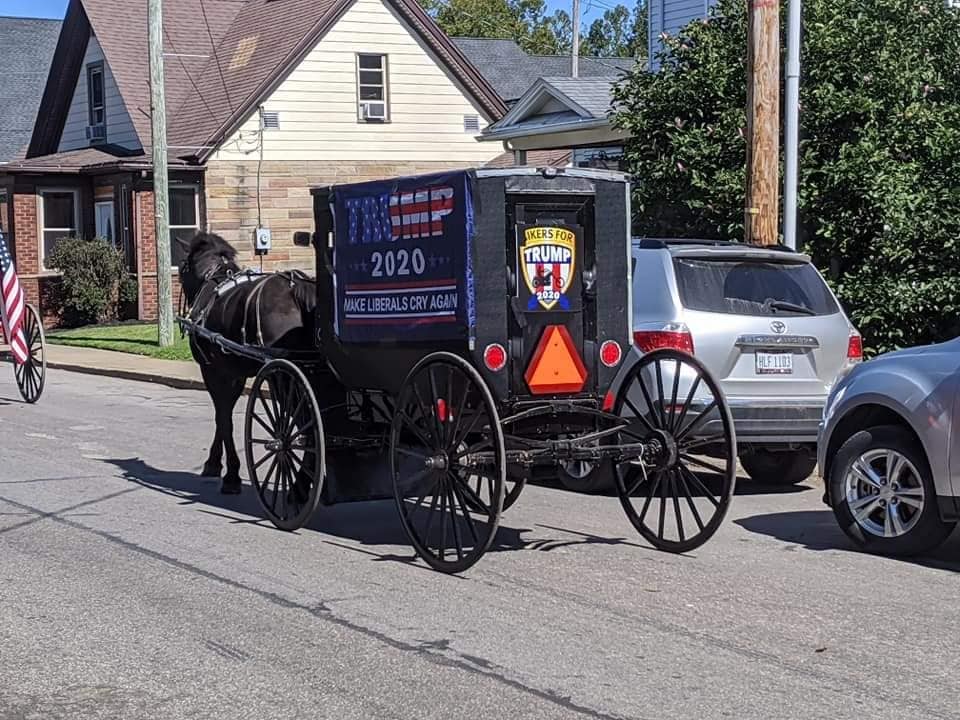
If you watched President Donald Trump’s campaign speech in Pennsylvania earlier this week, you may have seen some unexpected attendees in the background: three Amish men.
Turning and pointing to them, Trump remarked, “We have Pennsylvania Dutch…but they’re not known for going out and voting. Don’t tell anyone, but the Pennsylvania Dutch are voting en masse.”
The Amish men returned the president’s gesture with grins and thumbs up.
Trump was in Lancaster, Pennsylvania—famous as a center of America’s Amish population—to energize support in a battleground state.
Another large Amish settlement, in Camden Township, Michigan, lies just twenty minutes south of Hillsdale on the border of Ohio and Indiana.
Dairy cows stroll through fields of orange pumpkins, planted to help honey bee pollination. Buggy wheel marks run along the roads. The Amish community, marked by its well-kept white farmhouses and black horse-drawn buggies, settled in Camden in 1956 through the efforts of Swiss-rooted Amish from Allen, Indiana. These Amish speak a Swiss dialect of the German language, distinct from the majority, who speak the Pennsylvania Dutch dialect.
According to Hillsdale College Professor of Philosophy and Culture Peter Blum, the Swiss Amish are “more conservative” compared to other Amish groups. One can usually distinguish them by their plain black and dark blue clothing and open-top buggies, which they ride even during the winter.
Despite their reputation for austerity, the local bishop welcomed me with a warm smile. He told me more than 15,000 Amish people live in Michigan and that his settlement is one of six that surrounds Hillsdale. It might seem that Amish voters are a decisive but overlooked factor, considering that Trump defeated Hillary Clinton in Michigan by only 10,700 votes, the narrowest margin of any state in 2016.
So, could the local Amish vote swing Michigan for Trump next Tuesday?
According to the bishop, no.
The bishop, as well as others in the Amish community, asked not to be named because they don’t want to draw any attention to themselves or their community. Typically, the Amish don’t give their names to the press or allow photos to be taken of them.
He said he did not know of any Amish in Michigan who plan to vote this year. In fact, he guessed that the Michigan Amish have never voted.
“Mein Reich ist nicht von dieser Welt.”
“My kingdom is not of this world,” quoted the bishop from Jesus’ words.
He said the Amish believe in separation between Christ’s heavenly kingdom and the divinely-ordained governments that rule the earth.
“The trouble in Switzerland when our forefathers were persecuted,” he continued, “comes from when the state and church were one.”
“Voting isn’t something that Jesus commented directly on, but we can find old guidelines for the Amish religion, 400 years old, that discouraged an occupation like being a judge or being picked for the jury,” he said.
All of the Amish in Camden who I spoke with confirmed the bishop’s view. “No, we don’t really believe in voting,” said one woman emphatically. “We think we should rather just pray for the government.”
So, if Camden’s Amish seem flatly against voting, why did Trump brag about his Amish supporters last Monday?
Researchers at Elizabethtown College in Lancaster County, Pennsylvania, Kyle Kopko and Steven Nolt, found that a little more than 1,000 Amish people from Lancaster voted in the 2016 presidential election—only 6.5 percent of Amish who were eligible to vote.
According to Nolt, the difference between these Lancaster Amish and other Amish groups, such as those near Hillsdale, is assimilation. Many Amish in Lancaster own businesses, serve in the community, and have developed a sense of civic identity.
In 2016, the Amish Political Action Committee, attempting to encourage Lancaster Amish to vote, advertised Trump as a “hardworking businessman” and pro-life candidate. According to Blum, the Amish often say, tongue-in-cheek, “Even though we don’t vote, we pray Republican.”
The bishop from Camden acknowledges that those in Michigan are less assimilated than their Lancaster brethren, but also suggests that their restrictiveness is good for the community.
“So many times when somebody decides that they’re done with the way their parents did things, his children won’t stay where he went either,” he said. “They just continue the progress.”
“We have a lot of things to be thankful for that we was taught,” he concluded.
The Amish resistance to progress has often put the Amish at odds with the government, however. Amish religious beliefs have periodically come under attack, from the imprisonment of conscientious objectors during World War I, to Supreme Court cases over compulsory public education in the 1970s, to Obamacare’s contraceptive mandate for businesses in 2014. In Michigan and elsewhere, the Amish have disagreed with public officials over buggy regulations such as requirements to display reflective markers.
In January of this year, Lenawee County health officials filed suit and threatened to demolish 15 Amish homes over their use of outhouses instead of indoor plumbing. This Amish settlement, only a short drive from Hillsdale, was not the first one to receive similar charges from health officials.
The bishop, however, said he believes his community will remain true to their faith, living a simple life, no matter who is elected president or whatever government is in charge.
“There’s always a small portion of people who wish that the Amish would somehow disappear. But most generally, we’re well-accepted,” said the bishop.
“And it has a lot to do with our people being honest and living a life like we profess to do. It would be very sad if we lose that respect.”
