
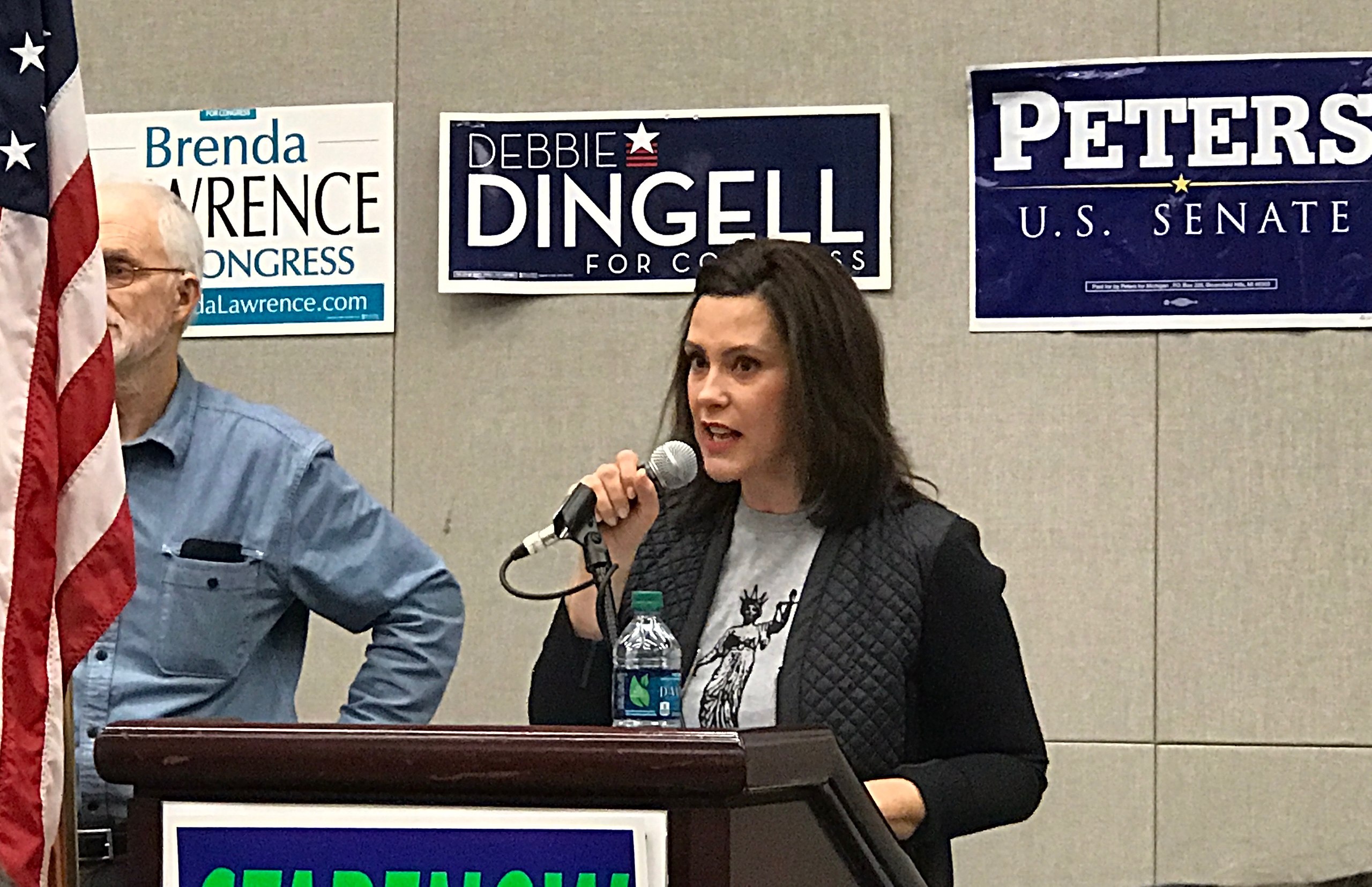
Gov. Gretchen Whitmer’s executive orders are no longer legally enforceable, according to a Michigan Supreme Court ruling on Monday. The ruling follows the state Supreme Court’s decision from nearly two weeks ago which established that the law Whitmer used for her emergency powers violates the Michigan Constitution.
Justice Stephen Markman, a distinguished visiting professor of politics at Hillsdale College who has taught constitutional law at Hillsdale since 1993, wrote the majority opinion in the case, saying that the Emergency Powers of Governor Act of 1945 violated the state constitution’s nondelegation doctrine.
“We conclude that the EPGA is in violation of the constitution of our state because it purports to delegate to the executive branch the legislative powers of state government,” Markman wrote in his opinion. “As a consequence, the EPGA cannot continue to provide a basis for the governor to exercise emergency powers.”
Since March, Whitmer has relied upon the 1945 law and the Emergency Management Act of 1976 to declare 140 COVID-19-related executive orders. The Michigan Supreme Court ruled 7-0 against Whitmer’s use of the 1976 law for her emergency powers, as the law provided that the governor must have legislative approval in order to extend a state of emergency after 28 days.
The ruling striking down the Emergency Powers of Governor Act was a narrower 4-3 decision. Michigan Supreme Court justices are elected on a nonpartisan ballot but are nominated by parties. The four Republican-nominated Justices ruled against Whitmer, while the three Democratic-nominated Justices held that her use of emergency powers was constitutional.
“With a case load exceeding 200 cases a month, it’s usually unpredictable which of our decisions are going to be given media attention,” Markman told the Collegian. “It was not particularly surprising that this was such a case.”
The plaintiffs in the case were four west Michigan medical providers and a patient seeking knee surgery. The lawsuit was filed on behalf of the plaintiffs by the Mackinac Center for Public Policy in May, when an executive order banned elective medical procedures.
“We want to have a system of government that works according to our constitutional system,” Mackinac Center Vice President for Legal Affairs Patrick Wright said. “A single person ruling a state of 10 million people is not freedom-inducing. What the governor was proposing was counter to that and, as we felt and the Supreme Court agreed, unconstitutional.”
Following the Supreme Court’s first decision on Oct. 2, Whitmer released a statement in which she called the decision “deeply disappointing,” saying that she “vehemently disagrees with the court’s interpretation of the Michigan Constitution.”
In the same statement, she also claimed that her executive orders remained in effect for another 21 days after the ruling. Two days later, however, Attorney General Dana Nessel announced that she would no longer enforce any executive orders issued under the unconstitutional 1945 emergency powers law.
The nullification of Whitmer’s emergency powers was further settled earlier this week when the Supreme Court concluded that “the executive orders issued under [the 1945 law] are of no continuing legal effect.”
The court’s decision “leaves open many avenues for our governor and legislature to work together in a cooperative spirit and constitutional manner to respond to the COVID-19 pandemic,” the order said.
The ruling came from a second lawsuit brought in May against Whitmer by the Michigan legislature. The effort was led by Senate Majority Leader Mike Shirkey and Speaker of the House Lee Chatfield. Shirkey praised the Supreme Court’s rulings.
“The Michigan Supreme Court opinion and their follow up ruling provides much needed clarity regarding the 1945 Emergency Governors Management Act statute,” Shirkey told the Collegian. “It was a huge victory for Michigan citizens, upholding our Constitution and the very important and fundamental concept of balance of powers.”
Both Shirkey and Chatfield have conveyed their desire to work with Whitmer now that she can no longer act unilaterally in dealing with the pandemic.
“It’s time for us to get together with equal positions at the table and get back to a regular ordered legislative process,” Shirkey said in an interview with Radio Free Hillsdale.
Whitmer has since relied on the Michigan Department of Health and Human Services to issue orders similar to her original mandates. Employing a 1918 law enacted after the Spanish Flu, MDHHS Director Robort Gordon issued an emergency public health order last Friday that reinstituted mask mandates and restrictions on gathering sizes and restaurant capacity.
While lawyers at the Mackinac Center said they see these new provisions as a potential way for Whitmer to get around the Supreme Court rulings, they also noted that the new orders are much less burdensome than the earlier ones.
“A lot of the things that the governor was doing in superseding certain statutes aren’t in the MDHHS orders,” Wright said. “So whether or not they are legal, they are certainly more narrow than what the governor was doing before.”
Though acknowledging that the new orders from the MDHHS do not have nearly the same broad reach of power, Shirkey expressed his frustration with Whitmer’s continued attempt to bypass the legislature.
“Now it appears our governor is attempting to ‘painfully stretch’ the Public Health Code to continue her rigid control over people and commerce in Michigan,” he said. “These actions deserve to be challenged. Unilateral governance has no place or role in America or Michigan.”
