
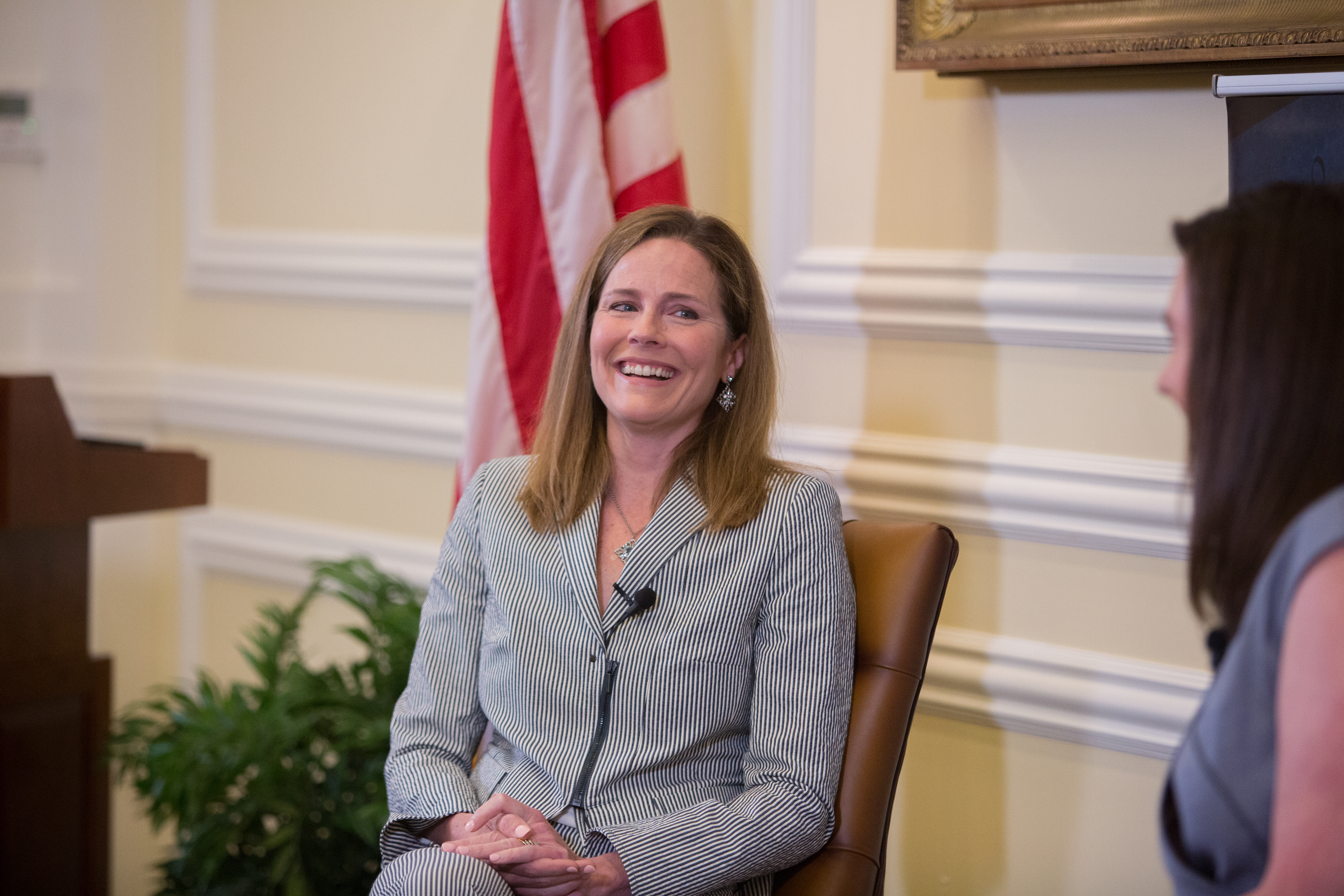
On Saturday, President Donald Trump appointed Amy Coney Barrett, a Notre Dame Law professor and U.S. Circuit judge to the United States Supreme Court. As Trump’s prospective third appointee to the court, Barrett is expected to undergo an expedited confirmation process as Senate Republicans work to confirm Barrett ahead of the November elections.
Barrett is a Notre Dame Law alumna, making her the first non-Ivy League law graduate to be appointed to the Supreme Court since Justice Sandra Day O’Connor, the very first woman to serve on the court.
For many Hillsdale students and faculty, Barrett has been a familiar name for some time. In May of last year, Barrett participated in a discussion on the responsibilities of the judiciary at the Allan P. Kirby Center for Constitutional Studies and Citizenship.
Barrett was also scheduled to address the class of 2020 during the college’s 168th spring commencement ceremony earlier this year before it was cancelled and rescheduled due to the coronavirus pandemic.
Barrett’s most recent visit to Hillsdale’s campus was in March 2018 when she spoke on the evolution of the Supreme Court at an event hosted by the Federalist Society. Professor of Philosophy and Religion Nathan Schlueter, who is the faculty advisor for Hillsdale’s Federalist Society chapter, jumped at the idea of bringing Barrett to campus.
“At the time, all of the things I saw and knew about her when she was a nominee for the circuit court were very impressive to me,” Schlueter said. “Her view is that the role of judges is not to read their own judgments about the natural law into their decisions, but to interpret the text as faithfully as possible.”
Schlueter noted that Barrett identifies herself as a prodigy of the late Supreme Court Justice Antonin Scalia, who is almost universally praised within conservative circles. Assistant Professor of Politics Adam Carrington expressed his delight over Scalia having been Barrett’s mentor.
“She would be in the mold of a Scalia textualist and originalist, and I think that that would be a significant improvement over Ruth Bader Ginsburg, the justice she is replacing,” Carrington said.
Carrington further noted the esteem that Barrett has garnered among her colleagues. Even those within her profession who vehemently disagree with her consider her among the best and most brilliant legal minds in the country.
Schlueter also mentioned that in addition to Barrett’s intelligence, her integrity will make it difficult for Democratic opposition to be too vocal during her hearings.
“They’re not going to find much personal dirt on her,” Schlueter said. “The only dirt they’re going to be able to find is going to come across as deeply prejudicial towards religious beliefs.”
Barrett became what Schlueter described as a kind of focal point for the culture war over religious freedom following a controversial comment from Senator Dianne Feinstein during Barrett’s confirmation hearing to the Court of Appeals in 2017. Feinstein told Barrett, “the dogma lives loudly within you, and that’s of concern.”
Because of this incident, Barrett’s Supreme Court appointment has been plagued by religious controversy. Barrett, a devout Catholic, has been disparaged by leftist critics for her traditional beliefs, including that of a woman’s familial duties.
Lecturer of History Dedra Birzer praised Barrett for being an example of a woman who meets the responsibilities of family life and also has a successful professional career. Birzer said that Barrett’s career exposes the false narrative that there must be a dichotomy between being a mother and having a career.
“That’s a false choice,” Birzer said. “Barrett has a big family, a really great marriage, a supportive husband, and she’s nominated to the Supreme Court at 48.”
Besides Barrett’s religious convictions, another point of controversy surrounding Barrett’s appointment has been Senator Mitch McConnell’s decision to rush through the confirmation process before the upcoming presidential election despite having refused to hold hearings for former President Barack Obama’s Supreme Court pick nine months before the 2016 presidential election. As a result, McConnell has been branded as hypocritical.
Carrington explained that McConnell’s treatment of the Barrett appointment has been both constitutional and actually largely consistent with what he said in 2016.
“As far as the consistency of McConnell, he didn’t just say that a vacancy in an election year was the only criteria to determine whether or not a vacancy should be left until after an election,” Carrington said.
McConnell also provided other reasons for refusing to allow former President Barack Obama to fill a Supreme Court vacancy in 2016. He referred to the results of the 2014 midterm elections that gave Senate Republicans more seats, portraying this as a mandate from the American people to delay filling any vacancies. McConnell also stressed the fact that Obama was a lame-duck President, meaning he was not up for reelection.
“According to those criteria, at least for now, it is entirely consistent to pursue confirming Barrett,” Carrington said. “If Biden were to win and the Senate were to flip, that nomination would still be constitutionally permissible, but it would be contradictory to what McConnell said in 2016.”
