
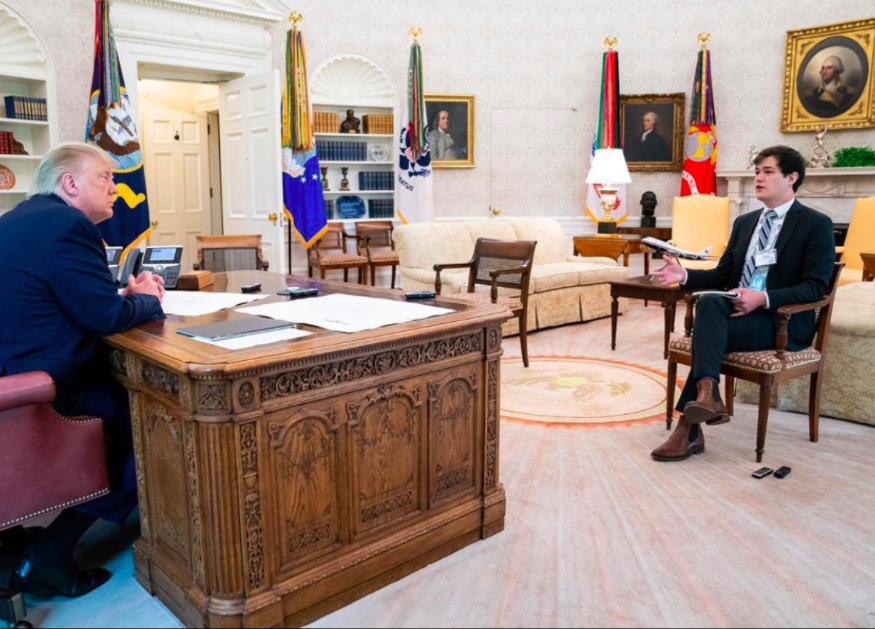
If there’s one thing Hillsdale alumni now working at RealClearPolitics have taken with them, it’s the virtue of properly understanding someone else’s argument, according to Hillsdale City Councilmember Bill Zeiser, a 2016 graduate of the Van Andel Graduate School of Statesmanship.
The political news site and polling data aggregate site founded in 2000 boasts four Hillsdale alumni on staff currently, including Zeiser; Mike Sabo ’15, editor of RealClearPublicAffairs; Philip Wegmann ’15, White House correspondent for RealClearPolitics; and Chandler (Lasch) Kuhlmann ’18, editor of RealClearReligion.
Now an editor of RealClearPolicy, Zeiser was a sophomore at Fordham University in New York when a faculty advisor told him he’d be branded as “an ultra-right wing radical” if he interned at National Review.
“That was 2001. If that’s radical right, what even is centrist?” Zeiser laughed.
But his advisor’s words pushed Zeiser to take an internship with New York Sen. Chuck Schumer instead of the journalism internship, which he credits with helping him understand arguments from all across the political spectrum.
“While no one would ever accuse me of being a Democrat, I learned from that experience in Schumer’s office,” Zeiser said. “I may have had a more direct path from doing National Review at that point, but I wouldn’t have gotten that experience.”
For Zeiser, this means pointing people to the best arguments from left, right, and center.
“In order to be good at that, I think it’s helpful to have a truly liberal education. You’re forced to take ideas that you might not agree with seriously,” Zeiser said. “This is an idea that is worth contending with. That’s pretty much what we do at Hillsdale.”
Both Zeiser and Sabo credit Hillsdale’s master’s program in political philosophy with honing their writing and thinking abilities. For his political science degree at Fordham, Zeiser said he studied technical details, like hegemonic stability theory, rather than the deeper philosophic ideas that underpin them.
“We were discussing hegemonic theory, a Cold War theory, in the early 2000s. So it was already out of date, even then. I realized I needed to learn more about the founding documents and the underpinning philosophies that lay behind my own beliefs,” Zeiser said.
For Sabo, though he grew up with a dad that read Imprimis regularly and knew about Hillsdale “for forever,” he only learned about Hillsdale’s grad program while working as a legislative aide in the Ohio House of Representatives.
After graduating from the master’s program in 2015, Sabo worked as a fellow in the B. Kenneth Simon Center for American Studies at the Heritage Foundation. While there, he began writing articles for The Daily Signal, Heritage’s in-house news publication. By March 2019, he was picking up part-time work for RealClear, and in August 2019 joined RealClearPublicAffairs full time, editing the American Civics portal, which aggregates civics resources for students, teachers, and anyone interested in learning more about America.
“In every Hillsdale class we wrote at least one large paper, of course,” Sabo said. “Well, when I’m compiling all these sub-pages, I’ve got quotes from the American founders, from all throughout American civics to pull from. Just the ability to know, ‘Oh, Lincoln said this in a speech at this point, that would be perfect for this page,’ — that’s so useful.”
Sabo said he still even refers to his class notes from time to time, to recall how Kevin Portteus, associate professor of politics, or Ronald Pestritto, dean of the Van Andel Graduate School of Statesmanship, responded to a certain topic.
“It’s the idea that citizens are made, not born. We have to form ourselves. And knowing the problems with civic education — we’re seeing it a lot this year, with the riots, the 1619 Project, the statues being torn down — I think there’s a huge need for civic education,” Sabo said. “To put the common ground and the unity we used to share as a country and say, how can we return to that? How can we make citizens? Thinking in that manner is basically behind everything I do at RealClear.”
Called “Cannon’s Law,” after RealClearPolitics Executive Editor Carl Cannon, who was a part of a Pulitzer prize-winning journalist team before joining RealClear, Zeiser said RealClear’s governing principle of journalism, like Hillsdale’s, is honesty.
“Cannon’s law basically means if you write something about someone, your words might be upsetting to them, but they should be able to see themselves” — rather than the writer’s political bent — “in what you have written,” Zeiser said.
This is especially important for editors like Kuhlmann, who runs the RealClearPolitics’ fact check review program, which examines fact check articles on sites such as Snopes, FactCheck.org, The Washington Post, and Facebook, to display their methodology. Kuhlmann also edits RealClearReligion.
“I think one of the things that was a really interesting take away from Hillsdale for me is that the liberal arts are not separate boxes,” Kuhlmann said. “They really bleed into each other and that’s where the interesting discussions happen. Especially in this job dealing with questions of religion — that overlaps with philosophy, and politics, of course, and so many other things.”
While Zeiser said he immediately began looking for Hillsdale students to bring on board since joining the company officially in December 2018, he had “nothing to do with Wegmann.”
“He’s just a testament to how good Hillsdale is. Phil Wegmann is out there kicking butt in the world as our White House correspondent,” Zeiser said.
Wegmann, who majored in history and politics while at Hillsdale, said he wished he’d gotten involved in journalism sooner.
“In a lot of ways, journalism is the definition of the liberal arts,” Wegmann said. “You get the opportunity every day to admit there are things you don’t know, figure out what the question is, and find answers. It is truly a pleasure.”
Wegmann, who has worked as White House correspondent at RealClearPolitics for about a year and a half, frequents the White House press pool, and even interviewed President Donald Trump in the Oval Office. He spent the first half of 2020 on the Democratic presidential campaign trail in Iowa until coronavirus restrictions sent him back to Washington, D.C.
“A lot of things just require you to be in the right place at the right time, to have your antenna up,” Wegmann said. “A lot of things we learn at Hilldale are the deeper, esoteric things. You have to dig down deep to understand those things fully, and that applies to my job today.”
The biggest thing he’s kept since graduating, however, was the value of work ethic, Wegmann said.
“Hillsdale just teaches you how to work hard. If you can write a 20-page term paper in two days, you sure as hell can write a 1,200-word piece in six hours. Do I remember a lot about German unification? Not really. I love Doc Conner, but to be honest I don’t remember a lot about that episode in nineteenth century Europe. But what I do know is how to understand things a little more quickly, and I think that’s a product of Hillsdale.”
