
How do you govern a country with 500 cheeses?
On Monday, the International Club hosted an event to discuss how European nations can maintain their distinct languages and cultures, without disturbing the current balance of power.
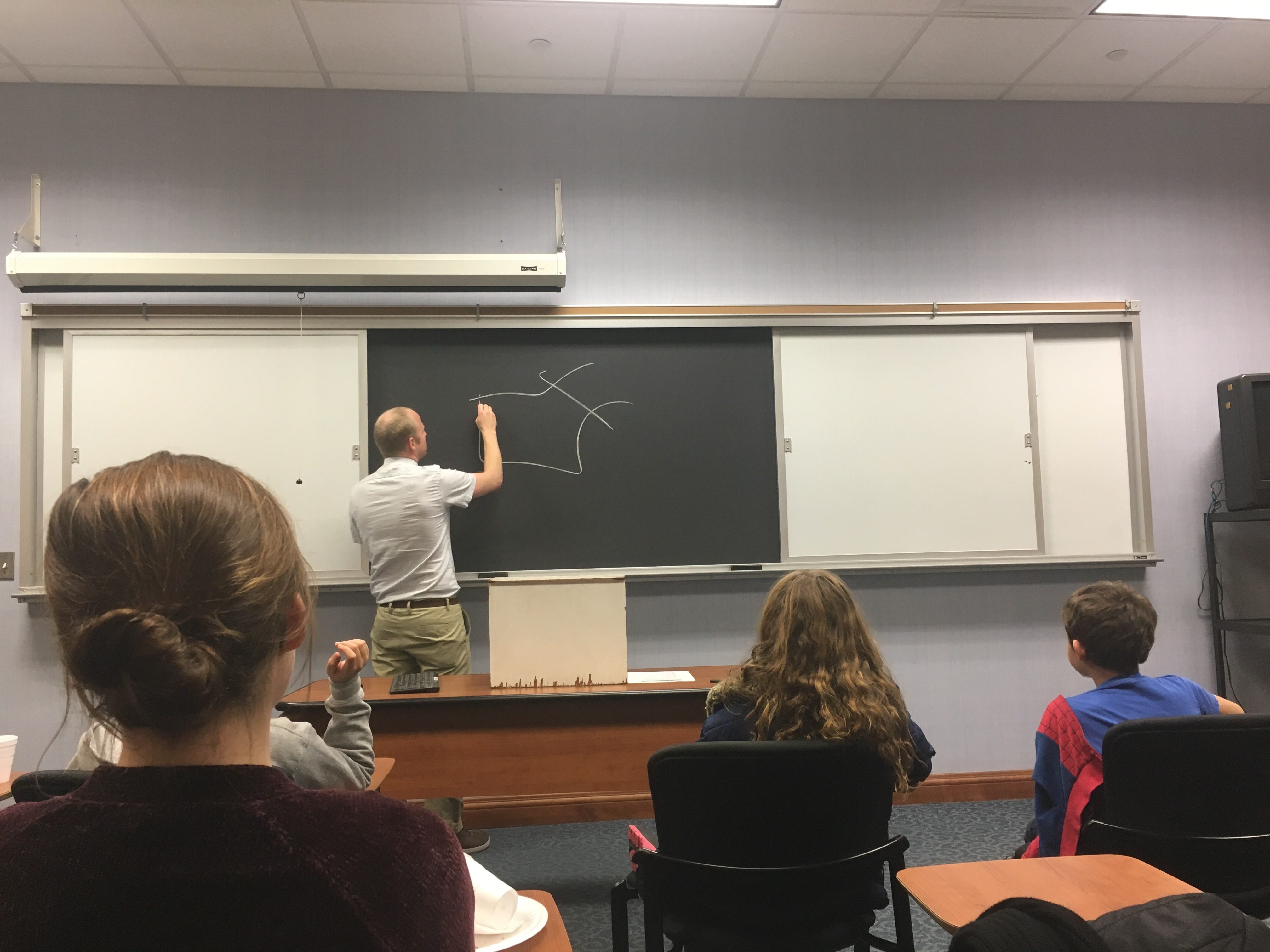
The speakers, Marie-Claire Morellec, chair and professor of French, and Assistant Professor of Spanish Todd Mack, discussed current events in European politics, and much of the history that led to them.
Immigration in Europe
Morellec, a native of Brittany in west France, explained that the formation of the European Union after World War II was a good idea because it encouraged Europe to rebuild after three destructive wars — the Franco-Prussian war and the two world wars. However, she added that many complications came with the creation of the union, most significantly the vastly disparate cultures, languages, and histories the union would have to represent.
“How, when you belong to such a large entity, do you retain your independence?” Morellec asked. “How do you manage to have, on the one hand, laws that are French law and then on the other hand European laws? Well, you often complain.”
Though the European Union consisted of six countries initially, it’s grown to include 27. This expansion caused problems for Europe not just culturally but also linguistically, she explained.
“There are 23 official languages in Europe,” Morellec said. “That means 23 different histories. That means 23 different cultures. That means 23 different ways of looking at life, in some cases. We have things in common, but still, that is the complexity of the European Union. It’s a grand idea, but it’s very complicated.”
Morellec explained that even within France, there are many different ways of doing things — such as making cheese.
“There are about 500 cheeses in France,” she said. “How do you govern a country where there are 500 cheeses? That’s not even talking about the wine that goes with the cheese. It’s difficult. That incredible diversity and that incredible identity — when it’s challenged by the European laws and rules, and it’s starting to totally disregard who you are or how you do things, like making cheese, that is a problem.”
But Morellec said there are bigger problems at hand than whether or not Europe can tell France to make Camembert with pasteurized milk instead of raw.
“There is a big issue with Europe right now, and it’s not milk; it’s immigration,” Morellec said. “Obviously, we can well understand that, because of the events in the Middle East that have been going on a long time. And we have a lot of refugees and immigrants that come from that area, but also from Africa. It’s not easy, because you don’t want people to be dying in the sea on some raft; you want to make sure these things don’t happen. But how do you manage that? It’s an incredibly large problem.”
She explained that in the past, waves of immigration were easier to handle because they came to France from other parts of Europe. The Algerians who came over in the 1960s spoke French, too, so the cultural differences were not huge.
“When you have people from Syria — poor people, I have to say, they don’t speak a word of French — they have to learn everything,” Morellec said. “That is a very different kind of situation.”
Revolution in Catalonia
Mack, who did his Masters’ in Spanish literature and linguistics and has spent time in Catalonia, walked students and professors through the long history of Spain’s civil wars.
He explained how the current conflict on the Iberia Peninsula began before Ferdinand and Isabella, and really developed when the two regions of Castile (present-day Madrid) and Aragon (present-day Catalonia) fought over who would succeed the Hapsburg family.
“The Catalans backed one guy and Castillians backed a guy from France, Felipe V of Anjou,” Mack said. “Felipe wins, and he is not happy with the Catalans. He establishes really strict laws against them. So the Catalans will say ‘Since 1714, we have been disrespected by the king of Spain.’ And it’s hard to say they’re not right.”
This conflict escalated after the Catalonians tried for freedom again in 2006, and elected a president who promised to pass a law allowing the Catalonians to vote for their independence. Spain’s current constitution says the country is indisolveable; when the law passed, it was repealed four years later. In 2017, however, Catalonians voted, and 90% of voters chose independence.
“Now, leaders are in a pickle,” Mack said. “They have said they will do what the election says, and the election said ‘independence.’ The Spanish government revoked the Catalans’ autonomy, called different elections, and arrested a bunch of the leaders of this rebellion against the Spanish state in 2017. In October of this year, the Supreme Court sentenced against these leaders of the rebellion, and the most important leaders got up to 13 years in prison.”
If Catalonia successfully earns independence, it could upset the stability of Europe as other small countries see them as an example, Mack explained.
“You’re willing to turn the world upside down — that’s what people said about the American Revolution,” he said. “An independent Catalonia that somehow is able to break away from Spain would turn Europe; it would be a big deal.”
President of the International Club junior Nico DeEnrique said the event went really well, and he was especially touched by Mack’s presentation, as a native of Spain.
“I have my own interests in Europe because the Catalonia-Spain controversy is in front of me, being from Spain,” DeEnrique said. “So I know what it’s like. There’s this cultural identity problem. And having Dr. Morellec explain that from a broad perspective and then Dr. Mack being more specific and talking about history and how that influences the economy and the political situation of the country — it was very cool.”
