
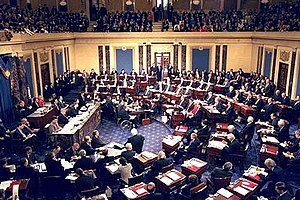
As impeachment proceedings begin, the Republican Party and conservative media are quick to defend President Donald Trump.
Based on testimony and phone transcripts, we know Trump tried to leverage federal funds to pressure the Ukrainian government into investigating and supplying information that could damage 2020 presidential candidate Joe Biden.
The specifics of the situation are trivial. Democrats focus on the offer itself as an example of a quid pro quo, and are currently hearing testimonies from different officials who have knowledge of the situation. So far, several witnesses have supported the quid pro quo narrative, signaling that Trump committed some level of wrongdoing.
The next step for both Democrats and Republicans, seeing the overwhelming evidence, is arguing over the legality of Trump’s actions. It’s a complicated question that I, far from a legal expert, will leave alone. But the standard itself is worth questioning.
In National Review, Victor Davis Hanson wrote a scathing critique of Rep. Adam Schiff, D-Calif., and the impeachment inquiry. Hanson wrote that witnesses in the inquiry were “incoherent” regarding their ability to describe a violation of the law committed by the president.
“They never cite knowledge of presidential crimes but feel that Trump is dangerous,” he wrote.
Of course, he’s correct. No witness explicitly confirmed that Trump broke the law, namely because the law in this domain is incredibly complex. That said, an impeachment proceeding and successful unseating of a public official does not require any criminal violation whatsoever. This is where Hanson and others make a critical mistake.
Article II of the Constitution defines a valid impeachment as concerning “treason, bribery, or other high crimes and misdemeanors.” Treason and bribery are usually well-defined in the legal world, but the meaning of “high crimes and misdemeanors” is legally ambiguous and undefined within the constitution.
Luckily, Alexander Hamilton wrote about impeachment in Federalist 65. During the constitutional convention, many framers disagreed whether impeachment powers should reside in the courts, the legislature, or an entirely separate body. Some even thought it should be left to state governors.
Eventually, the legislative view won out, which Hamilton justified in Federalist 65. In doing so, he illuminates the nature of impeachment.
The legislature has the ability to impeach based on “offenses which proceed from the misconduct of public men, or, in other words, from the abuse or violation of some public trust. They are of a nature which may with peculiar propriety be denominated political, as they relate chiefly to injuries done immediately to society itself.”
The Congressional Research Service agreed with this view in a 2015 report.
“The notion that only criminal conduct can constitute sufficient grounds for impeachment does not, however, comport with historical practice,” the report said.
A few paragraphs later: “‘Other high crimes and misdemeanors’ are not limited to indictable offenses, but apply to ‘serious violations of the public trust…’. ‘High Crimes and Misdemeanors’ are thus best characterized as misconduct that damages the state and the operations of government institutions.”
Put simply, the legislature can choose to impeach a president, or any public official, for virtually any act it deems corrupt or an abuse of power. Our standard is no longer limited to illegality but includes “abuse or violation of some public trust,” and therefore we can understand impeachment in a much broader, contextualized sense.
How does this relate to Trump? If the legislature can bring impeachment articles against him for any abuse or violation of public trust, it can do much better than the relatively minor Ukraine scandal.
There are dozens of examples of Trump violating this principle, like when a lobbyist representing Saudi Arabia paid to stay for 500 nights at the Trump Hotel in Washington, D.C., or when Trump approved a military raid in Yemen which killed an eight-year-old American girl. The legislature could bring articles for campaigning on a Muslim travel ban, hiding his tax returns, or even refusing to pay contractors that work on his buildings.
Here, a problem unfolds. If any violation of public trust is an impeachable offense, virtually every president in U.S. history, as well as thousands of department heads and other public servants, could — and should — have been impeached.
Perhaps former President Barack Obama should have been impeached when he authorized a drone strike on untried U.S. citizens. Or when NSA whistleblower Edward Snowden revealed the extent to which the executive branch, overseen by Obama, abused the law and violated privacy rights. Using our new standard, former President George W. Bush and former Vice President Dick Cheney could easily have been impeached for lying to the public about Saddam Hussein’s association with weapons of mass destruction and al-Qaeda.
High-profile impeachment proceedings, as they are currently used, represent the whims of party alliances and power dynamics rather than any semblance of justice or fairness. Recall that former President Richard Nixon was impeached in relation to documents stolen from the Watergate building, not for carpet bombing Vietnam and killing millions of people.
How did we stray so far? Every thoughtful American recognizes how corrupt and abusive our government is. Excusing war crimes, explicit lies, and horrifying violations of our privacy signals to public officials that this type of behavior is acceptable.
Maybe this interpretation is exactly what America needs: a mass impeachment of corrupt public officials who abuse their power and violate our trust. Let’s start with Trump.
Cal Abbo is a junior studying psychology and a columnist on Democratic politics. He is an assistant features editor for The Collegian.
