
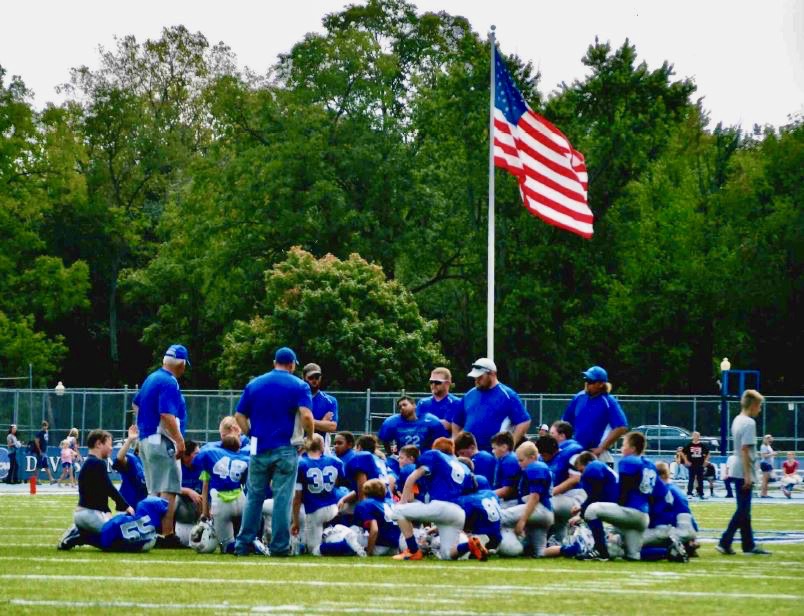
NFL players suffered 281 concussions in 2017, more than any in each of the previous five years, and parents in Hillsdale are taking note.
Youth participation in local football has severely declined, although this effect hasn’t reached the high school level yet. Hillsdale High School Athletic Director Dave Pratt said during the three years he has been at the high school, participation has remained stagnant with around 60 to 70 team members each year.
Across the nation, high school 11-player football is down 9.6% from its 2008-2009 season, according to the National Federation of High School Association’s latest participation survey, released in late August.
Youth football is on the decline on the national level, and many coaches, parents, and players say the cause is the concussion-scare that developed earlier in the decade.
The City of Hillsdale’s Recreation Director for 13 years, Michelle Loren, said the Hillsdale football program for students below the high school age is suffering from fewer numbers at a higher rate.
Loren said prior to her taking over the position, the football program was more dangerous than today. She and Chad Culbert, the Board of Public Utilities Executive Electrical Superintendent, came in at the same time and revamped the program from what it was before.
“It was pretty wild football at that time, almost out-of-hand,” she said.
Culbert aimed to get back to the fundamentals of football and restructured it to be safer for younger children. At the time, fathers voluntarily coached the teams, and Loren said many encouraged illegal behavior such as being intentionally tough on the field.
This behavior included ‘clothes-lining,’ or knocking someone down by grabbing their neck. To combat this behavior, Culbert paid closer attention to the coaching and modified the practices.
“It wasn’t supposed to be NFL football out there with these little boys,” Loren said.
The program had remained unchanged for over 20 years prior to the major changes with the coaching techniques. Loren said it used to be considered the best program to participate in, having 167 participants one year from all over the area, including Pittsford, Jonesville, Coldwater, and Adrian.
In 2012, the program had 70 boys, but decreased to 52 boys in 2013, which is the year that Jonesville pulled out of the program. Pittsford left shortly after, contributing to dropping numbers. Loren also observed that more boys are playing basketball, baseball, and soccer. Hillsdale’s club soccer is more popular than ever.
Although Loren said the program has gotten safer within the last 10 years, numbers don’t reflect this change.
Hillsdale College Head Athletic Trainer Lynne Nuekom said people are often more scared of concussions in football than they should be.
Concussions occur at a rate of 26.3% with youth football — the highest of any age group. That number has significantly increased from 10.4% only 10 years ago. The reason, Neukom said, isn’t that concussions are occurring more, but because trainers and coaches are better at recognizing and evaluating them.
Younger children involved in football, Nuekom said, are at a more dangerous risk. From ages 8 to 13, concussions expose children to the possibility of repetitive trauma to the brain since their brains are going through the most changes in that time period.
Youth football overall leads to more injuries. Next to concussions, the most common injury is ankle sprains. Nuekom said the reason kids are at the greatest risk is because their growth plates are still open and there are different types of fractures associated. And with growth, the bones develop faster than tendons do, so there is more stress on the bones. Typical ankle sprains often result in more serious fractures for that age group.
Different measures are in place now with the organization Heads Up Football which teaches teaching tackle techniques. Coaches undergo coaching certification, which now includes learning how to identify concussions.
Regarding concussion training at the high school level, Pratt said they train coaches to be on the lookout for any potential issues.
“As we learn more about concussions and the more we are prepared for them, it’s changed the level of awareness of our coaching staff as well as our trainers,” Pratt said.
In 2017, there were over 1 million children who played youth football. The injury rate is 4.7% for every 1,000 exposures, which Nuekom said is low.
Aside from injuries, one cause for the decline in football numbers Nuekom has noticed is early sports specialization, especially the increase of youth soccer.
“Every sport has injuries, but what people fail to remember is what sports offer: learning to win and lose, leadership, organization,” Nuekom said. “Injuries happen and we don’t want them to, but I think the good outweighs the injury.”
