
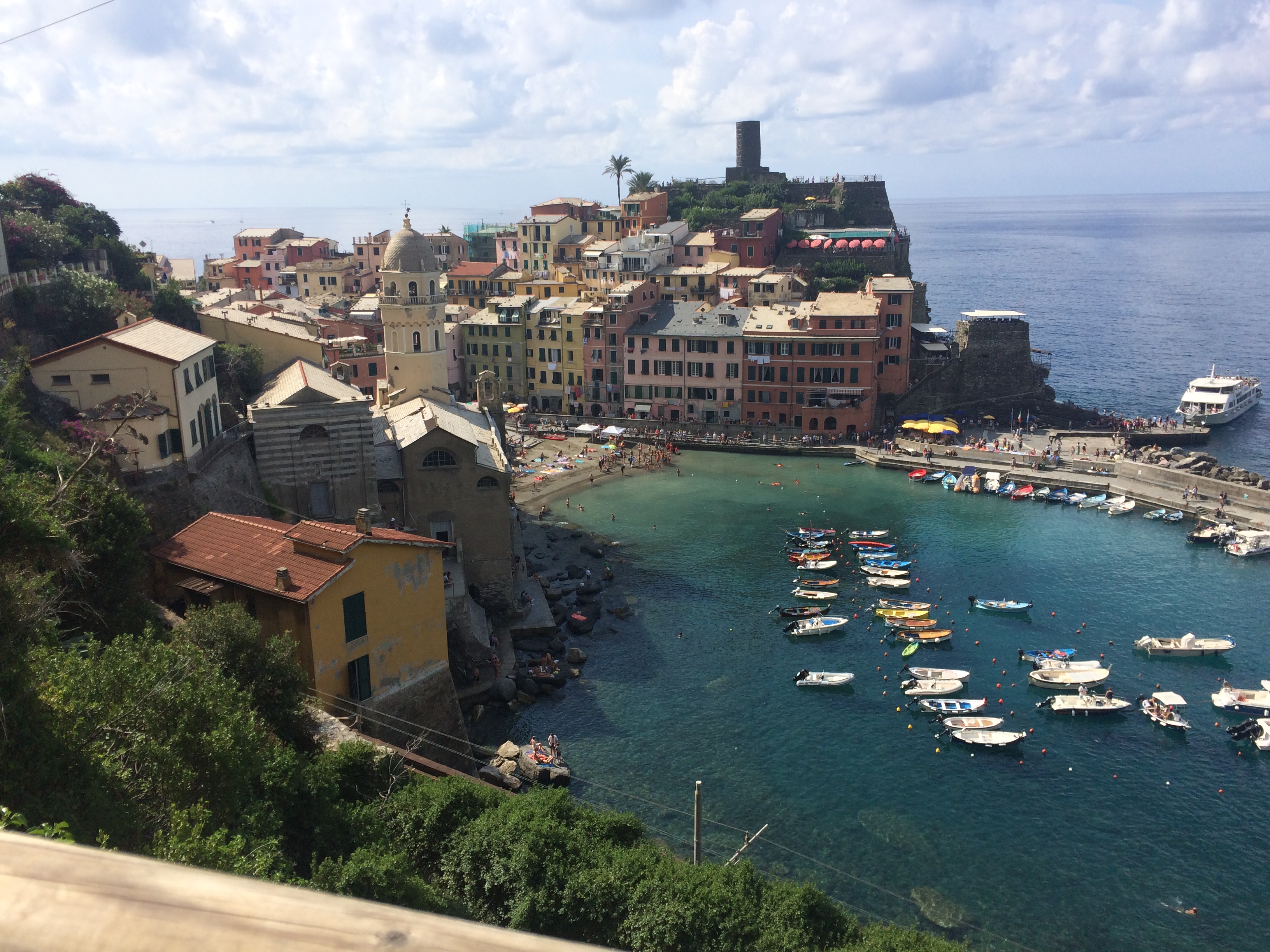
As I entered a crowded train in Genoa, Italy this August, I briefly met a pair of dark eyes. In a sea of huge suitcases and bulging duffel bags, this girl was only carrying a small, stuffed drawstring backpack.
My friend Aaron and I had already spent two weeks in Spain and Italy. We were flying to Greece that day—the last leg of our European grand tour.
That day had started well. Since we had hiked through the country’s most famous national park, the Cinque Terre, the day before, we took it easy—strolling through the town on sore legs and shopping for food and postcards before catching a series of trains to the airport.
Ours was the last train of the day and it was delayed.
There was standing room only in every train car by the time we got on, so we squeezed into the un-air-conditioned rubber floating platform between the last and second-to-last train car. Already, the dark-eyed girl and four others were crammed on the platform.
She looked up from her feet at us, moved over, then returned her gaze downwards.
It wasn’t easy to coax her into conversation. Her English was decent; we stumbled through a polite conversation with the occasional help of Google translate. She was returning from a weekend trip to the beach. No, she had never been down this way before. Yes, she took weekend trips alone often. Yes, she had only brought a small backpack with her.
As a first-born with an independent streak, I understood her desire to be free and roam. Yet, she had an independence in her that seemed deeper than my own. She told me that she worked at a car dealership while she was saving the money to go to flight school. She had always wanted to be a pilot, she told me, because she wanted to travel the world.
Unlike most of the locals we had met during our travels, who were interested in who we were and why we were traveling, I had to instigate most of the conversation with this girl. With effort, I learned that she was Albanian and had moved to Italy with her father after her mother died. She still lived at home with her three sisters and her cat, Crystal. She enjoyed camping, hiking, and mountain biking. She was three years younger than me and she owned a sports car because she liked to drive fast. She had never been to America but somehow, she possessed the same American grit and spiritedness.
Completely engrossed by her story and her fierce independence, despite our difficulty in communicating, I hardly noticed when we pulled into our station.
As the train stopped, I snapped back to reality.
“It was nice meeting you,” I said and she nodded and gave me half of a smile.
I lugged my 40-liter, 30-pound backpack off the floor. Aaron and I darted out of the train and zig-zagged through the station to our gate.
We had met many other fascinating people on our trip. Late nights in hostels offered us conversations with travelers from all over the world, people of every race, religion, and background. None of those encounters, however, are etched in my memory like the girl on the train with her small, stuffed backpack.
While separated from family and friends throughout our trip I had often reflected on the opportunity-cost of traveling abroad. A lengthy trip through Europe satisfied my adventurous itch but left other desires unrealized, namely time at home with my family after a summer away from them. That cost is missing from the lure of travel magazines and exotic Instagram pictures.
As our plane left for Greece, my mind was spinning. In a few days, I would be returning to the stability and familiarity of my life in the United States. For me, family and community is the norm and travel is the exception.
The girl I met on the train chose to live differently.
Travel, and all the uncertainty that goes with it, was her norm.
