
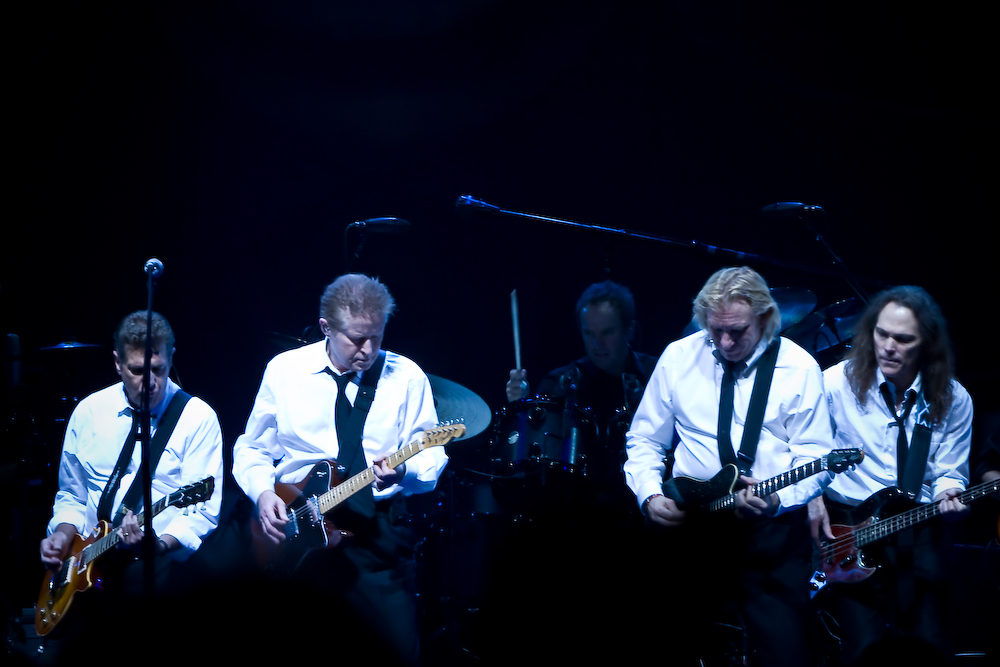
If you know one song by The Eagles, it’s probably “Take It Easy.”
The moody 1970s California rock band enjoyed enormous career success with that song from the get-go, success that continues into our own age. Despite a change of band members and a generation and a half of newer musicians on the market, no one can compete with The Eagles.
Strangely, however, no one knows their name.
I tell a friend I love The Eagles, and she hasn’t heard of them. She uses the now-colloquial phrase “life in the fast lane” and knows how to “take it easy,” but both references to Eagles hits are merely good songs to her, isolated from their creators. Another friend — a California-native, no less — knows the song “Hotel California,” but has never really listened to it; when I tell her the story of my sister appropriating the song’s tune but replacing the key phrase with “Hotel Del Coronado,” she doesn’t get the joke. When I mentioned my love of The Eagles to a colleague at work, he thought I meant the football team.
The Eagles are a phrase in the Gen-Z lexicon for which we have lost the etymology. While we struggle to identify the name, however, their music has left a lasting impression — an obsession, even — that developed into the genre of “chill.” It draws in equal measures on disco-era keyboard riffs and Americana folk. They captured the entire mood of the West in a sound. America has never been the same.
At the end of the summer, I was reading a Rolling Stones tribute magazine, a compilation of all the articles the magazine wrote about The Eagles over the years. Without fail, each article paused to appreciate the pure musical excellence of each track. “Take It Easy” may have been their original motto, but only a meticulous attention to detail and perfectionism — an obsession that almost destroyed the band on multiple occasions — created one heck of a feel-good sound in the process.
“My oh my, you sure know how to arrange things,” Don Henley, half of Eagles lead songwriting duo, croons in “Lyin’ Eyes,” a song about a girl who is cheating on her lover with a man on the other side of town.
And it’s true: The Eagles had a knack for arranging music that tapped into two different realms of nostalgia, both important to the flavor of American music. Nostalgia for the ’60s era of music that had just ended (“One of These Nights” could almost be a Bee Gees bop) paired well, it turns out, with nostalgia for American folklore that was the heart and soul of Western U.S.A. (see “Lyin’ Eyes,” “Peaceful, Easy Feeling”).
The signature smooth sound of older Eagles songs moved into a heavier rock influence as the ’70s turned into the ’80s, but the folk influence remained, grounding the more heady electric guitar of songs like “Life In the Fast Lane” by harping back to the founding documents of American music.
The Eagles mastered lyrics, too. Rock is notorious for being the music of rebellion — perhaps the reason it took so well in the U.S. — but “Hotel California” is a surprisingly moralistic song for a band whose members had a history of affairs and even some drug abuse. Henley and Glenn Frey, the duo that remained the Eagles’ constant source of songwriting success, detail not simply the destructive nature of a life of excess with an almost Montesquieuian tone, but also its psychological trap: “You can check out any time you like, but you can never leave.”
The Eagles don’t just decry the problems of America’s materialism; they also examine the Western easy-breezy vibe which defines so much of their music, and its potentially harmful effects.
“So I called to the captain/Please bring me my wine/He said, ‘We haven’t had that spirit here since 1969.’”
They play on the word “spirit” and the lack of it in modern American culture.
Where Springsteen was the spirited, high-school-drop-out of rock ‘n’ roll, The Eagles brought a more mature rebellion — and with it, a slightly darker tone. Their acute awareness of the times in which they were living made them a collective prophet of the trajectory of American culture.
More importantly, however, they produced some of the best feel-good tracks in the repository of rock ‘n’ roll. If rock defines culture, it’s an Eagles’ America I want to live in.
