
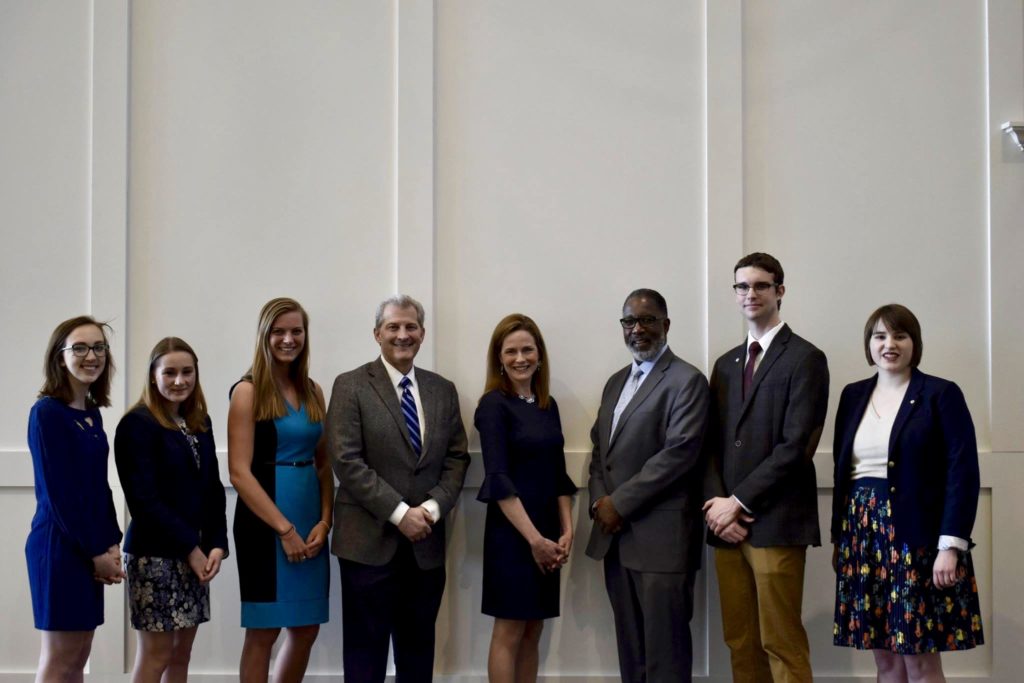
Three years ago, senior Anna Perry saw the need for a pre-law club on Hillsdale College’s campus. During this same time period, Justice Brian Zahra — who serves on the Michigan Supreme Court — approached College President Larry Arnn and Professor of Philosophy and Religion Nathan Schlueter about establishing a Federalist Society on Hillsdale’s campus.
In November 2016, Hillsdale became the second undergraduate program to have a Federalist Society on campus. Schlueter, the director of the pre-law program and adviser for the chapter, said he loves that Hillsdale has a Federalist Society.
“It’s a great honor at Hillsdale College, and I’m excited to be a part of it,” Schlueter said. “It’s really a great opportunity for our students at the college.”
According to its website, the Federalist Society for Law and Public Policy Studies was founded in 1982 and is made up of conservatives and libertarians dedicated to reforming the current legal order. The society is a membership organization that features a student division, a lawyers division, and a faculty division.
Executive Vice President of the Federalist Society Leonard Leo said the Federalist Society creates an environment where people can gain a deeper appreciation for the United States’ constitutional system and the ways it contributes to freedom and well-being.
“It’s very valuable to have informed, civil, and reasonable debates about the importance of the rule of law in terms of protecting the freedom and dignity of all people,” Leo said. “The Federalist Society provides a unique forum that does all of those things.”
Schlueter said that Leo is credited with selecting most of President Donald Trump’s court appointees.
“Leo is the head of our society and we have that association on campus,” Schlueter said. “That’s a powerful connection.”
Today, only three undergraduate programs have Federalist Society chapters. Rice University started its chapter in 2013, followed by Hillsdale College in 2016, and Princeton University in 2018.
Leo said most universities and colleges with law schools have Federalist Society chapters, and the undergraduate students can participate in the law school’s chapter activities.
“At some universities that’s a very extensive collaboration and some it’s less so,” Leo said. “It all just depends on the university community.”
Prior to starting a Federalist Society on campus, Leo said the senior management looks at the program’s proposal.
“The senior management of the organization decides whether it’s worth pursuing based on potential effectiveness and demand,” Leo said. “It’s not a matter that the board of directors has to vote on.”
Vice President and General Counsel of Hillsdale College Robert Norton — who has served on the litigation executive committee of the Federalist Society — said it was a logical step for Hillsdale to have a Federalist Society chapter.
“If there was a college worthy of some designation of being an outstanding potential Federalist undergrad, Hillsdale College stood head and shoulders above other choices,” Norton said.
He also said Hillsdale’s reputation continues to grow in the legal field.
“We know more about the Constitution, and our students are taught through the Socratic method,” Norton said. “They are excellent writers. They’re taught to think critically and read and write well.”
Perry, who was the first president of Hillsdale’s Federalist Society said the chapter’s first event included attending the Agraino Award Dinner for the Michigan Lawyers Chapter of the Federalist Society in November 2016.
“They host a big award dinner once a year to honor a reputable and important member of the society who’s done good work,” Perry said. “Justice Zahra was the person getting the award that year.”
After helping Hillsdale start its Federalist Society, Zahra bought a table for 10 Hillsdale students to attend the dinner and be recognized. Perry said she and the other students networked with appellate judges, federal judges, and Michigan Supreme Court judges.
“We took a picture with Michigan Supreme Court Justice Joan Larsen,” Perry said. “She was one of Trump’s short list nominees.”
Perry said the chapter began recruitment in 2017, which was difficult because it was the middle of the year. At its first meeting, Perry said about 75 students showed up.
Since 2016, the chapter has collaborated with Hillsdale’s Career Services to bring in speakers and people to help students preparing for the LSAT.
“Our main campus presence, even for people who aren’t going to law school, comes from speakers that we’ve had,” Perry said.
One thing Perry has learned in the past couple of years is that she can tell the speakers to give a graduate-level presentation because Hillsdale students already have a strong foundation in understanding the Western tradition.
“We don’t realize how blessed we are to have the classes that we do,” Perry said. “We can go deeper into really technical, legal, or philosophical things because our students are at a level where they can understand these principles.”
Abigail Allen, the Hillsdale chapter’s former vice president, said the Federalist Society has given her the opportunity to build a strong network with other members.
“I was able to gain a lot of advice from all the different people who I was able to interact with through the Federalist Society,” Allen said. “There’s a huge number of Hillsdale alumni who have gone to law school, who have worked with the Federalist Society, and who want to come back and help us. They’ve been great.”
Allen will be attending the University of Notre Dame Law School this fall. She said the network she has built within the Federalist Society has given her confidence going into law school.
“I have a network of people to support me in my career,” Allen said. “It’s very reassuring to be able to build that network as an undergraduate and be able to choose a law school in light of what I know.”
Last spring, Allen invited U.S. Circuit Judge Amy Barrett, a professor at Notre Dame Law School, to Hillsdale’s campus. Allen and a couple of other students had dinner with Barrett and discussed life, law, and ethics.
“When I started looking at law schools more seriously, her influence and her ability to explain her experiences at Notre Dame were really helpful,” Allen said.
Allen also said the study groups and various speakers helped prepare her for the LSAT.
For example, the Federalist Society teamed up with Career Services to bring in Josiah Kollmeyer ’14, who earned a perfect score on his LSAT and attended Harvard University Law School. Kollmeyer gave students advice to prepare for the LSAT.
The Federalist Society also brought in Daniel Cody ’18 who shared his 12-week LSAT study program with students.
In addition to bringing in alumni, the Federalist Society also held a series called, “What Can You do With a Law Degree.”
“We brought in job lawyers, intellectual property lawyers, traditional firm lawyers, people in academia with a law degree, and people in Council,” Perry said.
Perry said she will be taking two years off before applying to law schools because she is getting married to her fiance who currently lives in Dallas. She has learned about job opportunities in Dallas through the connections she established through the Federalist Society.
“We had Clark Neily come in to talk about how the criminal justice system worked,” Perry said. “Now I’m looking at jobs in the district attorney’s office in Dallas, because I had no idea that the criminal justice system is the way it is.”
Perry, an economics major, said she learned about how economics and incentives are involved in the criminal justice system.
“The Federalist Society exposed me to ideas that made me think about things,” Perry said. “Just being involved has made me think about things more than ever.”
One observation Perry had about the Federalist Society at Hillsdale compared to other campuses is that it does not face push back from the administration.
“We don’t have any debates that are that heated because we’re not going to find a faculty member who’s an opponent of something one of our speakers talks about,” Perry said.
Blake Delaplane started the Federalist Society at Rice University as a junior and said the first event the chapter held was met with resistance. The new chapter invited Charles Murray to speak about the true meaning of free speech on campus.
“We heard the school administration was providing supplies, free of charge, to protesters who were going to protest the event,” Delaplane said. “The day of the event, we had police everywhere. We had a packed auditorium, over 230 people. And then we had another 35 protesters outside, and here was heckling at the event.”
Delaplane said the event shook the Rice undergraduate campus.
“People began to think, ‘What does it actually mean to allow someone to speak on an issue I don’t agree with? Is this a place that is just an incubator for group think, or is it a place that is going to encourage intellectual curiosity and risk taking, and honesty,’” Delaplane said.
After the event, Delaplane said the chapter didn’t fade because of strong leadership and showing respect toward the administration at Rice.
“The key to making these groups successful is focusing their leadership on character,” Delaplane said.
Schlueter said the atmosphere at Hillsdale has fostered success within the Federalist Society.
“We’ve had success in getting students in at top law schools,” Schlueter said. “And those students have been successful at law schools.”
In addition to success at top law schools, Schlueter said more Hillsdale graduates clerk on the Supreme Court than the vast majority of law schools.
“The truth about a law school education is that nothing prepares you better than a liberal arts education because of the kinds of skills you need to know: close and careful textual reading, analysis, interpretation, and argument,” Schlueter said. “And that’s what we’re doing in the core anyhow.”
Norton said Arnn’s approach to education holds students to a high standard of excellence. This expectation, he said, allows students to succeed at difficult law schools and earn high positions in the legal field.
“Hillsdale graduates are known to be deep thinkers, honest individuals, and people who have high integrity,” Norton said. “And I think that’s what really has caused people to say, ‘There’s something different about the students at Hillsdale.’”
