
An overemphasis on the “great tradition” has led to provincial thinking among Hillsdale students and faculty, according to Robert Snyder, lecturer in religion.
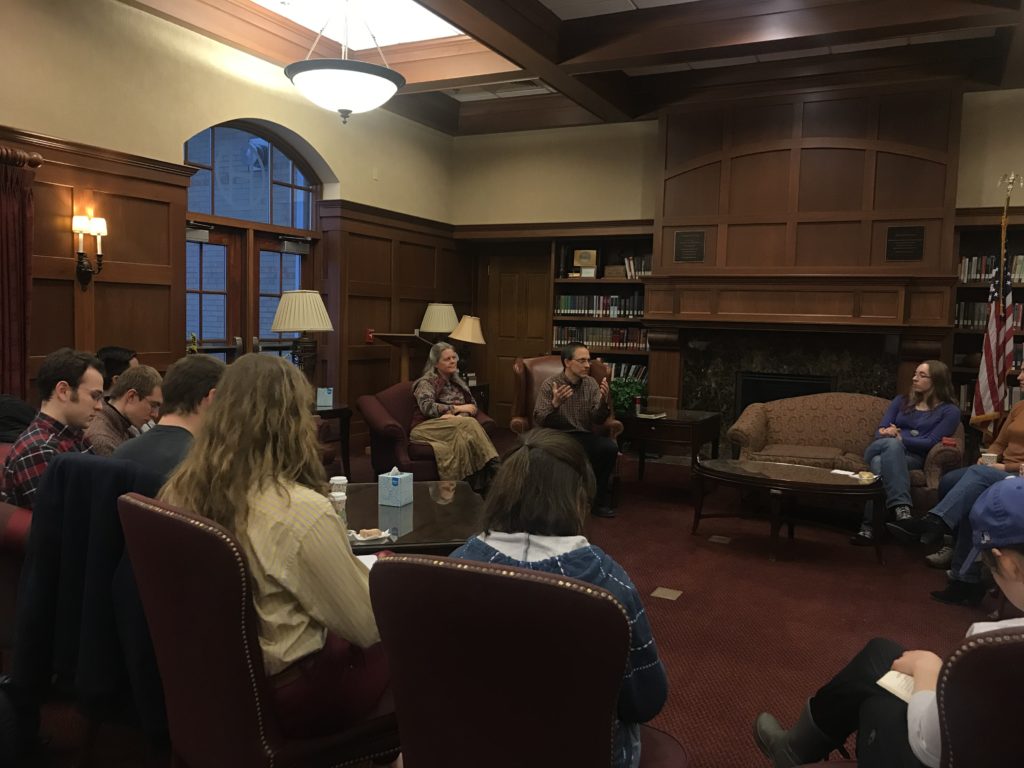
On Wednesday, Feb. 20, student apologetics club Aletheia hosted Snyder to give a talk entitled “Campus Debates, Provincial Thinking, and the Advent of Christ” in the Formal Lounge.
Snyder began with the concept of provincial thinking, which he defined as “being locked into a certain time, a certain space, and not really having a part of a larger conversation.”
Snyder said this is a phenomenon that occurs at Hillsdale, likening campus culture to a playing field.
“There are certain kinds of debates, and there are people that you quote and you don’t quote, and there’s a certain playing field that you play on,” Snyder said. “Meanwhile, nobody ever questions the playing field, but you never picked the playing field, you just stepped onto it.”
Snyder said Hillsdale students try to get out of provincial thinking by subscribing to the great tradition.
“So maybe, if we get in contact with the great tradition, and the great conversation that has gone on for centuries, we can get beyond provincial thinking — outside of space and time,” Snyder said. “In a large part, I think that’s your campus. I think your campus tries to do that.”
But Snyder is not convinced that strategy works. Rather, it has the opposite effect.
“You can bring in a ton of Greeks and quote them; you can bring in a ton of church fathers and quote them because that’s part of the game. It’s all being played that way. But it begs a couple of questions,” Snyder said.
Snyder pointed out that he is not convinced that classical thought is in continuity with Christian thought. Classical virtues such as temperance, fortitude, and justice, Snyder said, are all virtues achievable by the development of mere human abilities–man does not need God to achieve them.
Christianity’s virtues are different.
“Christianity’s virtues are faith, hope, and love,” Snyder said. “They are rooted and grounded in not what you do but what God does.”
The second question which comes up, Snyder said, has to do with the realm of truth. Citing Paul in 1 Corinthians, Snyder said God made sure, in His wisdom, that the world would not come to know God through its wisdom, or human reason.
Following this assertion, Snyder said ancient philosophers were not inspired by Jesus or the Holy Spirit, unlike what early church fathers point to.
“Jesus is not the underlying rationality behind all thinking people and ideas that come out of every thinking place,” Snyder said. “When you go to the way the Hebrews thought, Christianity is not the fulfillment of paganism; it is the fulfillment of the Old Testament. Hebrew culture was built on God speaking and God giving answers. Reason and rationality and wisdom start from there and goes out. That’s very a different picture from classical thought.”
Thus, according to Snyder, as long as we lean on the great tradition created by fallible human beings, we will still be in the throes of provincial thinking.
“I am suggesting that the whole playing field is still provincial. Even though it’s a big tradition — even though it’s spread over centuries — it’s still locked into space and time,” Snyder said. “It’s provincial because it’s trapped within the limitations of humans that can only see so much.”
The only solution to raise us out of provincial thinking, according to Snyder, is to get back to the authority of Scripture.
“The playing field which you have been handed takes out that authoritative quoting of outside Scripture,” Snyder said. “Unless the conversation gets pushed outside of its provincialism, back to the authority of Scripture, it’s still locked into time and space; it’s still finite.”
Students who attended Snyder’s talk responded well to his message and agreed with his conclusion.
Senior Christine Ausherman said she enjoyed Snyder’s lecture and was particularly struck by the concept of provincial thinking.
“I actually have never heard of provincial thinking before,” she said. “I was reminded that people we take as sources of truth are ultimately human.”
Senior Chloe Kookogey, president of Alethia, agreed with Snyder’s conclusion.
“I think he made an excellent point about the fact that there are better ways to achieve spiritual peace in terms of knowing what you believe and going back to Scripture and prayerfully approaching it and knowing that it is sufficient to answer our questions on salvation,” Kookogey said.
