
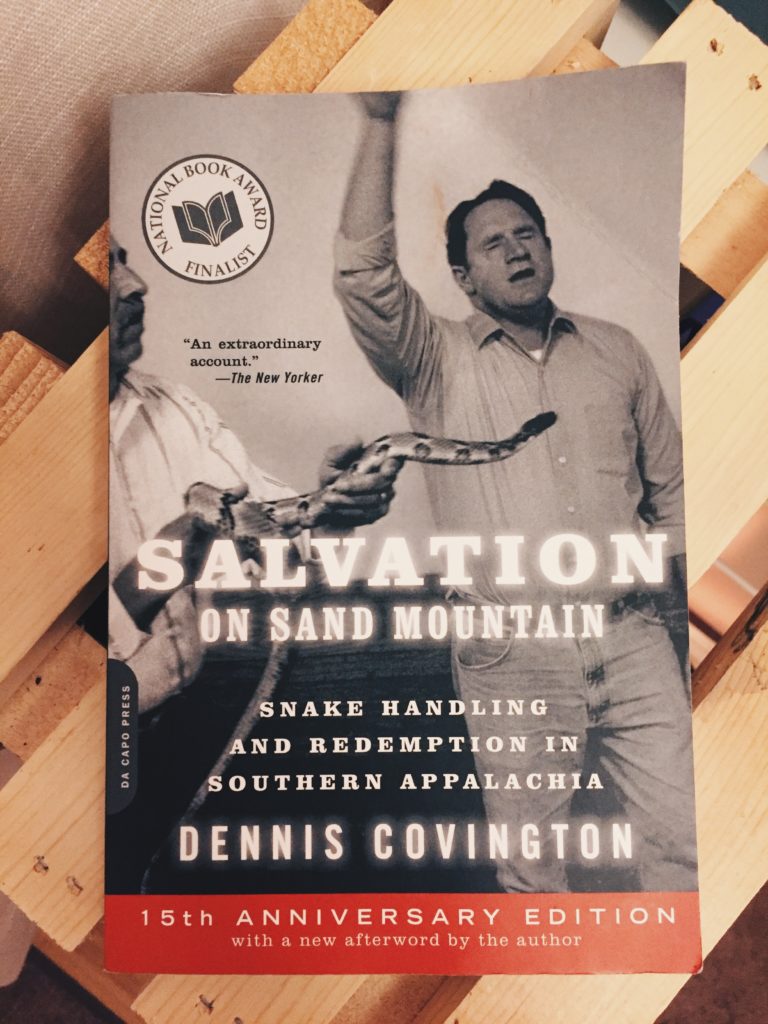
“Salvation on Sand Mountain” reads like a Flannery O’Connor story come to life. In her stories, men steal girls’ false legs and literally eat the pages of the Bible. In Dennis Covington’s book, snake handlers call down the Holy Ghost, cast out demons, and risk their lives each time they reach into the serpent boxes.
When Covington goes up into the Appalachian Mountains, he finds himself in the midst of spiritual warfare, with a congregation that takes up serpents and drinks poison to prove their faith. Churchgoers sling vipers around their necks and walk barefoot on the backs of rattlesnakes as if on a tightrope. Some get bit a hundred times; some die of the venom.
Covington enters their world as a journalist when he covers the trial of a snake-handling preacher accused of trying to murder his wife with rattlesnakes. It’s a dark beginning for a spiritual journey, but Covington leads his readers on his own pilgrimage to rediscover his roots and to unravel the mystery of the snake handling services.
A worse writer might have treated the handlers as a joke or an exotic specimen, but Covington treats them as human beings, with compassion. He befriends the church members, attends their services, and eventually takes up snakes himself.
For Covington, the snake handlers aren’t simply a backwoods oddity that can be dismissed. They reveal something about the vitality of the South, and represent the reaction of a religious people against a “hostile and spiritually dead culture.”
At first, Covington’s role as a journalist creates a distance between himself and his subject.. His personality is hard to define. What personal feelings and motives he does share, he tends to dissect conscientiously, as though with a scalpel.
But as he begins to lose himself in the snake handler’s services, Covington’s personality begins to emerge, and he becomes a character in the story himself. The boundary between journalist and subject crumbles, and the book transforms into something electric, alive with mystery and terror.
“It’s hard for me to talk about myself. As a journalist, I’ve always tried to keep out of the story,” he admits in the novel. Later, he adds, “I am excessively calculating, especially when I appear not to be, in order to avoid being shamed…but what happened in Jojo wasn’t calculated. I had experienced something genuine, and I was awed.”
In the moment Covington first takes up a serpent, a massive yellow-bellied rattlesnake that is “thick and melancholy,” he understands why the handlers handle, even though they risk dying.
“I, too, was fading into the white. I was losing myself by degrees, like the incredible shrinking man,” Covington writes. “I knew then why handlers took up serpents. There is power in the act of disappearing; there is victory in the loss of self. It must be close to our conception of paradise.”
Covington even preached in a snake-handling church himself once, but he parted ways with the handlers shortly afterwards, declaring that he had a vocation and a family to live for. Three of the handlers he knew are now dead of snakebites.
“Feeling after God is a dangerous business,” Covington writes. “And Christianity without passion, danger, and mystery may not really be Christianity at all.”
