
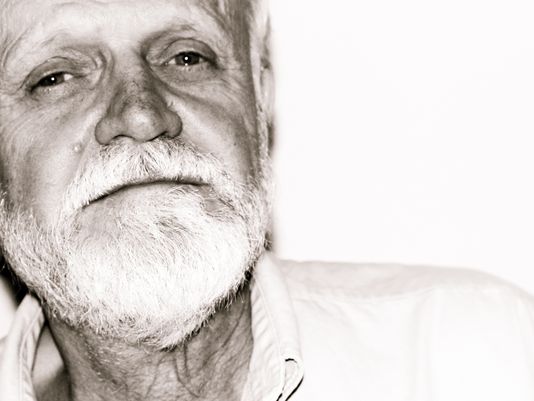
The small Dow A and B conference room bustled with eager students and excited professors who awaited author Dennis Covington’s reading from his renowned, “Salvation on Sand Mountain,” an account detailing his experience with Christian snakehandlers in the Appalachian Mountains.
Professor of English John Somerville Jr. invited Covington to speak on Feb. 18 as part of the Visiting Writers Program, which brings in well-known contemporary writers throughout the year to speak about their work and themselves with Hillsdale students.
“We’ve been doing this program for about 25 years now. We’ve had the pleasure of bringing many writers to campus, but one of my favorites is Dennis Covington,” Somerville said. “This is his third visit to campus.”
Sophomore Carmel Kookogey introduced Covington and highlighted his educational background from the University of Iowa’s Writers Workshop, from which literary giants Flannery O’Connor, Donald Justice, and Marilynne Robinson have also hailed.
His 1995 National Book Award finalist, “Salvation on Sand Mountain,” has the same genius.
Originally from Birmingham, Alabama, “city boy” Covington, chose to sport work-worn jeans, leather cowboy boots, and brown wide-brimmed hat.
“Hey y’all” were Covington’s first words. His native Alabama accent shown through.
“I’m a little hoarse, and I’ll be a little coarse later on,” he said.
But by God’s good grace, the hoarseness dissipated and failed to thwart his dramatic reading.
Giving liveliness to the people in his book, Covington conveyed the many speakers’ attitudes through his inflection, shaking his arms up and down when emphasizing a point, and even singing a deeply southern rendition of “I shall not be moved” with great vibrato.
Covington said he was extremely impressed by the faith of the people in the Appalachian church. Despite their poor economic statuses and lack of formal education, he said they were very well-versed in the Bible.
“They knew the Bible, backwards and forwards,The King James Bible,” he said. “Cause what the handlers say is, ‘if it was good enough for Jesus, it’s good enough for us.’”
The audience responded with laughter.
Perhaps the most climatic account of the night was the description of his involvement in a snake handling ceremony. He held the largest rattlesnake he had yet laid eyes upon.
Almost dreamlike, he said, “I didn’t stop to think about it. I just gave in. I stepped forward and took the snake with both hands.”
“I knew then why the handlers took up serpents. There is a power in the act of disappearing; there is a victory in the loss of self,” he said.
“It must have been close to our conception of paradise, what it’s like before you’re born or after you die,” he said.
The periodic pauses from his dynamic readings allowed the audience to hear anecdotes about other dangerous encounters in his field.
Some notable encounters included: getting punched in the face by a member of the Klu Klux Klan, having his Jeep torched by a group of hunters, and surviving a firefight with a Salvadoran army patrol.
“To Mr. Covington, his life seemed more interesting told in stories,” said junior English major Henry Brink. “Everything he did seemed commonplace to him because they were just everyday things.”
Covington said that he chose to search for stories in the most dangerous spots because there is little competition.
“You can’t doubt he experienced the things that he wrote about,” junior English major Dietrich Balsbaugh said. “After hearing him read, you knew that he knew it was real, whether or not you’ve experienced it. Especially something as outlandish as the handlers.”
Despite all the carnage he has witnessed, the personal pains he has endured, Covington sees God in those who persevere through suffering.
Even though he has experienced both thrill and terror in his adventures, Covington takes the greatest joy and comfort in one of the simplest activities: walking his grandchildren home from school.
