
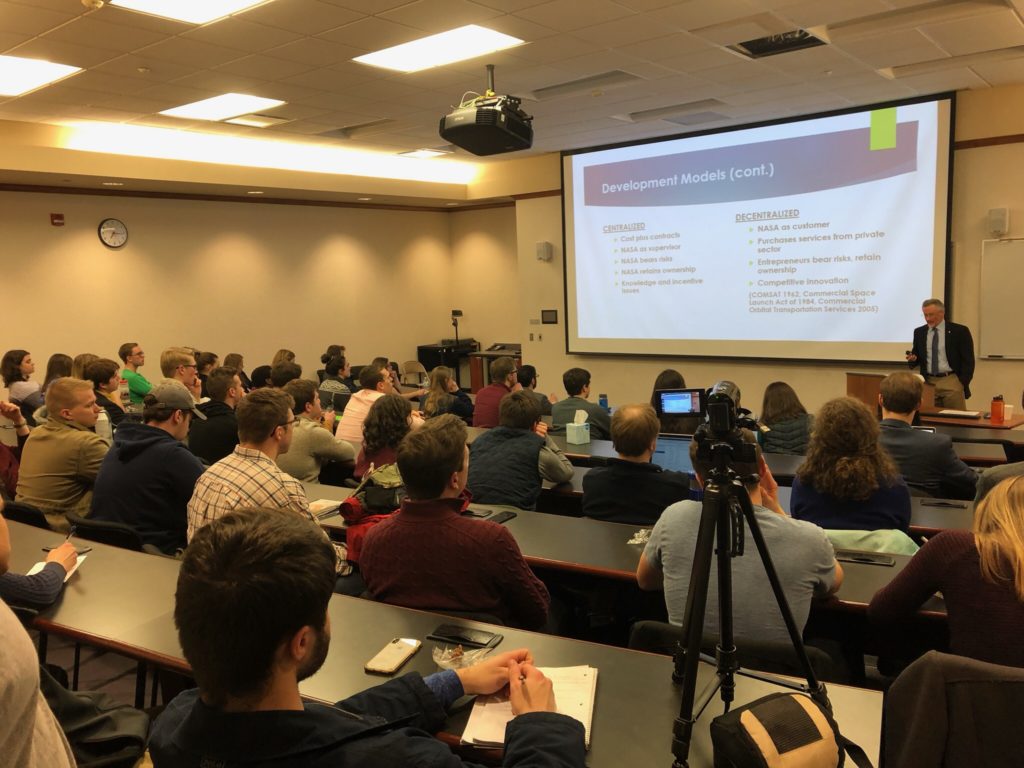
What is space economics? Is it important? Associate Professor of Economics Charles Steele asked students on Monday, Feb. 11, at an event hosted by Praxis to discuss the future of space economics.
Praxis’ first official event of the semester addressed the topics of space development, the question of private property in space, and the kinds of economic structures that may be developed to govern space.
There are two ways to predict the progress of technology, Steele said. The first is through economic forecasting, which predicts the future based on the past, but he says this becomes meaningless for predictions beyond 10 years. The other alternative — science fiction — is more useful for predicting beyond 10 years, but deals in possibilities, not probabilities. Steele said he hopes for “a middle ground between forecasting and science fiction.”
“That middle ground is economic theory,” he said, and used positive economics to explain what he believes will happen, ruling out the unlikely possibilities where economics is less certain.
Steele pointed out that with a projected minimum GDP growth rate of 2 percent over the next century and the significant advantages of space for manufacturing purposes, the potential for the increase of space activity is huge.
“The world will be six to eight times wealthier by 2100, technology is going to be more advanced, development is going to be greater than my grandmother witnessed, and we’re going to have a multi-trillion dollar space economy,” Steele said. “Now that’s the space economy, but what about space economics?”
Steele addressed three major components of the potential space economy: the development of models for a space economy and the role of private sector in that process, the development of private property rights in space, and the role of government in space. He juxtaposed the current American model of centralized space development, as exhibited by NASA, with a more decentralized space development process in which NASA would just be another customer.
“The space shuttle was actually the last big, centralized project for the United States. It was supposed to provide easy access to space, and it was a failure,” he said. “It was supposed to be cost-effective. It was not cost-effective.”
Steele said the world is already in the process of moving from the centralized to decentralized model.
“The Chinese understand this,” he said. “Anybody who’s going into space at this point understands that this decentralized model is the cost-effective way to do it. Decentralization is inevitable. Anybody who doesn’t do this is going to be left behind. The Russians even seem to be catching on.”
Steele quoted Ludwig von Mises, who said that civilization is based on private property rights, to assert that any expansion in space would necessarily involved some method of securing those rights.
The existing institution to protect private property rights in space is the Outer Space Treaty of 1967, he said, which was signed by the U.S. and all the major space-travelling nations, and extends to the moon and other celestial bodies. No group exists to enforce the treaty, however, and there are questions about its effectiveness. The law is also unclear about what kind of mining or production is actually allowed in space.
Senior Andrew Berryhill said he felt it provided a better framework for him to think about news stories or political questions that relate to space.
“I personally did not know a whole lot coming into this talk, and I think it was not only comprehensive, but as an economics major, it was presented in a language that I could very easily understand,” Berryhill said. “I think I got a lot more out of it because of that.”
He added that he appreciated that Steele covered a variety of topics related to space development and how those elements may play out in the future.
“His goal of finding that middle ground between forecasting and science fiction I found really innovative and really interesting,” Berryhill said.
Praxis Secretary sophomore Joy Brower explained that the club’s goal for the event was to bring together both science and economics students with a common interest. She said Steele was a natural choice for speaker.
“Dr. Steele has been studying space economics for probably going on a year now, he’s really interested in it,” Brower said. “Every day after class when I have him, he’ll show me different things that he’s reading about space econ; he’s a great, knowledgeable speaker.”
Praxis Public Relations Officer sophomore Melody McDonald said Steele’s talk made her want to invest in space.
“It made everything seem a lot more real. I like that,” she said. “It’s a whole field of things I never thought about before.”
