
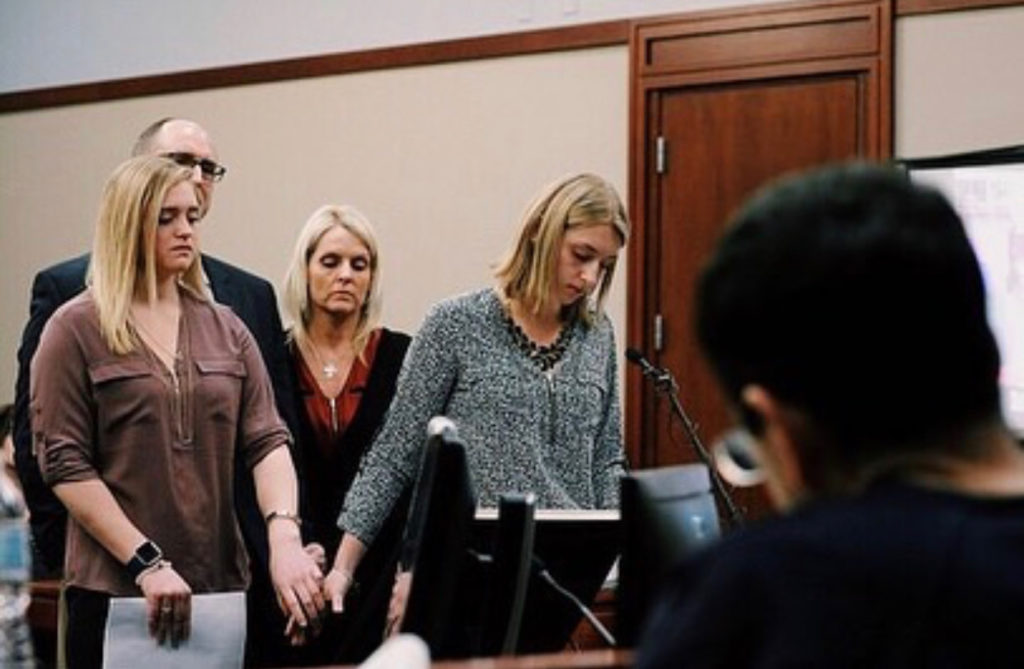
One year ago, 19-year-old Hillsdale freshman Kara Johnson stood before a monster.
She remembers how fast her heart beat and how her hands shook as she held her prepared remarks. But climbing onto a podium in a small Lansing, Michigan courtroom, Johnson disregarded her fear, looked her monster in the eyes, and began to speak.
Johnson was one of hundreds of young women and girls who stood before Larry Nassar — the former Michigan State University and USA Gymnastics doctor convicted of sexual abuse, sexual assault, and the possession of child pornography — during his seven-day sentencing last January.
Their stories were heard across the nation as they confronted the man who had violated them without their consent, and, as in Johnson’s case, often without their knowledge.
“Watching it on the news, that was the first time I was angry,” Johnson told me. “I was so mad that they were saying things like that about him. Little did I know that was exactly what was happening to me. I always thought I would know if that happened to me, but I was innocent, naive, and he was my doctor.”
Nassar violated Johnson’s body, mind, and spirit repeatedly throughout her middle school years. She was a young athlete involved in cross-country and tennis, and she trusted the renowned doctor who was supposed to fix her. She ignored her discomfort and worry during her appointments in part because of the photos of Olympic athletes that decorated the walls of his office, and because “you’re supposed to trust your doctor.”
But as the testimonies and evidence continued to emerge, Johnson said she knew she needed to do something.
“It’s weird how the trauma kept hitting,” she says. “It kept coming back, and suddenly I knew, ‘My God, he did this.’”
Johnson and her family wrestled with whether to publicly testify against Nassar. The unwanted attention, stress, and toll it would take on their everyday lives was something they expected, and something they still seek to overcome. But Johnson knew she needed to stand in that courtroom and face her monster. “I needed to take my life back from him,” she says.
And walking toward that podium, clutching a sticky note with Philippians 4:13 written on it, Johnson began to take back what Nassar stole.
“I remember going up to the podium, facing the judge, and seeing him — and everything hit me. I knew what he did, who he was. And I thought, ‘Never again,’” she says.
Johnson testified along with her younger sister, Maddie, and her father, Brad Johnson. “It wasn’t as hard as I thought it was going to be, facing him,” Johnson told me.
And it did help, albeit not in a dramatically relieving way, Johnson said. There was no sudden release of pent-up emotion, no immediate relief for the burden of unwanted confusion she had carried with her. “To be honest, I didn’t walk out of that courthouse feeling any different,” Johnson says. “I was still confused. Maybe I still am.”
After her testimony, the real “uphill climb” began, she says. “I started struggling with anxiety — and no wonder! My body had been trying to tell me something for years.”
There have been “lots of ups-and-downs through this whole process,” she says, but she knows that now, one year later, she is a changed person — and for the better.
“Speaking up is the most important thing I’ve ever done,” Johnson says. “If we wouldn’t have spoken up, Larry could still be hurting young women.”
Facing Nassar and sharing her story has changed the way Johnson thinks of mental health and sexual assault — and she said she hopes to change the way others think about these issues too.
“There’s a stigma about mental health and sexual abuse that needs to change,” she says. “It’s part of the reason why people are afraid to speak up. We need to encourage them not to think of themselves as victims, but as people who come back stronger, who come back as warriors. And that doesn’t mean you won’t be weak. There will be hard days, of course.”
Working through those hard days and those low moments is something Johnson said the college can help with. “It’s so important to understand that this happens everywhere,” she says.
And she’s right: Offering students access to on-campus support groups would be a great place to start. Any number of Hillsdale students struggle with anxiety, depression, and trauma, and giving them a weekly place to open up in a private, safe environment, guided by a trained professional like Director of Health Services Brock Lutz, would prove invaluable.
One-on-one counseling, which the college regularly provides through Lutz and others, is necessary and good. But offering a group alternative — where students can share their experiences and collectively carry burdens — is another option that could form important friendships, support that “uphill climb,” and most important, show survivors that they’re not alone.
“We need a place where we can all come together and say, ‘You know what, I don’t need to have my crap together right now,’” Johnson says.
Hillsdale’s administration should continue to encourage survivors to report assault and abuse, as well. “Protect yourselves and protect others — report,” Johnson said.
“I didn’t realize until I was standing in front of my abuser that it was going to be a hard journey,” she says. “And I’m still trying to figure it out. But we should all be figuring this out together. It doesn’t matter who you are, so many people can relate to these stories. And we don’t even realize how many people have gone through similar things.”
Again, she’s right. If you are struggling with anxiety, depression, guilt, trauma, no matter how big or how small: Don’t be afraid to speak up. Talk to people you care about. Ask for help. This school is filled with individuals who want to help and encourage. And perhaps keep in mind that little verse Johnson took with her to the podium: “I can do all things through Christ who strengthens me.”
Kaylee McGhee is a senior studying Politics and Journalism
