
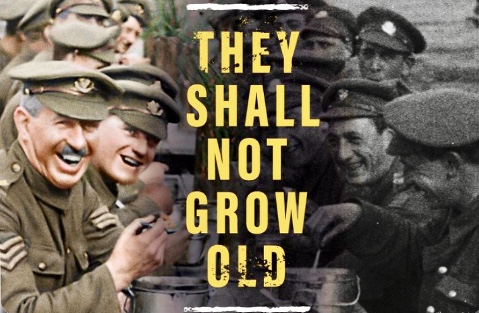
“They Shall Not Grow Old” opens with black and white reels of young, British soldiers heading off to war, overlain with upbeat whistling and audio interviews of World War I veterans. Slowly, unbelievably, the footage expands and transforms into an immersive world of colorized film. The audience is transported into the daily life of a British infantryman in the trenches of France.
As modern Americans looking at the world wars of the 20th Century, we’re more familiar with World War II. It’s closer to our own time, and many of us have relatives who fought in it or, at least relatives who were old enough to remember it. We tend to be less aware, however, of the Great War: It tends to be eclipsed by the Allies’ struggle against the threat of the Third Reich.
The aim of Peter Jackson’s passion project, “They Shall Not Grow Old” is to address this lack of understanding regarding World War I. The film pulls the audience into the era of conflict between the European powers of the 1910s. Jackson, whose grandfather fought in the war, has created a revolutionary documentary which fuses original footage of the war with cutting-edge technology.
Jackson’s team cleaned up the old footage — which, by this point, were damaged copies of copies — and painstakingly colored each detail of every frame used in the documentary. He also brought in sound technicians to record background sound effects which match the footage. If this wasn’t amazing in its own right, he also used professional lip-readers and voice actors to identify and record the words of soldiers in the scenes, words which were hereto unknown.
In this first-of-its-kind film, Jackson allows the audience to actually hear and see the stories of British soldiers in their own words. No longer are these black and white young men silent — they speak directly to us, urging us to understand what exactly happened in those trenches.
“They Shall Not Grow Old” is truly eye-opening, but it requires us to see the utter horrors these men faced. Jackson presents the audience with the harsh realities of literally living in the dirt of the trenches: The men put up with terrible conditions which they describe for the viewer, conditions that can be difficult for modern viewers to fully grasp.
But the hardest scenes to watch are not the ones with live footage; cameramen didn’t capture video footage of the charges over “no-man’s land,” but the still images of the aftermath are gut-wrenching, nonetheless.
In a brilliant yet tragic scene, Jackson alternates between close-up photos of the soldiers before battles, only to suddenly cut to full-color images of mutilated corpses, lying in the desolate wasteland that was war-torn France.
We see footage of soldiers as they wait to rush over a hill to charge the German front lines. Paired with the added voices, we not only see but feel the humanity of that moment — the faces, the eyes of these young men betray their realization that they are moments from running headlong into a hell on earth.
“They Shall Not Grow Old” carries the modern audience back into a different time, and almost a different world. The men who forsook the comforts of home say they were simply upholding the duty they owed to their nation. It’s important that we don’t forget the price they paid, as we read in the words of poet Laurence Binyon: “They shall grow not old, as we that are left grow old:/Age shall not weary them, nor the years condemn./At the going down of the sun and in the morning/We will remember them.”
