
I didn’t expect to see my boyfriend on one knee by the Sea of Galilee, where Christ once walked on the water, calmed the storms, and filled Peter’s nets full of fish — but my engagement was not the biggest shock of my ten-day journey in Israel this month.
When I first applied to Passages, the tour of Israel hosted by The Philos Project, I had a rather shallow mental picture of Israel consisting wholly of sand dunes and camels, and a distorted, Westernized view of the political situation. Yet, last summer, after I visited a concentration camp and six Holocaust museums across Germany, I desired to understand the history of Israel and, more specifically, the Jewish people. Especially as a German citizen, I felt as if I owed it to the Jewish culture to visit Israel and express my honor to this tiny country whose people endured such horrific hardship at the hands of the people of my heritage.
On Sabbath, I shared my intentions of coming to Israel to experience a true Shabbat dinner with the Jewish family who was hosting me and several other students at the time. With tears in her eyes, the grandmother of the Jewish family shook my hand, thanking me for my words and the honor I had shown by coming to Israel. At this moment, the extent of the pain the nation of Israel has, and still endures, struck me afresh.
This was not the only reminder we received of the intense realities Israeli citizens face. The population of Israel, which is the size of New Jersey, is more than 75 percent ethnically Jewish. But the global Jewish population makes up only 0.02 percent of the world religions.
Israeli citizens learn to toughen up at a young age. Because of Israel’s small size and hostile borders — such as Lebanon, Syria, the Gaza strip, and the West Bank — military participation is mandatory. Over the course of the short trip, it became normal to see groups of 18- to 21-year-old men and women walking around with military-grade rifles.
Perhaps the most chilling site our group visited, however, was the small Kibbutz near the town Sderot, otherwise known as the “bomb shelter capital of the world.” This small town was less than a mile away from the Gaza strip where Hamas-led Palestinians launched missiles as often as ten times a week into the Kibbutz. The people living there have a maximum of ten seconds to run for a bomb shelter after hearing the “Red Alert” warning siren. Only six weeks ago, 370 missiles were launched into Israel in a span of thirty-six hours, by Hamas on the Gaza strip. One resident of the Kibbutz said that creative terrorists soak tampons or condoms in gasoline, attach them to a long string and a balloon, and send it into Israel to burn the houses and crops.
The most disturbing Hamas tactic was to send colorful ‘Up’-style balloons into Israel, with bombs attached to them. Launched by Palestinian children so that the Israeli soldiers would not shoot them, the balloons targeted young and curious Israeli children, so that as soon as the balloon is discovered and tugged at, the bomb explodes.
It sent chills down my spine to walk past the kibbutz’s bomb-sheltered kindergarten schoolhouse and see the little children’s rain boots, lined up perfectly at the door, knowing the chaos those young children continue to live with.
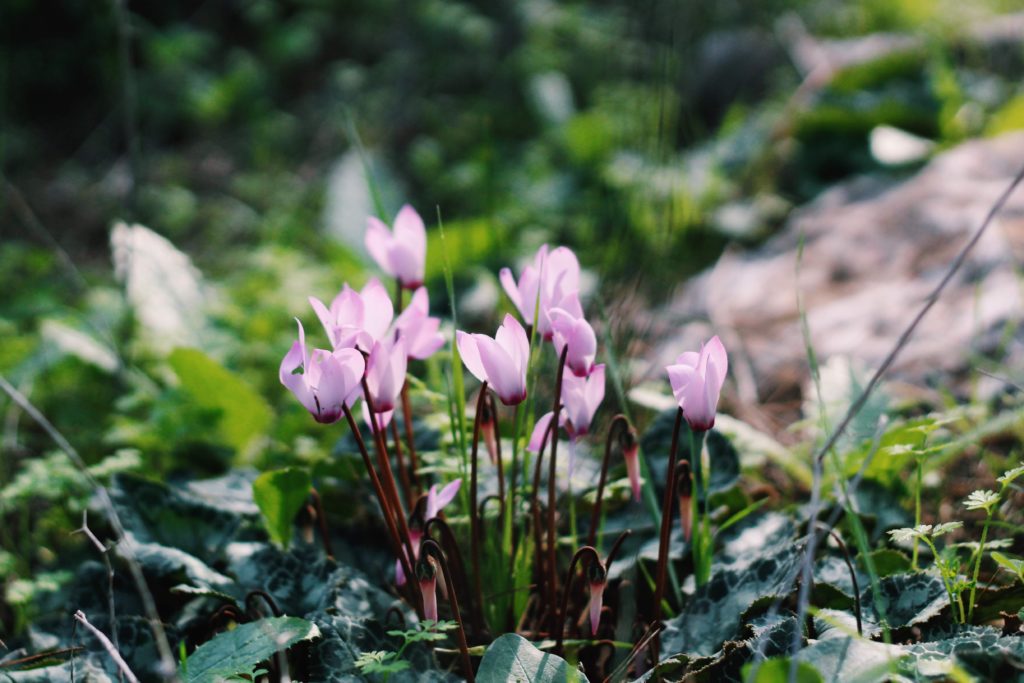
Despite these horrors, I was comforted and encouraged by a small pink flower which grows across Israel. Cyclamen, the Israeli national flower, is known to thrive in harsh conditions, and stands as a symbol of the Israeli people.
Israel has long endured these harsh conditions. Yet, time after time, the people continue to persevere, and hold true to their ethnicity and religion. Despite the pain of the Holocaust, anti-Semitism, or the bombs that threaten the people of Israel today, the Israeli people stand their ground. My ten days in Israel brought perspective to my life, as now I am inspired to live my life like a cyclamen — thriving under harsh conditions.
