
Hanging in the back of the Kirby Center’s Van Andel Room is a small painting of George Washington and James Madison by retired Hillsdale College art professor Sam Knecht. They stand in the halls of the Philadelphia state house, the first to arrive at the Constitutional Convention. Madison’s five-foot, four-inch frame stands in stark contrast to Washington’s height of at least six-feet, three-inches, but Madison proved to be the true towering figure during the convention. Across the room from this portrait is another Knecht painting, this one of the signing of the Constitution. Madison and Washington once again are the focal point, both poised to add their names to our founding document.
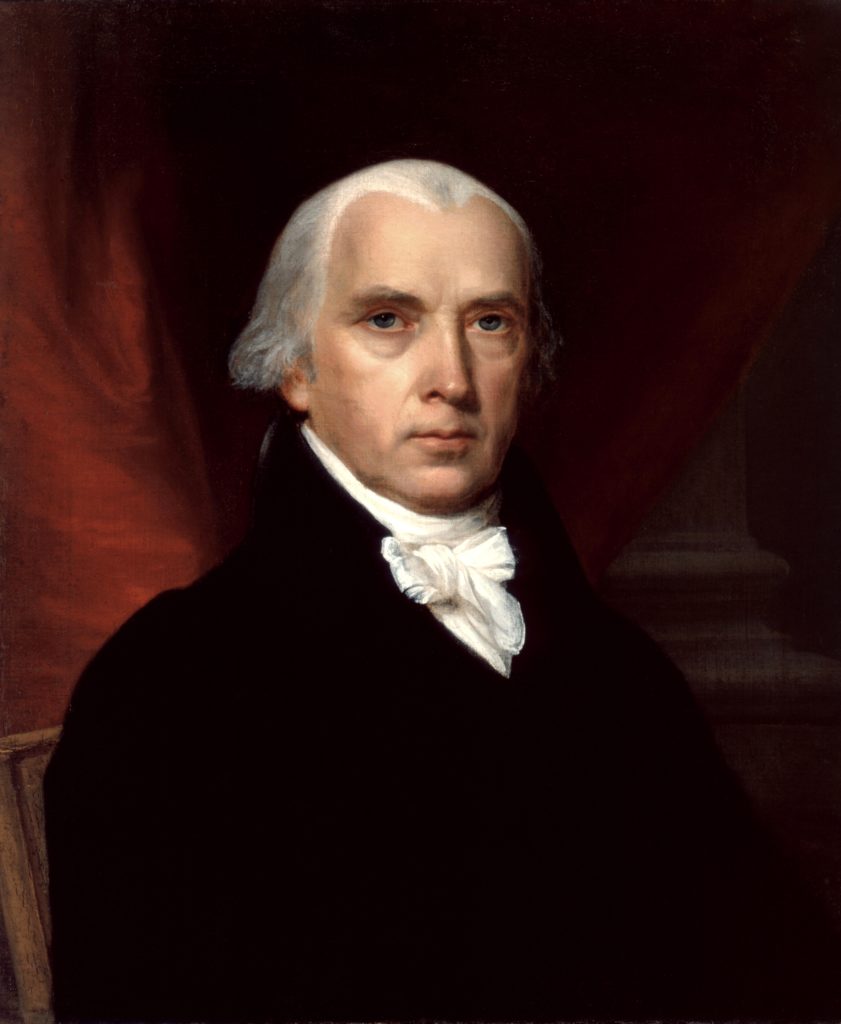
Washington is already honored on Hillsdale College’s Liberty Walk. He stands in front of Mossey Hall, seemingly poised to cross the Delaware River and take on the British. Missing, however, is a monument to James Madison. As an institution that reveres the Constitution, Hillsdale College should honor the Father of the Constitution by making him the next statue on the Liberty Walk or by placing him in a prominent position at Hillsdale College’s Kirby Center in D.C.
Madison played a key role in the founding of our nation. He was instrumental in organizing a convention of the states to reform the Articles of Confederation, and he convinced George Washington to attend the Constitutional Convention.
According to history and politics professor Paul Rahe, “If James Madison is sometimes called ‘the father of the Constitution,’ it is because he played a prominent role in summoning it and because, with the help of his fellow Virginians, he provided it with an agenda.” Madison was the delegate to present the Virginia Plan, a plan that laid out the American system of checks and balances, an independent judiciary, a bicameral legislature, and proportional representation. Though a shy and quiet man, he spoke more than 200 times throughout the convention. Much of what we know about the convention’s debates today come from Madison’s notes.
Larry Arnn, President of Hillsdale College said, “Madison was a small man, economical in his movements. He reasoned as he moved, precisely. Also, his writing could soar. He was not showy, but he was driven by determination as fierce as quiet. If there was a book needing to be read, a letter to be written, a conversation to be had to produce a better Constitution, he was energetic and constant. His writings explain the heart of the Constitution with surpassing insight. He is justly remembered as the father of the greatest fundamental law ever written and adopted.” After the convention, Madison teamed up with Alexander Hamilton to launch a national campaign for the Constitution’s ratification. Under the pen name Publius, he, Hamilton, and John Jay wrote essays that were published in newspapers throughout the states. These essays are now known as the Federalist Papers. They have have been used ever since their publication as an authoritative source on how to interpret the Constitution according to its original intent.
Though Hamilton wrote most of the essays, Madison wrote some of the best. He is the author of Federalist 10, which talks about the importance of protecting minority rights and explains how American republicanism is different than any form of government that had come before. He also authored Federalist 51, which lays out the need for the separation of powers and famously says of human nature, “If men were angels, no government would be necessary. If angels were to govern men, neither external nor internal controls on government would be necessary.”
An opposition group known as the Anti-Federalists had launched an aggressive campaign against it. They claimed that the Constitution tended towards centralization which would lead to tyranny — something the American people had just fought a long war to escape.
Without the Federalist Papers, it is likely the Constitution would not have been ratified.
Madison was a political leader as well as a philosopher, a man of thought and of action. In 1789, Madison was elected to the House of Representatives. He then authored the Bill of Rights and ensured that it became law. Despite his reservations about the bill of rights — one of America’s most prized and enduring political document, responsible for protecting the individual rights of Americans against ever-expanding government intervention — Madison helped bring it to life.
Because of Madison’s work, America is the freest nation that has ever existed. Madison’s contributions to American political thought are second to none. Throughout his life he demonstrated prudence and virtue as a statesman. There is no better way for Hillsdale College to honor the Constitution than to choose James Madison as its next statue on the Liberty Walk. This will not only be a monument to Madison, but to the documents that have shaped American political thought — the Constitution, the Federalist Papers, and the Bill of Rights.
Krystina Skurk is a graduate student at the Van Andel Graduate School of Statesmanship.
