
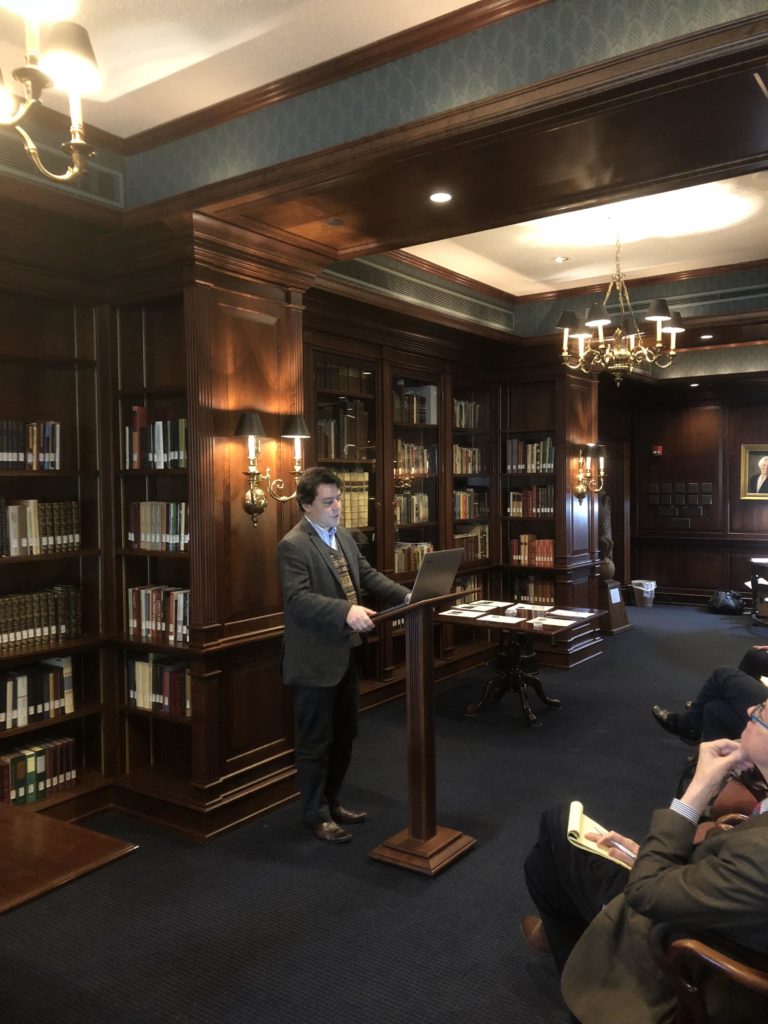
Danielle Lee | Collegian
People are disillusioned with the political process, Lucas Freire said in a talk at Hillsdale College.
Freire, professor of political science and economics at Mackenzie Presbyterian University in São Paulo, Brazil, led a discussion on Brazil’s 2018 Presidential Elections and populism in South America. The event, hosted by The Alexander Hamilton Society on Nov. 9, also featured John Elliot, director of the Alcuin Fellows Program at the Charlemagne Institute.
Freire said his focus was on victories and challenges of Jair Bolsonaro, Brazil’s newly elected president. He focused on three main topics: the 2018 presidential elections show that the country is going through a crisis; voters believe Bolsonaro will bring actual change; and many people voted for him because he speaks to cultural and economic fears about the future.
One problem observers of mainstream and social media will pick up is the decline in dialogue. This issue resulted from a long process of decline in low-quality public debate in Brazil, according to Freire. He emphasized truth, beauty, and goodness as three values that should be upheld in public discussion.
“There was little truth — fake news was widespread, people don’t know how to judge the quality of the source they use, and there was little beauty,” Freire said. “Name-calling became actual reasoned arguments, with premises and sound conclusions. And there was very little charity as well, where people did not try to understand what others, across different political spectrums, were trying to say.”
Freire said if politics becomes too personal, people will start worrying about charismatic politicians as celebrities. He explained that this is what has happened in Brazil.
“Supporters and detractors of Bolsonaro treated him like a celebrity and focused considerably on what he says and does, more than on his platform,” Freire said. “He has said some pretty horrible things, but he talks about policies.”
As a congressman, Bolsonaro consistently voted for nationalists, protectionists, interventionists, and the increase in salaries for the political class, said Freire. He added that in light of the Workers’ party corruption scandals and economic crisis, the change of power was inevitable.
“Bolsonaro has a clean criminal record, and isn’t suspected of any involvement in corruption scandals,” he said. “He’s a former military; he speaks of order; he speaks against crime. So when Bolsonaro signaled that, suddenly, he had also turned into a friend of the free market economy, despite his vast votes in congress, the voters had an easy choice.”
He added that Brazil must decide whether to keep a more partisan stance internationally, as it did under the Workers’ party, or to allow more autonomy in their foreign department, which was the case 16 years ago, Freire said.
“I would suggest a prudent, non-nationalistic, non-militaristic policy of free international trade, multilateralism and avoidance of any militaristic ventures,” Freire said. “This talk of intervening Venezuela because of the crisis there, for example: to me, that’s nonsense.”
During the question and answer segment, a student asked Freire if he thinks Bolsonaro will enact these proposed policies. Freire said he hopes so, but Brazil’s government will have to shrink its size and, in a short-term, borrow a lot of money from the market for funds.
“I think his free-market oriented people understand that,” Freire said. “There will be a period of slow economic recovery, maybe things might get a bit worse in the first few months before they start to get better— so that will hurt. Whether Bolsonaro will want to pursue that or not will be if he wants to feel popular in the beginning.”
Callahan Stoub, sophomore and vice president of the Alexander Hamilton society, said South America is generally overlooked in global political discussions, and said she hopes President Bolsonaro’s election will attract more attention to these important issues.
“I was glad to hear how hopeful Dr. Freire felt about the election results,” Stoub said. “Major European news sources claim Bolsonaro will make a ‘disastrous president’ since he breaks the mold of increasingly socialist world leaders, but Dr. Freire said Bolsonaro plans to strengthen relations with the U.S., so that makes me hopeful.”
Juan Hernandez, a sophomore at Hillsdale College, said he thought it was amazing that Freire experienced the entire election.
“The fact that he came from Brazil and experienced the whole election was just a remarkable thing, because living the election is completely different than seeing it from the outside,” Hernandez said.
For those who interested in global politics but know very little, Hernandez recommended that they branch out from local and national news.
Most people in the U.S. stick with local news and politics, and they only know about big international issues, things that have to do with Syria or Russia. If you’re interested in learning about global conflicts, go online and you’ll find different website and perspectives, you’ll learn about different things,” Hernandez said.
