
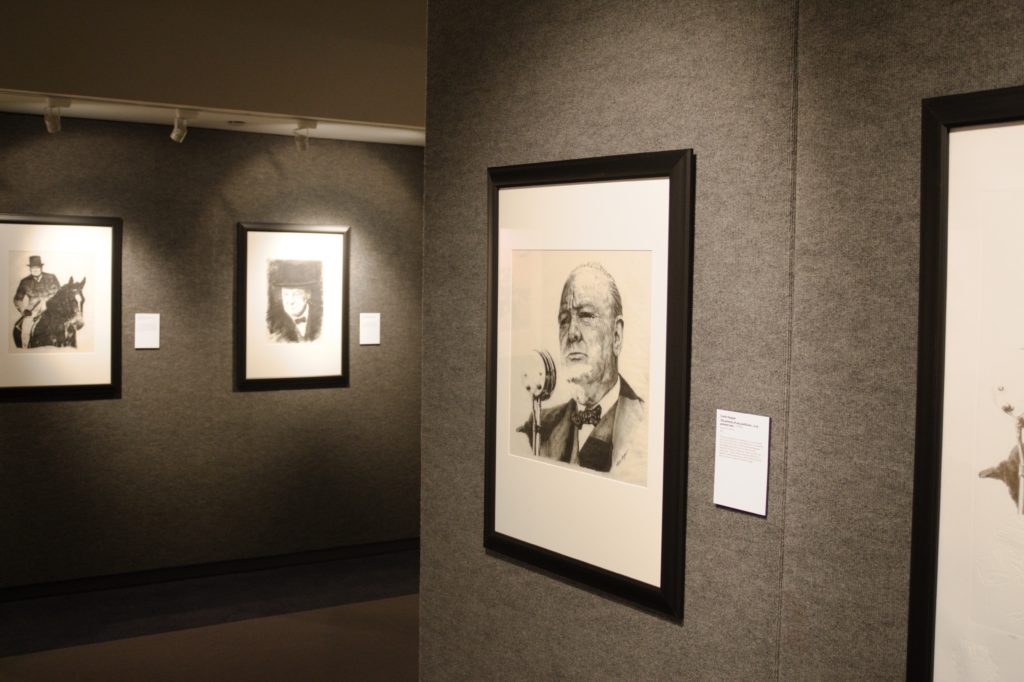
Decades have passed since Winston Churchill’s death, but Curtis Hooper’s dramatic graphite drawings of the World War II era prime minister are as lifelike as ever.
“While many only know Churchill for his wartime leadership, the gallery is very unique in that it contains vignettes drawn from throughout his entire life,” Churchill Fellow and senior Ross Hatley said.
In the 1970s, English artist Curtis Hooper was commissioned by Churchill’s second daughter to create what would become known as “A Visual Philosophy of Winston Churchill.”
This complete collection of works based off of photographs selected by Sarah Churchill is on display in the Daughtery Gallery through Nov. 20.
Among the 27 original drawings, eight have a nearly identical lithograph with Hooper’s and Sarah Churchill’s signatures, as well as an embossment and Winston Churchill quote.
“Very few full collections of these prints exist,” said Senior Fellow for the Churchill Project Richard Langworth, in an article titled “Sarah Churchill – Curtis Hooper Prints.”
A significant portion of the exhibit focuses on Churchill’s accomplishments during the war, but also on aspects of his life that are less often portrayed by other artists.
To the left of the entrance hangs a drawing titled, “I have no fear of the future. Let us go forward into its mysteries,” and depicts the face of Churchill as a schoolboy in the left foreground. Hooper contrasts this youthful innocence with an experienced and aged face of Churchill in his later years. On the right of the page is a sketch of Churchill, back turned toward the viewer, walking forward into the mysteries of the future.
The next drawing shows Churchill in his mid-20s as a war correspondent during the Boer War. With his slightly pursed lips and cocked hat, his face exudes great confidence. His service overlapped with Lt. Gen. Robert Baden-Powell, who would later become a national hero and founder of the Boy Scouts.
Hooper drew one picture that showed Churchill painting in Normandy, titled “A hobby is of the first importance to a public man.”
Churchill was a prolific writer, but also produced several hundred paintings in the latter half of his life. He enjoyed painting so much that he wrote a book titled “PAINTING as a Pastime” to teach others the beauty of painting.
“It’s a wonderful book about painting, and it isn’t very long either,” said Professor of Art Barbara Bushey.
Hooper finds a way to represent all significant elements of Churchill’s life. Some of the pieces reflect the deep depression that plagued Churchill for most of his existence. In particular, the sketches of him during the war are marked by profound sadness.
“I really like how Hooper finds something different to depict in his face every time,” sophomore Jonathan Meckel said. “None of faces are quite the same.”
Hooper covers the immense swath of Winston Churchill’s life with only graphite: peacetime painting in a civilian suit, negotiations with President Roosevelt, Clementine Churchill superimposed on a silhouette of her husband, and Churchill standing tall in honorary colonel uniform are just a few examples.
“Take a moment to experience an artistic synthesis of the great statesman,” Hatley said.
